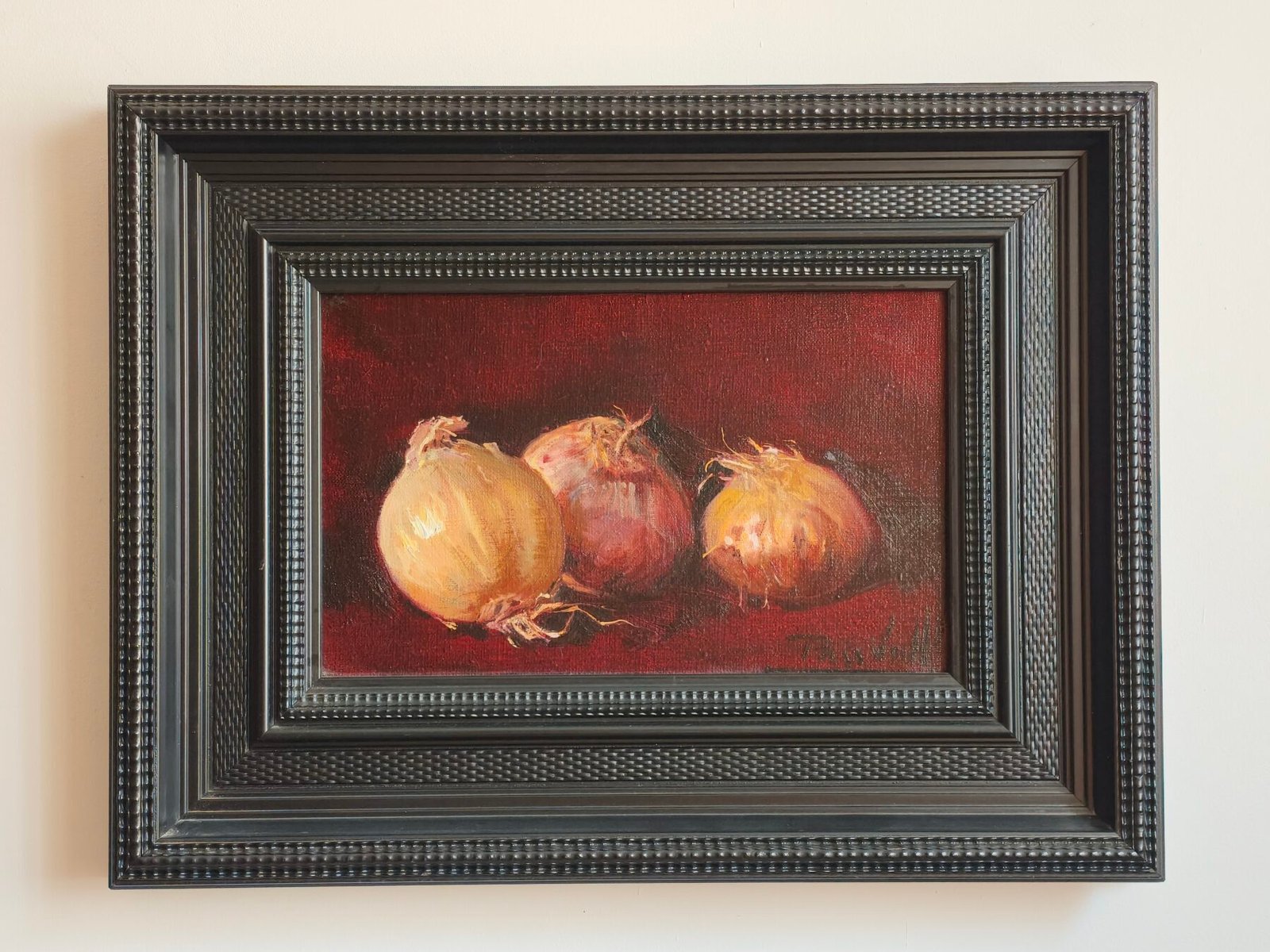
Still Life with Onions
1100 €
This work by Pau Valls Cañellas, executed in oil on canvas and signed by the artist in the lower right corner (Pau Valls), is a refined and intimate figurative still life depicting three onions naturally arranged against an enigmatic, enveloping background of burgundy and crimson tones; the composition is structured through a painstaking study of organic forms and the tangible presence of humble objects, placing the three bulbs in a visual dialogue where incoming light pierces the shadows to highlight the papery textures of their skin, the golden and coppery hues of their outer layers, and the delicate shoots or roots emerging at the ends; thematically, the piece belongs to the historic tradition of Iberian still-life painting and the intimate realism of the School of Paris, celebrating the poetic beauty hidden in everyday life and nature morte through a contemplative, serene approach; technically, the artwork displays a rich, luscious impasto full of volume, blending a direct, vigorous brushstroke with small dabs of heavy paint —most visible in the accents of white and yellowish light across the spherical surfaces— which contrast masterfully with the more fluid, darker layers that form the cast shadows and the deep atmosphere of the background; stylistically, it reflects the strong legacy of Catalan naturalism inherited from his father Nolasc Valls, filtered through the lyricism of 20th-century figurative painting and demonstrating total mastery over chiaroscuro and color temperature; the color palette unfolds in a warm harmony of vermilions, deep magentas, sienna earths, warm ochres, and flashes of creamy white, achieving a visually sophisticated chromatic balance; Pau Valls' work enjoys significant international recognition and is included in prominent private and institutional collections across Spain, Andorra, France, the United States, and Japan.
TechniqueOil sobre tela
Dimensions55x42cm
YearCirca 1990
ArtistVALLS, Pau
VALLS, Pau
The Barcelonan painter and draftsman Pau Valls Cañellas (1935-2020) began his artistic journey under the direct tutelage of his father, the distinguished and prestigious Impressionist painter Nolasc Valls Martí, at the renowned Valls Academy, where he mastered the fundamentals of life drawing, compositional rigor, and a devotion to plein-air light, later continuing his solid academic training at the Llotja School of Arts and Crafts, the Massana School, and the Sant Jordi Superior School of Fine Arts in Barcelona; stylistically imbued with the grand tradition of mid-20th-century Catalan landscape and figurative art, his painting was directly influenced by Impressionism, Post-Impressionism, and the lyricism of the School of Paris, developing a fully figurative style of profound poetic depth, serene atmosphere, and refined light sensitivity across landscapes, seascapes, urban views, interiors, and still lifes; technically, Valls is distinguished by a virtuosic command of oil on canvas and panel, characterized by a fluid, luscious brushstroke rich in texture, a balanced color scheme, and a subtle application of glazes alongside knife and broad-brush impasto to capture the ephemeral nuances of light; following a period of artistic maturity and formal consolidation, in 1977 he held his first major solo exhibition in Barcelona —marking the beginning of an uninterrupted and highly successful international career—, gaining early recognition when presenting his works in Paris in 1983 and becoming a member of the prestigious Société Internationale d'Art Figuratif (SIAF) in Paris the following year, a milestone that opened doors to major galleries and international exhibitions in France, Germany, and the United States; his global reach achieved a key breakthrough in 1986 when he debuted in Japan with exhibitions in Tokyo and Osaka, a market where his work established deep roots with exceptional success and where he has continued to exhibit regularly over the decades; throughout his prolific career, he has been honored at numerous figurative painting competitions, and his artwork is featured in major institutional collections, prestigious galleries, and prominent private collections across Spain, Andorra, France, Belgium, Great Britain, Switzerland, Italy, Germany, the United States, Japan, Mexico, Venezuela, and Cuba, cementing his reputation as an undisputed master of contemporary poetic figurativism.
Recommended works
Other selected pieces from the Art Andorra catalogue.