
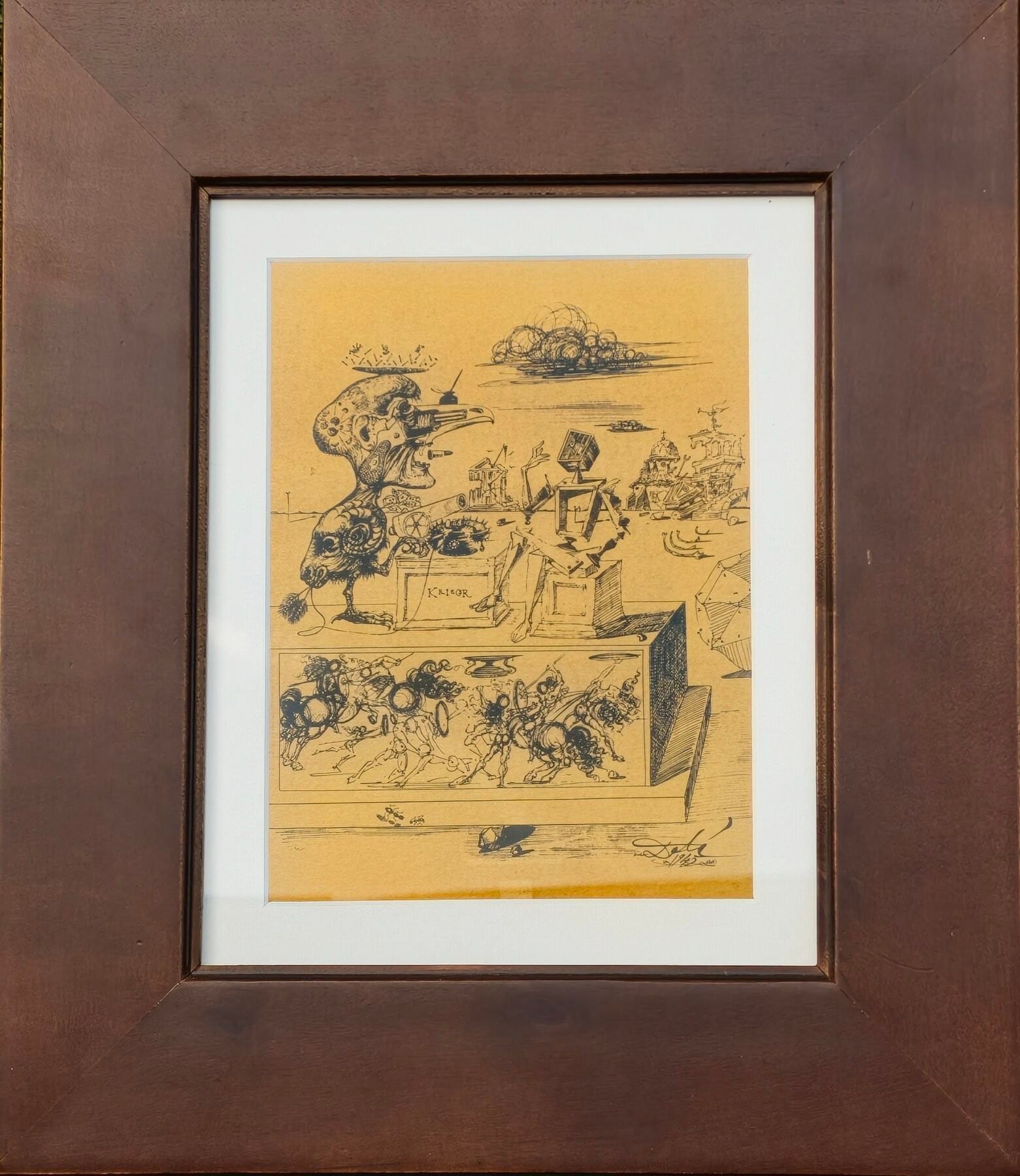
DALÍ, Salvador
Salvador Dalí (Figueres, 1904–1989) was a Spanish painter, sculptor, printmaker, set designer, and writer, widely recognized as one of the leading figures of Surrealism. Trained at the San Fernando Academy of Fine Arts in Madrid, he formed close friendships with influential figures such as poet Federico García Lorca and filmmaker Luis Buñuel, with whom he co-created the landmark film Un Chien Andalou (1929). In 1929, Dalí officially joined the Surrealist group in Paris and met Gala, who became his lifelong muse and wife. He developed the "paranoiac-critical" method, a creative technique using subconscious associations to generate double images and optical illusions. His masterpiece from this era, The Persistence of Memory (1931), introduced his iconic melting clocks. Though later expelled from the formal Surrealist movement over ideological conflicts with André Breton, Dalí continued to innovate across cinema, fashion, design, and advertising. During his years in the United States (1940–1948), he achieved international celebrity and commercial success. Upon returning to Spain, his work shifted toward "Nuclear Mysticism," blending religion, classical art, and modern physics. Today, his most iconic works are exhibited in prestigious international institutions such as the Dalí Theatre-Museum in Figueres, the Reina Sofía Museum and Thyssen-Bornemisza Museum in Madrid, the Museum of Modern Art (MoMA) in New York, The Salvador Dalí Museum in St. Petersburg (Florida), and Tate Modern in London. In his later years, he designed the Dalí Theatre-Museum in Figueres, which serves as his final resting place.
Works