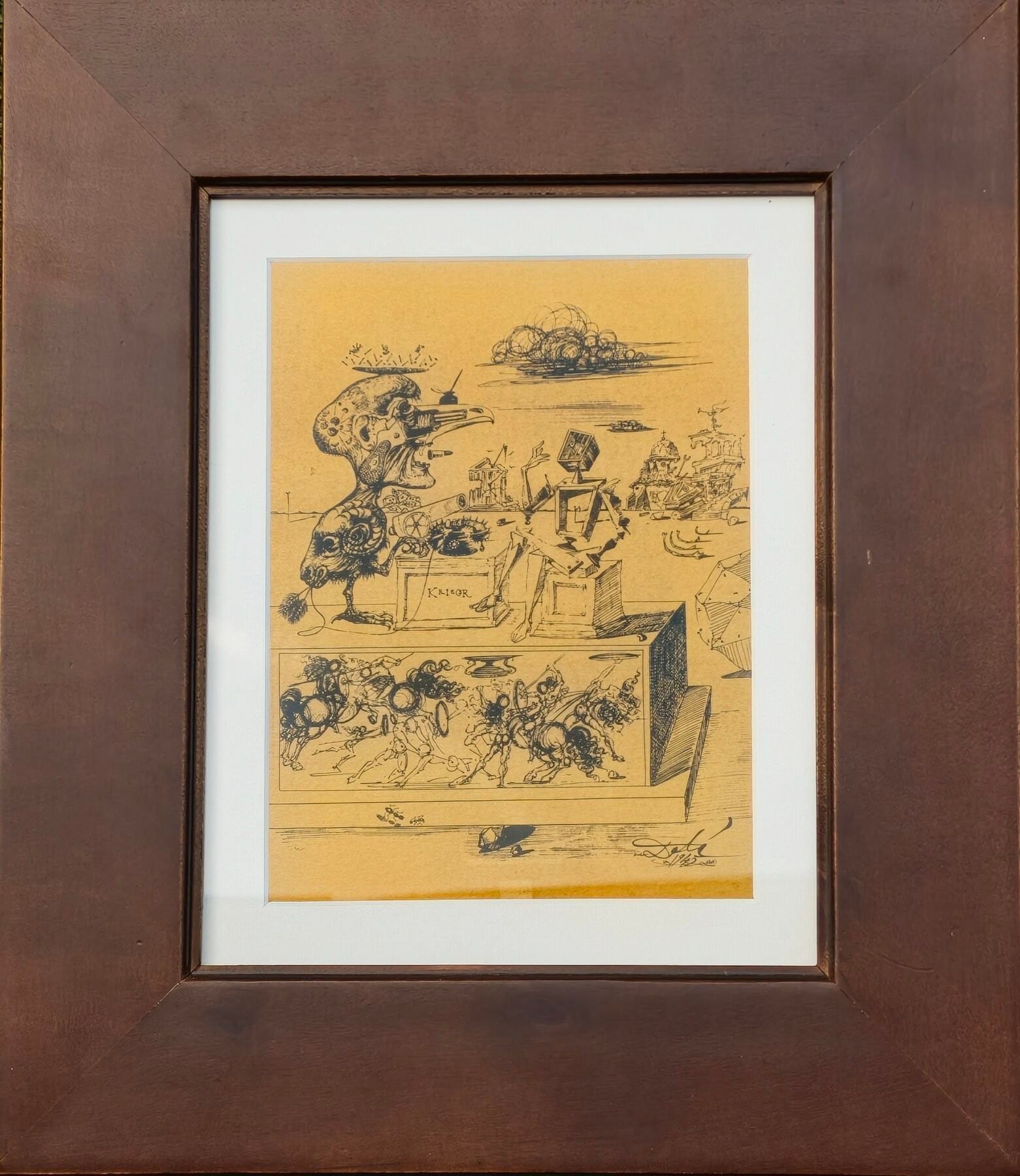
Krieger (Warrior)
550 €
Official reproduction of the Surrealist artwork Krieger (Warrior), illustrated in pen and ink by Salvador Dalí in 1945 to accompany journalist Gerald Kersh's article "Wars for Sale (An entrepreneur of atomic destruction finds peace at last)" (Wars for sale: An entrepreneur of atomic destruction finds peace at last), a piece that presents a profound critique and reflection on World War II and the dawn of the nuclear age. The composition, executed on golden cardboard, features an arid landscape dominated by a rectangular altar decorated with a relief of knights in battle, atop which stand a grotesque figure with a plate on its head and another anthropomorphic mechanical structure, accompanied in the background by ruins and a dense floating dark cloud. Interpreted by Dalí himself from the perspective of "Nuclear Mysticism," the work uses the dynamism of classical battle and the monstrosity of the figures to symbolize the metamorphosis of human suffering and collective panic in the face of atomic devastation. This print belongs to a limited edition of 599 hand-numbered units—this piece being number 378—measuring 32.7 x 25.3 cm, with legal copyright registered under Dalart N.V. (the official entity managing Dalí's rights) produced by the Government of Andorra in 2001.
TechniqueEngraving sobre cartón dorado
Dimensions32,7 x 25,3
Year2001
ArtistDALÍ, Salvador
DALÍ, Salvador
Salvador Dalí (Figueres, 1904–1989) was a Spanish painter, sculptor, printmaker, set designer, and writer, widely recognized as one of the leading figures of Surrealism. Trained at the San Fernando Academy of Fine Arts in Madrid, he formed close friendships with influential figures such as poet Federico García Lorca and filmmaker Luis Buñuel, with whom he co-created the landmark film Un Chien Andalou (1929). In 1929, Dalí officially joined the Surrealist group in Paris and met Gala, who became his lifelong muse and wife. He developed the "paranoiac-critical" method, a creative technique using subconscious associations to generate double images and optical illusions. His masterpiece from this era, The Persistence of Memory (1931), introduced his iconic melting clocks. Though later expelled from the formal Surrealist movement over ideological conflicts with André Breton, Dalí continued to innovate across cinema, fashion, design, and advertising. During his years in the United States (1940–1948), he achieved international celebrity and commercial success. Upon returning to Spain, his work shifted toward "Nuclear Mysticism," blending religion, classical art, and modern physics. Today, his most iconic works are exhibited in prestigious international institutions such as the Dalí Theatre-Museum in Figueres, the Reina Sofía Museum and Thyssen-Bornemisza Museum in Madrid, the Museum of Modern Art (MoMA) in New York, The Salvador Dalí Museum in St. Petersburg (Florida), and Tate Modern in London. In his later years, he designed the Dalí Theatre-Museum in Figueres, which serves as his final resting place.
Recommended works
Other selected pieces from the Art Andorra catalogue.