
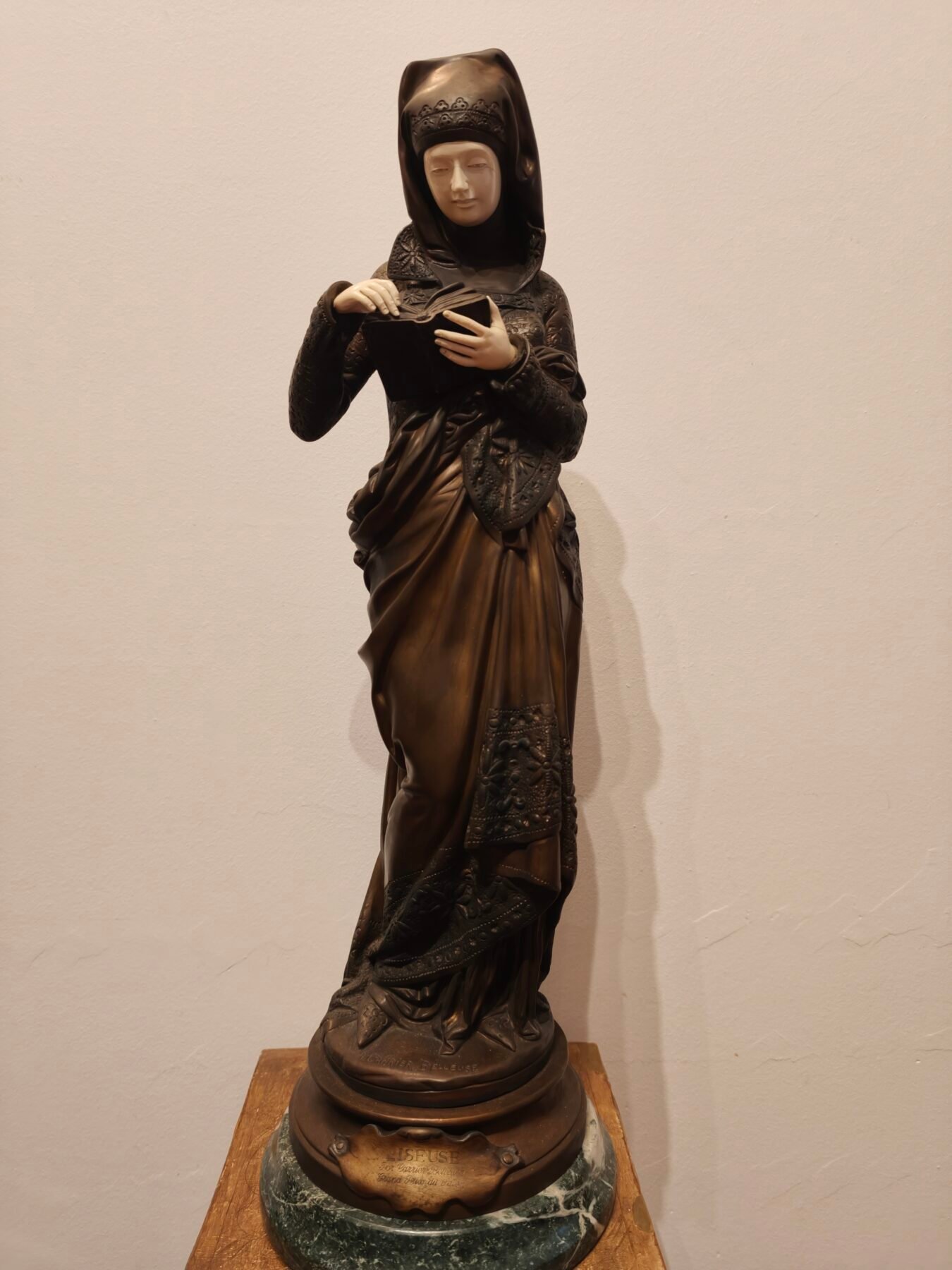
CARRIER-BELLEUSE, André-Ernest
Albert-Ernest Carrier-Belleuse (Anizy-le-Château, June 12, 1824 - Sèvres, June 3, 1887) was a prolific and prominent French sculptor and painter, considered one of the most representative artists of the Second Empire and a key figure in the transition toward naturalism and decorative eclecticism in sculpture during the second half of the 19th century. He initially trained at the small drawing school in Paris and later entered the École des Beaux-Arts, where he was a pupil of sculptor David d'Angers. During his early years, he faced financial difficulties, prompting him to work intensively on the production of decorative objects, goldsmithing, and terracottas, which sharpened his technical mastery of detail. He debuted at the Paris Salon in 1851. Starting in the 1860s, his career took off meteorically, making him the favorite sculptor of the high bourgeoisie and the court of Napoleon III. He won numerous medals at Salons and Universal Exhibitions (such as the Paris Exhibition in 1867). His studio became a veritable factory of decorative art where numerous assistants worked. Among them, a young Auguste Rodin stood out, whom Carrier-Belleuse hired in 1864 and with whom he maintained a close professional collaboration for several years, even taking him to Brussels to work on architectural projects. In 1876, he was appointed artistic director of the prestigious Sèvres National Manufactory, a position in which he revitalized porcelain production with designs of great elegance and dynamism inspired by the Rococo and Neo-Baroque, holding the post until the end of his days. His style was characterized by exceptional technical virtuosity, compositional grace, dynamic forms, and a predilection for the meticulous treatment of textures (fabrics, hair, jewelry). He mastered bronze, marble, terracotta, and porcelain. Among his most prominent works are: The Abduction of Hippodamia (1871): A masterpiece in marble showcasing his command of movement and muscular tension, preserved in the Museum of Fine Arts of Troyes; Monument to Manuel Belgrano (1873): A celebrated equestrian monument located in the Plaza de Mayo in Buenos Aires, Argentina; Decoration of the Paris Opera House: He actively participated in the reliefs and ornamental sculptures of the building designed by Charles Garnier; The fountain in the Place de la Concorde and numerous busts: He created countless female portraits of great delicacy and allegoric terracotta statuettes that flooded the salons of the European bourgeoisie of the era.
Works