
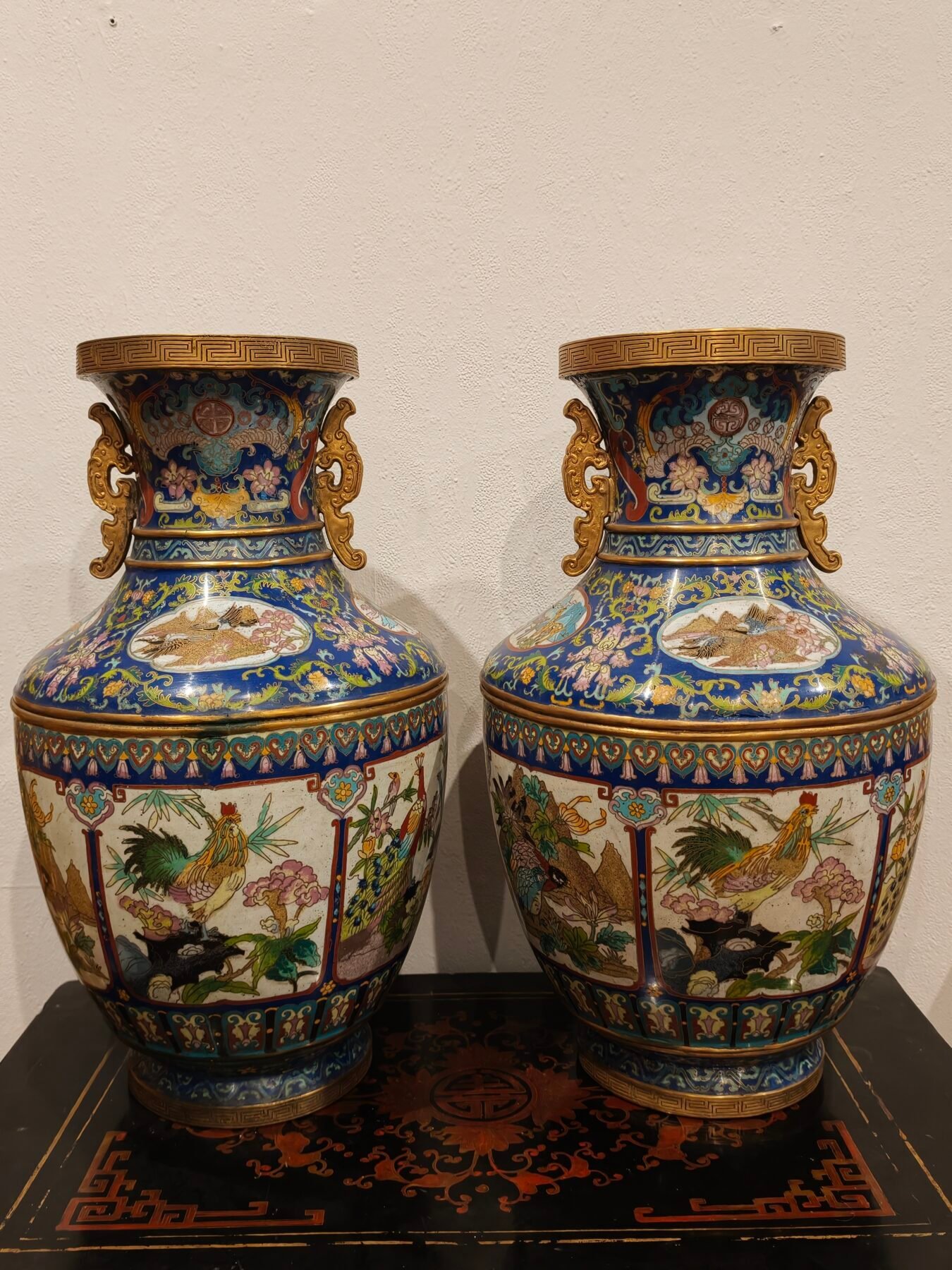
BEIJING, Talleres de esmalte deAntiques
The enamel workshops of Beijing (Peking) represent the historical pinnacle of cloisonné (Jingtailan, 景泰蓝) production in China. The tradition of cloisonné enamel in the imperial capital reached maturity during the reign of the Jingtai Emperor (1449–1457) of the Ming Dynasty, a period that gave this technique its official Chinese name due to the prevalence of its signature turquoise blue. During the Qing Dynasty (1644–1912), under direct court patronage, the golden age of these workshops was consolidated. In the 18th century, the Qianlong Emperor reorganized the Zaobanchu (Imperial Household Workshops), creating specialized divisions within the Forbidden City devoted exclusively to enamelwork, where master craftsmen combined bronze casting, chasing, and glass chemistry. In the late 19th and early 20th centuries, coinciding with the reigns of the Tongzhi and Guangxu Emperors (1875–1908), the hub of enamel production expanded beyond the strictly courtly sphere, concentrating in the famous guild district of Liulichang and the Chongwenmen area in southern Beijing. Within this environment, private workshops of supreme commercial and aristocratic prestige emerged, supplying both the Manchu nobility and international collectors and diplomats. Among these prominent firms was Lao Tian Li (老天利), celebrated for the exceptional purity of its gilding and the refinement of its wirework, which earned international acclaim at the 1915 Panama-Pacific International Exposition in San Francisco, along with other renowned workshops such as De Xing Cheng (德兴成) and Jing Tai Cheng (景泰成). These workshops excelled in preserving traditional coal-firing kiln techniques, manual mercury-gilding and chasing, and imperial-grade iconographic design, establishing Beijing as the undisputed world capital of cloisonné art. Today, masterpieces from these same Beijing workshops are preserved and exhibited in the Oriental art collections of the world's most prestigious public institutions, most notably the Palace Museum in the Forbidden City in Beijing, the National Palace Museum in Taipei, the Victoria and Albert Museum in London, the Musée Guimet and the Musée Chinois du Château de Fontainebleau in France, the Metropolitan Museum of Art in New York, the Museo Nacional de Artes Decorativas in Madrid, and the Museu Nacional d'Art de Catalunya (MNAC) in Barcelona.