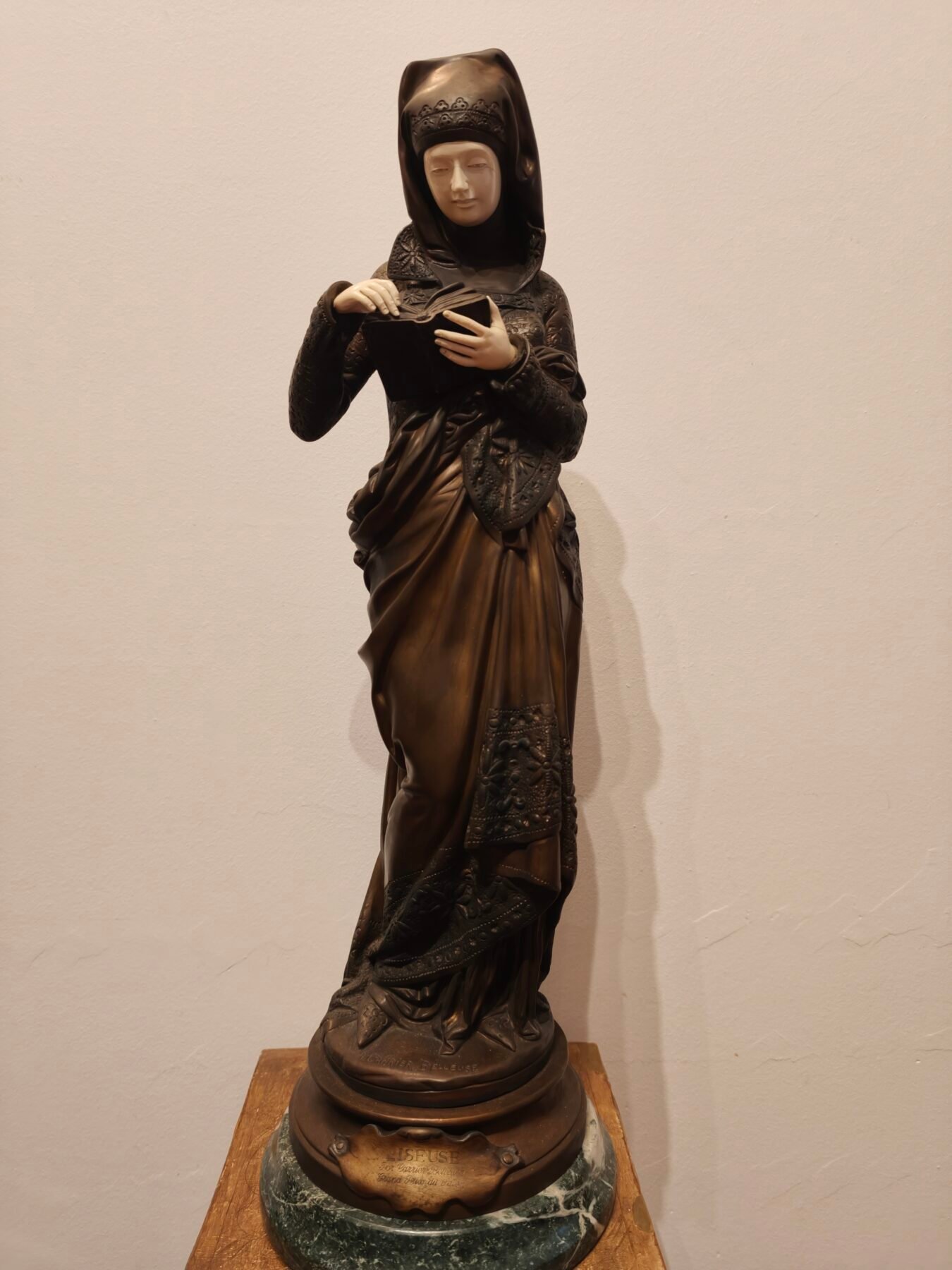
The Reader
17.000 €
The Reader(circa 1880–1882), a crowning creation by Albert-Ernest Carrier-Belleuse (1824–1887), represents one of the most refined heights of 19th-century French decorative and historicist sculpture, firmly positioning itself at the pinnacle of high-end collecting. Far removed from mere anatomical virtuosity, Carrier-Belleuse displays his characteristic synthetic mastery, fusing Neo-Renaissance sophistication with Pre-Raphaelite sensibility and a subtle Symbolist atmosphere that anticipates the Fin de Siècle aesthetic. The figure, absorbed in the timelessness of the act of reading, embodies an allegory of intellectual introspection and aesthetic devotion, visually articulated through a refined interplay of contrasts where the limpid flesh tones in carved ivory engage in a majestic dialogue with the warmth of the sumptuously chased bronze drapery. The opulence of the late-medieval inspired drapery, the design of the Flemish bonnet, and the meticulous craftsmanship of the embroidery demonstrate the artist's training in the applied arts —consolidated during his tenure as art director at the Manufacture Nationale de Sèvres—, his mentorship over key figures of modern sculpture such as Auguste Rodin —who trained and worked under his direct tutelage in his Parisian studio— and his technical leadership in the evolution toward monumental chryselephantine sculpture. Presented to great acclaim in the official exhibitions of the era and commemorated by the frontal plaque invoking the undeniable prestige of the Grand Prix du Salon —the highest institutional distinction of the Parisian Salon, awarded to the master in 1867 for his celebrated work Mélodie—, this iconic composition achieved an emblematic status within European patrician taste. The present piece stands out exceptionally for its imposing scale of 65 cm in height —principal cabinet dimensions substantially superior and far rarer than the common smaller domestic editions— as well as for the technical integrity of its materials and the extraordinary workshop finishing. The combination of a foundational authorship in 19th-century sculpture, the irreproachable nobility of the chryselephantine pairing of bronze and natural ivory, its commanding vertical presence, and its museum-grade quality firmly substantiate its positioning in the upper tier of the international antiques market, fully justifying a top-tier valuation suited to its rarity and collector significance.
TechniqueSculpture criselefantina (bronce patinado y marfil esculpido)
Dimensions65cm
YearCirca 1890-1892
ArtistCARRIER-BELLEUSE, André-Ernest
CARRIER-BELLEUSE, André-Ernest
Albert-Ernest Carrier-Belleuse (Anizy-le-Château, June 12, 1824 - Sèvres, June 3, 1887) was a prolific and prominent French sculptor and painter, considered one of the most representative artists of the Second Empire and a key figure in the transition toward naturalism and decorative eclecticism in sculpture during the second half of the 19th century. He initially trained at the small drawing school in Paris and later entered the École des Beaux-Arts, where he was a pupil of sculptor David d'Angers. During his early years, he faced financial difficulties, prompting him to work intensively on the production of decorative objects, goldsmithing, and terracottas, which sharpened his technical mastery of detail. He debuted at the Paris Salon in 1851. Starting in the 1860s, his career took off meteorically, making him the favorite sculptor of the high bourgeoisie and the court of Napoleon III. He won numerous medals at Salons and Universal Exhibitions (such as the Paris Exhibition in 1867). His studio became a veritable factory of decorative art where numerous assistants worked. Among them, a young Auguste Rodin stood out, whom Carrier-Belleuse hired in 1864 and with whom he maintained a close professional collaboration for several years, even taking him to Brussels to work on architectural projects. In 1876, he was appointed artistic director of the prestigious Sèvres National Manufactory, a position in which he revitalized porcelain production with designs of great elegance and dynamism inspired by the Rococo and Neo-Baroque, holding the post until the end of his days. His style was characterized by exceptional technical virtuosity, compositional grace, dynamic forms, and a predilection for the meticulous treatment of textures (fabrics, hair, jewelry). He mastered bronze, marble, terracotta, and porcelain. Among his most prominent works are: The Abduction of Hippodamia (1871): A masterpiece in marble showcasing his command of movement and muscular tension, preserved in the Museum of Fine Arts of Troyes; Monument to Manuel Belgrano (1873): A celebrated equestrian monument located in the Plaza de Mayo in Buenos Aires, Argentina; Decoration of the Paris Opera House: He actively participated in the reliefs and ornamental sculptures of the building designed by Charles Garnier; The fountain in the Place de la Concorde and numerous busts: He created countless female portraits of great delicacy and allegoric terracotta statuettes that flooded the salons of the European bourgeoisie of the era.
Recommended works
Other selected pieces from the Art Andorra catalogue.