
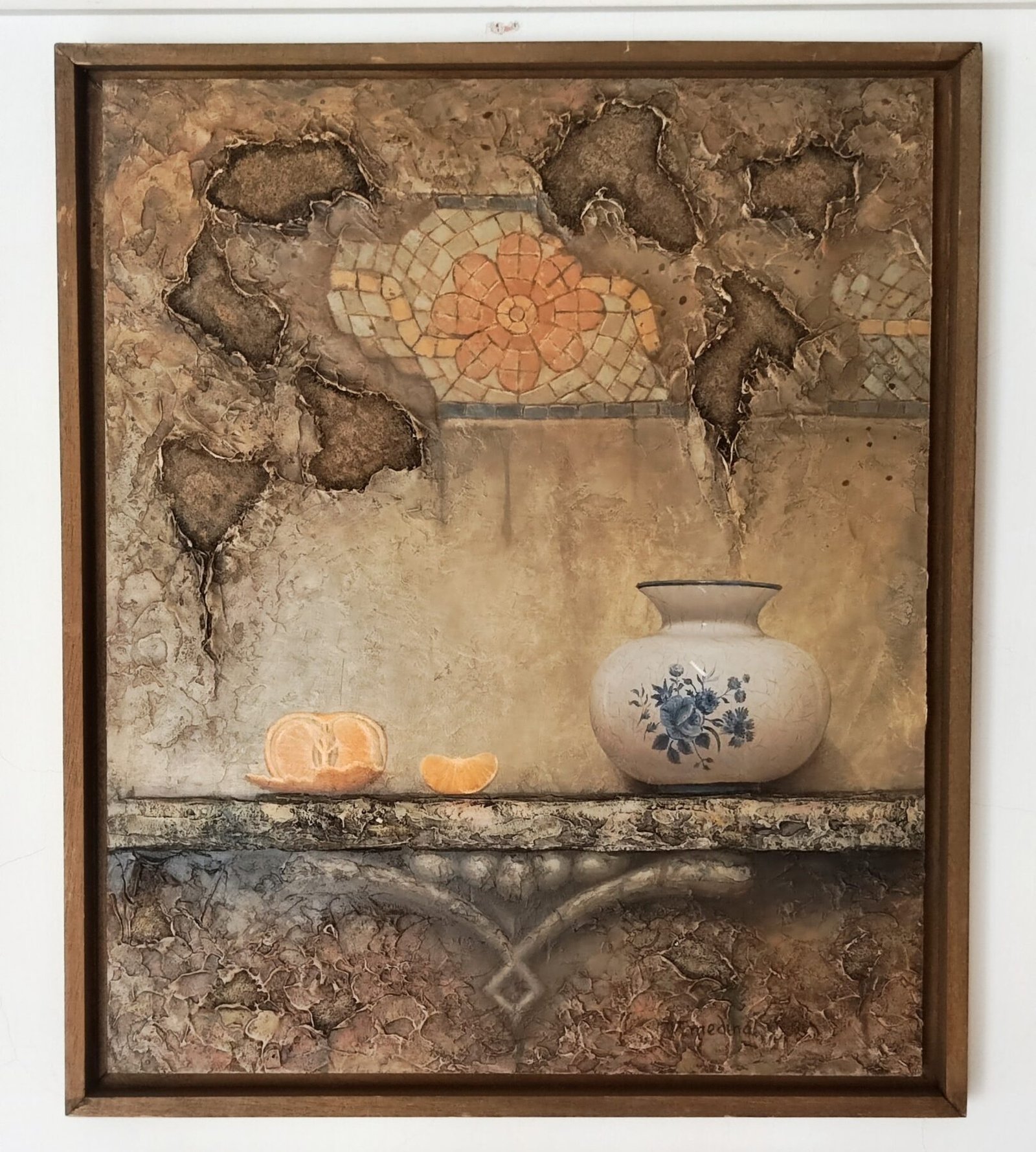
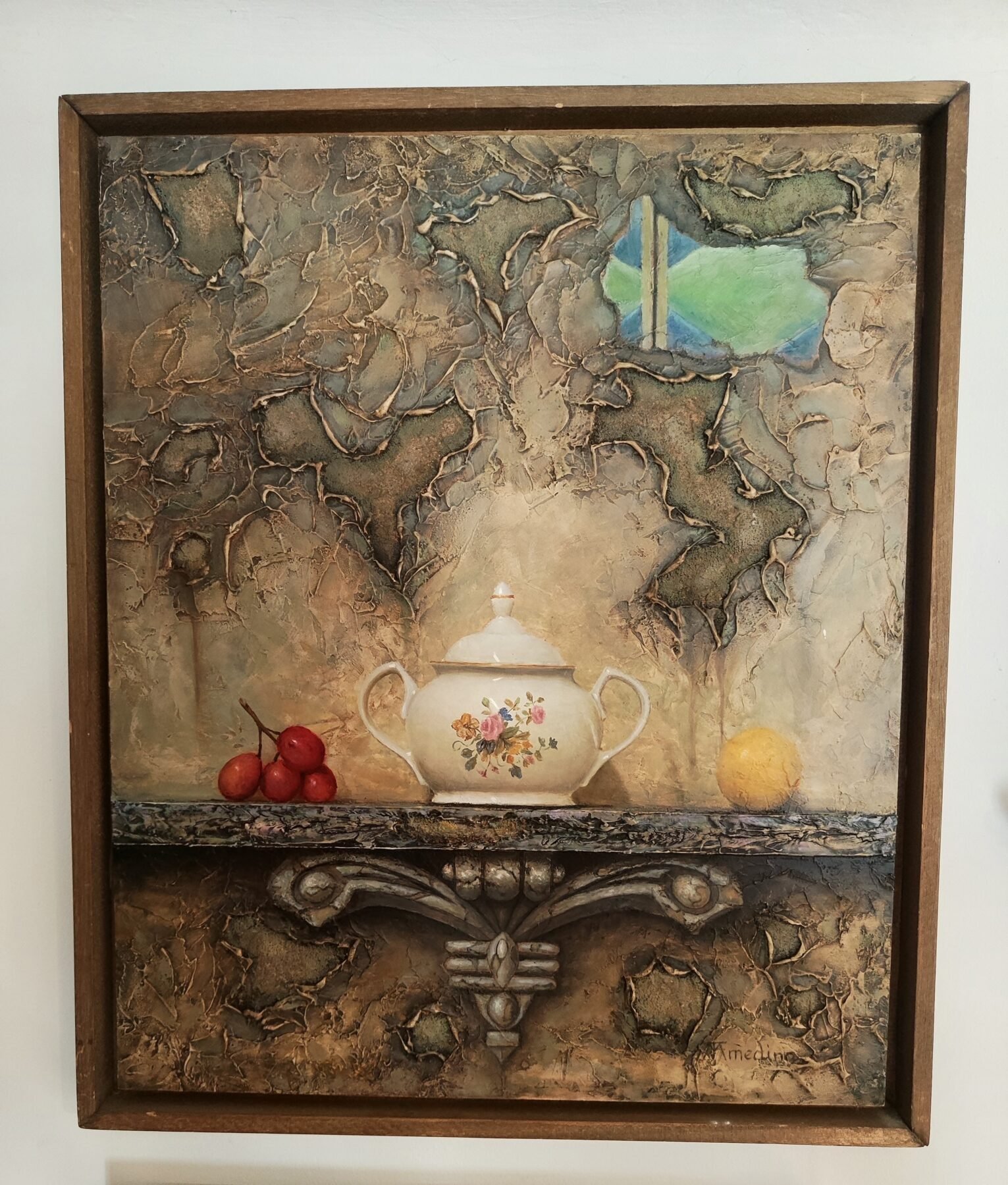
Echoes of Time II
950 €
his formidable composition by Tomás Medina, conceived as a companion piece to the previous work circa 1995, reaffirms the artist's mastery in mixed media on board by combining hyperrealistic figurative detail with a powerful textural, three-dimensional investigation. The work dispenses with conventional pictorial statism to build upon an elaborate foundation of relief pastes, mineral fillers, and resins that recreate a deeply weathered wall surface of striking sculptural quality, over which refined, miniaturist oil glazes are applied. At the compositional center, resting upon a simulated stone ledge supported by an elegant molded architectural bracket in the lower register, stands a white porcelain vessel with a lid, two handles, and gilded accents, decorated with a delicate polychrome floral bouquet in shades of pink, yellow, and cobalt blue, whose crispness and vitreous luster contrast dramatically with the tactile roughness of the wall. To the left, a small cluster of red berries showcases a virtuous treatment of surface gloss and volume, while to the right, a spherical citrus-toned fruit balances the thoughtful distribution of masses across the space. The background, a sumptuous exercise in trompe-l'œil illusionism, features pronounced high-relief flaking that reveals a fragment of mural painting in emerald green and cobalt blue tones intersected by vertical bands, articulating a poignant poetic discourse on the passage of time, the decay of human structures, and the endurance of everyday objects. The light, entering from the left side, models the volumes with surgical precision, casting subtle shadows that emphasize the roughness of the substrate and the three-dimensional quality of the elements. Iconographically, the piece connects with the great tradition of Spanish Baroque still-life painting—inheriting the rigorous shelf-like arrangement of Juan Sánchez Cotán and the austerity of Francisco de Zurbarán—while aligning with Spanish magic neorealism from the second half of the 20th century, engaging in dialogue with masters such as Claudio Bravo or Eduardo Naranjo and incorporating the material experimentation of contemporary informalism. The signature "T. medina," incised directly into the textured mass in the lower right corner, confirms the authenticity and artistic process of the work. Tomás Medina's oeuvre is represented in various collections of public institutions, art foundations, and regional and municipal museums in Spain, as well as in prominent private collections dedicated to late 20th-century Spanish figurative and realistic art.
TechniqueMixta sobre madera
Dimensions
YearCirca 1995
ArtistMEDINA, Tomás
MEDINA, Tomás
The Spanish realist painter Tomás Medina Mota (born in Santa Cruz de la Zarza, Toledo, in 1940) is a notable figure in contemporary Castilian figuration and still-life painting; after spending his childhood in Tarancón (Cuenca) until the age of ten, he settled at seventeen in Madrid, where he established his permanent residence and studio; his artistic training is eminently self-taught, having consolidated his technique from the 1960s onward through constant personal study of drawing from nature, the physics of light, and traditional oil painting methods, bypassing formal academicism while mastering the craft through contact with informal instructors and great past masters studied in Madrid's museums; regarding his influences, his work draws directly from the chiaroscuro and material restraint of Spanish Baroque art—with a strong imprint of classical still life by Juan Sánchez Cotán, Francisco de Zurbarán, and Meléndez—as well as 20th-century hyperrealist and illusionist precision from figures like Claudio Bravo and Antonio López; concerning his style, he stands out for an exceptional technical mastery of pictorial realism and three-dimensionality, achieving a striking tactile definition in the volumes, folds, and textures of depicted objects that creates a powerful trompe-l'œil effect for the viewer; with regular gallery exhibitions since his early career across Spain, Italy, Germany, Portugal, and Andorra, his trajectory has been endorsed by major awards, including First Prize at the Salon International d'Arts Plastiques in Béziers (France), First Prize at the Málaga and Environment Fine Arts Contest, and First Prize at the Vinos de La Mancha National Painting Contest in Alcázar de San Juan (Ciudad Real); regarding the destination of his work and museum collections, his creations form part of public institutional holdings in Andalusia and Castile-La Mancha, municipal art collections, cultural foundations, and distinguished private collections of contemporary figurative art across Europe and the Principality of Andorra.
Works
More works by this artist
Pieces related to the same artist.