
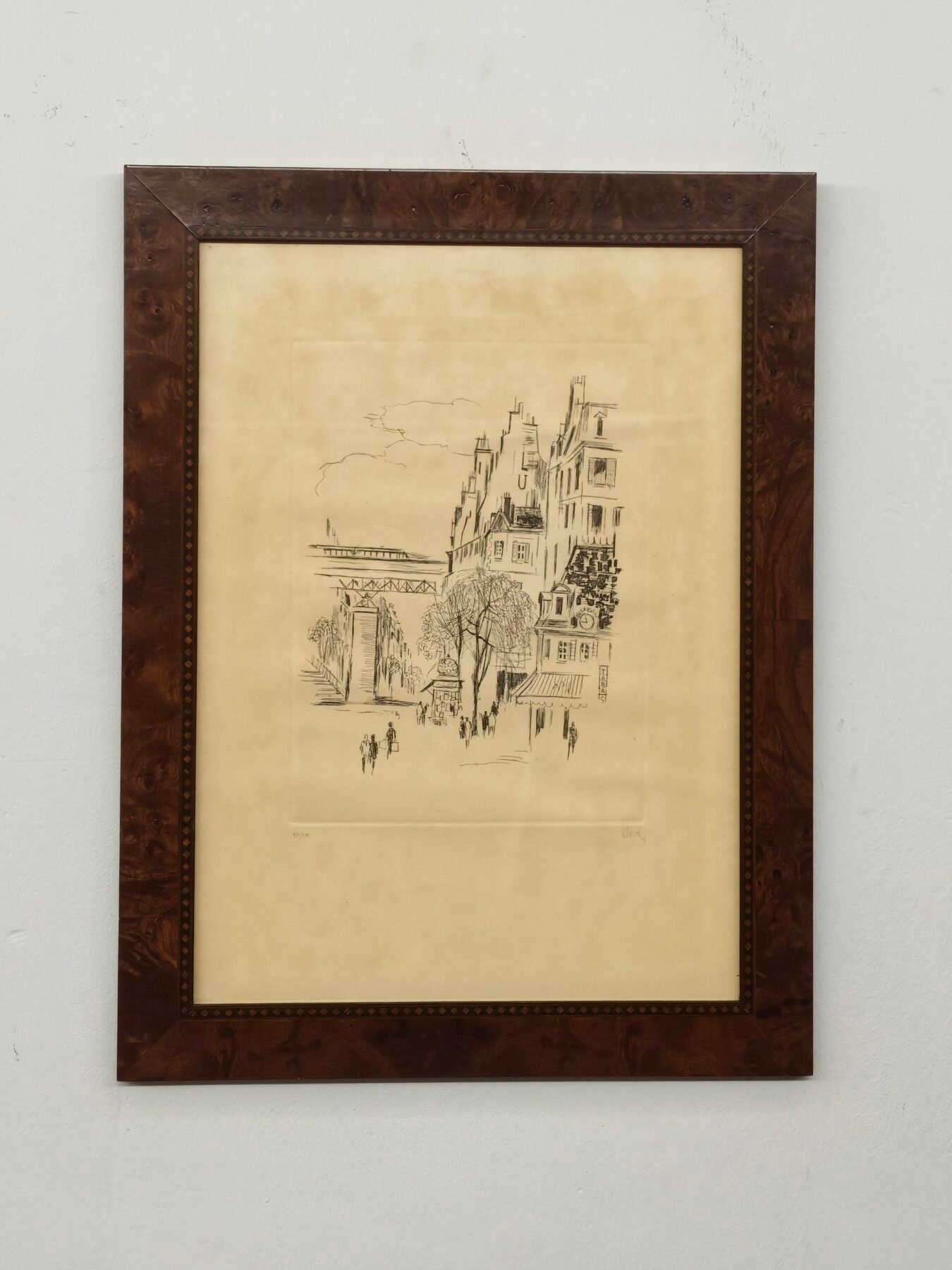
FLORIT, José Luís
The versatile Madrid artist José Luis Florit Rodero (1909-2000) represents one of the most solid, adaptable, and technically refined trajectories in 20th-century Spanish figurative art, whose work encompassed easel painting, drawing, printmaking, editorial illustration, and mural painting. Born in Madrid into a family with deep-rooted cultural sensitivity, his early years of training took place in Catalonia, specifically in Olot and Figueres, where he studied under the decisive guidance of master Juan Núñez Fernández—a teacher who would also influence Salvador Dalí—from whom he inherited absolute rigor in anatomical drawing and linear discipline. His subsequent admission to the Royal Academy of Fine Arts of San Fernando in Madrid solidified his academic mastery, which he complemented with specialized training in etching techniques under the tutelage of the eminent printmaker Ricardo Esteve Botey. Throughout his youth, Florit absorbed both the language of Noucentisme and the innovative trends of interwar figuration alongside the spirit of the Society of Iberian Artists, actively participating in the cultural landscape of the Second Spanish Republic and earning a Third Medal at the National Exhibition of Fine Arts in 1933, a triumph that led to his first major solo exhibition at the Museum of Modern Art in Madrid in 1935. Following the Spanish Civil War, he settled in Barcelona, serving as artistic director for the Diario de Barcelona and engaging in extensive work as an illustrator and graphic designer. Between 1952 and 1960, he channeled his talent into a prominent phase of public and religious mural painting, later undergoing a material and conceptual evolution toward landscape lyricism and synthetic abstraction, characterized by energetic strokes, sketched forms, and a restrained mastery of color that earned him accolades such as the Bronze Medal at the Zaragoza Biennale in 1967 and the Estrada Saladich Foundation Award in 1969. Established in Paris during his final decades until his passing in the year 2000, Florit's oeuvre remains safeguarded in major museum institutions and public collections across Spain and internationally—notably including the Reina Sofía National Museum Art Center, the Museum of the Royal Academy of Fine Arts of San Fernando, the National Library of Spain, and civic institutional holdings in Barcelona—positioning his legacy as an essential testament to the synthesis between classical drawing traditions and European figurative modernity.
Works