
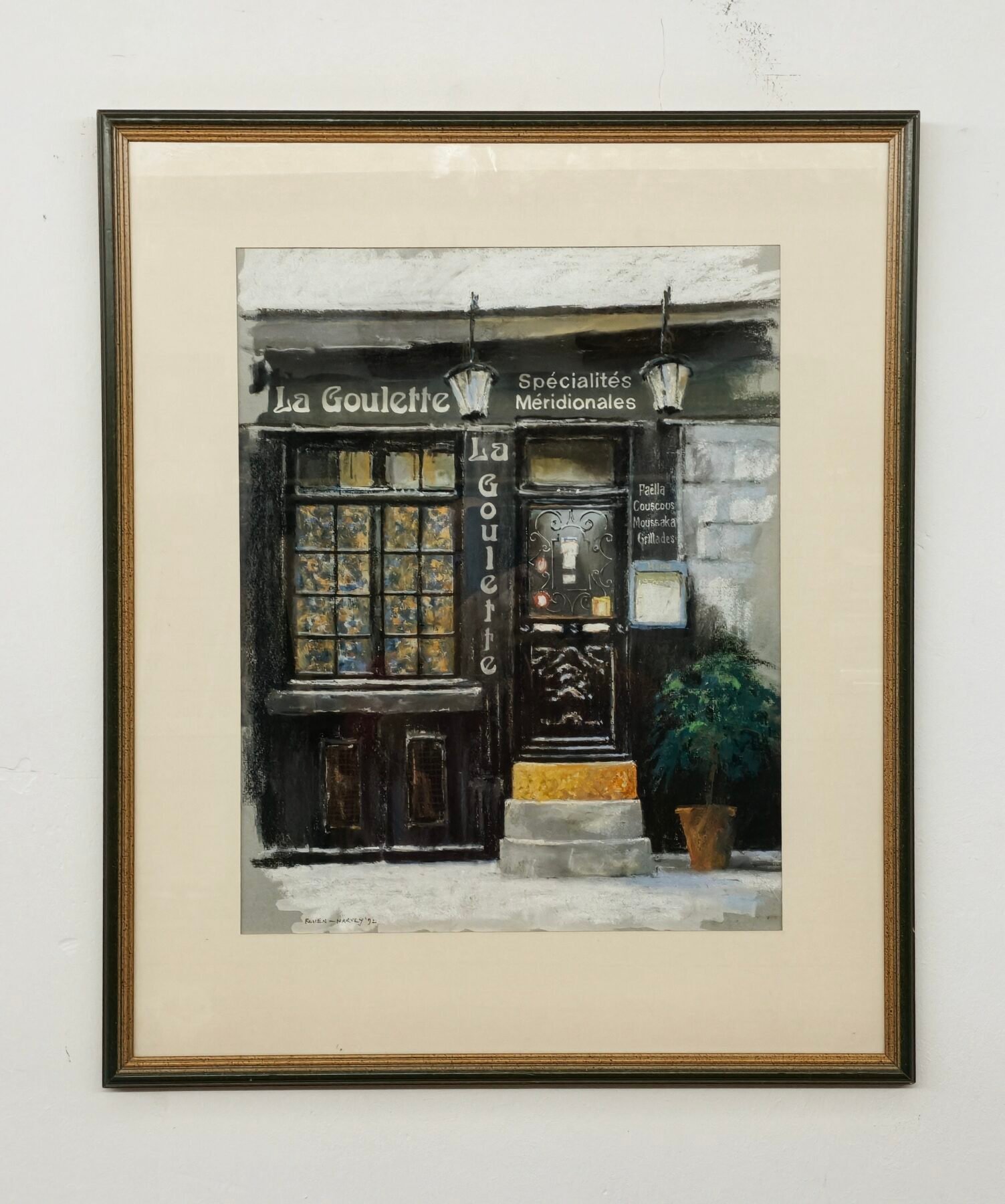
La Goulette, Rouen
475 €
The work La Goulette, Rouen (1992), executed by British artist John Harvey (1935–2023) during his working stays in Upper Normandy, constitutes a rigorous example of urban vedutism focused on the visual cataloguing of historic French commercial architecture. In this composition executed in pastel and mixed media on paper, the artist adopts a strict frontality centred on the establishment's facade, articulating a meticulous syntactic study of the material textures of varnished woodwork, dressed stonemasonry, and the luminous reflections across leaded windowpanes. The technical execution demonstrates Harvey's solid background at the Camberwell School of Art in London, combining a base of gouache and dense pigment with layered applications of soft and oil pastel to define, with analytical draftsmanship, the typographic lettering of the commercial signage ("La Goulette", "Spécialités Méridionales"), while handling with compositional ease the potted greenery and the dim, atmospheric entry ambiance. Stylistically, the piece draws upon post-impressionist lineage and the structural lessons of the St Ives School—paying particular homage to the geometric rigor of Ben Nicholson and the light capture of Patrick Heron—filtered through the graphic sensibility of his early career in commercial art. On an institutional level, John Harvey's body of work is represented in various art foundations and public collections of contemporary British art; his work has been exhibited at prominent UK venues including the Institute of Contemporary Arts (ICA) in London, the Whitechapel Art Gallery, the South London Art Gallery, the Gordon Hepworth Gallery in Exeter, and historic St Ives venues such as the Salthouse Gallery and the Porthmeor Gallery.
TechniquePastel y técnica mixta sobre papel
Dimensions67x58cm
Year1992
ArtistHARVEY, John
HARVEY, John
John Harvey (Plymouth, 1935 – Penzance, 2023) was a distinguished British painter and illustrator based in Cornwall, whose artistic career articulated a refined synthesis between commercial graphic arts and figurative plein air landscape painting. Following an initial career in printing and commercial art, Harvey consolidated his fine art studies at the renowned Camberwell School of Art and Crafts in London between 1975 and 1978, earning a Bachelor of Arts with Honours grounded in the rigorous analytical drawing and direct observation characteristic of the London school, before completing his Art Teacher's Certificate at Brighton Polytechnic (1978–1979). After teaching art in Cornwall, he retired early from academic instruction to focus exclusively on painting, establishing his residence and studio in Liskeard and later in the Penwith peninsula (Penzance), at the very heart of Britain's South West artistic circle. Harvey's output draws upon post-impressionist heritage and the influential St Ives School, defined by a dynamic working method based on direct field studies, where pastel techniques (both soft and oil pastel) alongside gouache on paper became his primary media for capturing atmospheric light, urban architectural textures, and the subtle tonal range of the Cornish coast as well as his travels across Great Britain and France. These pastel studies, noted for their vibrant tactile quality and strong linear definition, functioned both as standalone small and medium-format works and as preparatory studies for larger studio paintings. Throughout his career, he exhibited individually and collectively at prominent UK institutions and galleries, including the Institute of Contemporary Arts (ICA) in London, the Whitechapel Art Gallery, the South London Art Gallery, the Gordon Hepworth Gallery in Exeter, and key St Ives venues such as the Salthouse Gallery and Porthmeor Gallery. John Harvey's work is represented in various art foundations, public holdings of contemporary British art, and prestigious private collections dedicated to 20th-century landscape and urban vedutism.
Works
More works by this artist
Pieces related to the same artist.