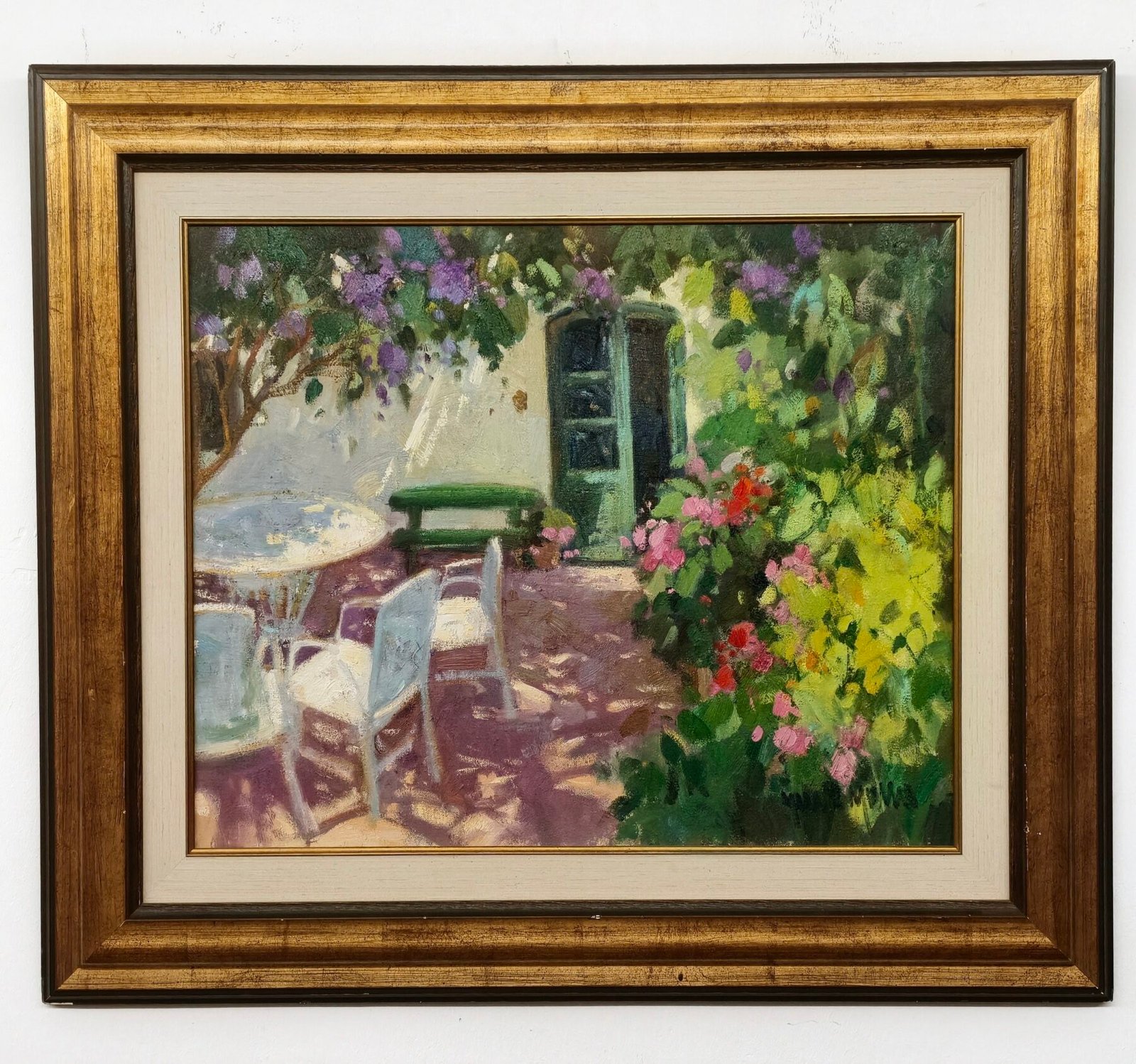
Sun and Shade
1.300 €
Autographically titled on the reverse as Sol i sombra, this oil on canvas painting by Mercè Massa (Barcelona, 1940 – Palafrugell, 2023) represents a work of singular beauty within late-20th-century Catalan genre and intimate landscape painting (c. 1997). The composition depicts a garden nook of a traditional Empordà home where Mediterranean light filters through a pergola of bougainvillea and ivy, casting a vibrant play of shadows and luminous highlights across a paved patio with wrought-iron furniture and a half-open greenish wooden door. Stylistically, the piece synthesizes the post-impressionist heritage of the Olot School and Empordà luminism with subtle Fauvist nuances, distinguished by an impastoed, rhythmic brushstroke of striking gestural freshness that resolves floral clusters in shades of pink, violet, and yellow against deep, somber greens and purples. Influenced directly by her mother, the painter María Massa, the artist here develops a vocabulary of lyrical synthesis akin to her celebrated "white background" period, defined by the primacy of softened light and Mediterranean atmosphere. Awarded major European accolades including the Grand Prix de la Main d'Or and Medals from the Ville de Paris and Bourges, Mercè Massa’s artwork is held in prominent institutional and public collections, notably the holdings of the Casa de Cultura Josep Pla in Palafrugell, municipal art collections in Girona and Tossa de Mar, the Cercle Català in Madrid, and the Ave María Foundation in Sitges, as well as holding a distinguished place in private collections dedicated to preserving post-war Catalan painting.
TechniqueOil sobre tela
Dimensions85x74cm
Year1997
ArtistMASSA, Mercè
MASSA, Mercè
Mercè Hernández-Villaescusa Massa, artistically known as Mercè Massa (Barcelona, 1940 – Palafrugell, Girona, 2023), was a prominent Empordà painter and sculptor whose life and creative career embody the post-impressionist refinement of Catalan landscape and seascape painting from the second half of the 20th century and early 21st century. Introduced to visual arts at an early age within the family setting under the technical and intellectual influence of her mother, fellow painter María Massa, she enriched her academic and conceptual training by closely observing the circles of Catalan post-impressionism and the landscape tradition of the Baix Empordà, settling her residence and studio in the ancestral home in Palafrugell and developing a creative environment in constant dialogue with Calella de Palafrugell, Cadaqués, and the Empordà coastline. Her stylistic vocabulary, associated with modern figuration featuring deep impressionist resonances and Fauvist synthesis, is distinguished by the primacy of Mediterranean light, the decomposition of color through a juicy, impastoed brushstroke, and the formulation of her celebrated "white background" period, where the luminosity of the bare canvas structures the atmospheres and volumes of seascapes, still lifes, fishing scenes, and rural landscapes, evolving in her final years toward three-dimensional research with bronze sculptural works centered on the human figure and lyrical reflection. Throughout a fruitful international exhibition career that took her work to galleries and venues across Spain, France (Paris, Toulouse, Bordeaux, and the Côte d'Azur), Andorra, Germany, Belgium, and Switzerland —highlighted by shows at the Galerie Médicis in Paris, the Galerie du Cygne in Geneva, the Galerie "C" in Mouscron, and the Cercle Català in Madrid—, her artistic mastery was recognized through numerous major European distinctions, notably the Golden Palm for Belgo-Hispanic Merit (1986), the Bronze Medal at the Salon International de Béziers (1985, 1986), Gold Medals from Lacapelle-Marival (1988) and Bourges (1989), Silver Medals from the Ville de Paris (1989) and the Grand Prix de la Main d'Or (1987, 1988), as well as the Silver Medal from the Institut Académique de Paris (1989). Kept apart from ephemeral trends and deeply rooted in the collecting of the post-war Catalan school, the artwork of Mercè Massa is held in important cultural institutions and municipal archives, such as the artistic collection of the Casa de Cultura Josep Pla in Palafrugell, municipal collections in Girona and Tossa de Mar, institutional holdings at the Cercle Català in Madrid and the Ave María Foundation, as well as holding a prominent place in notable Spanish and international private collections dedicated to Mediterranean landscape art.
Recommended works
Other selected pieces from the Art Andorra catalogue.