
Country Idyll
450 €
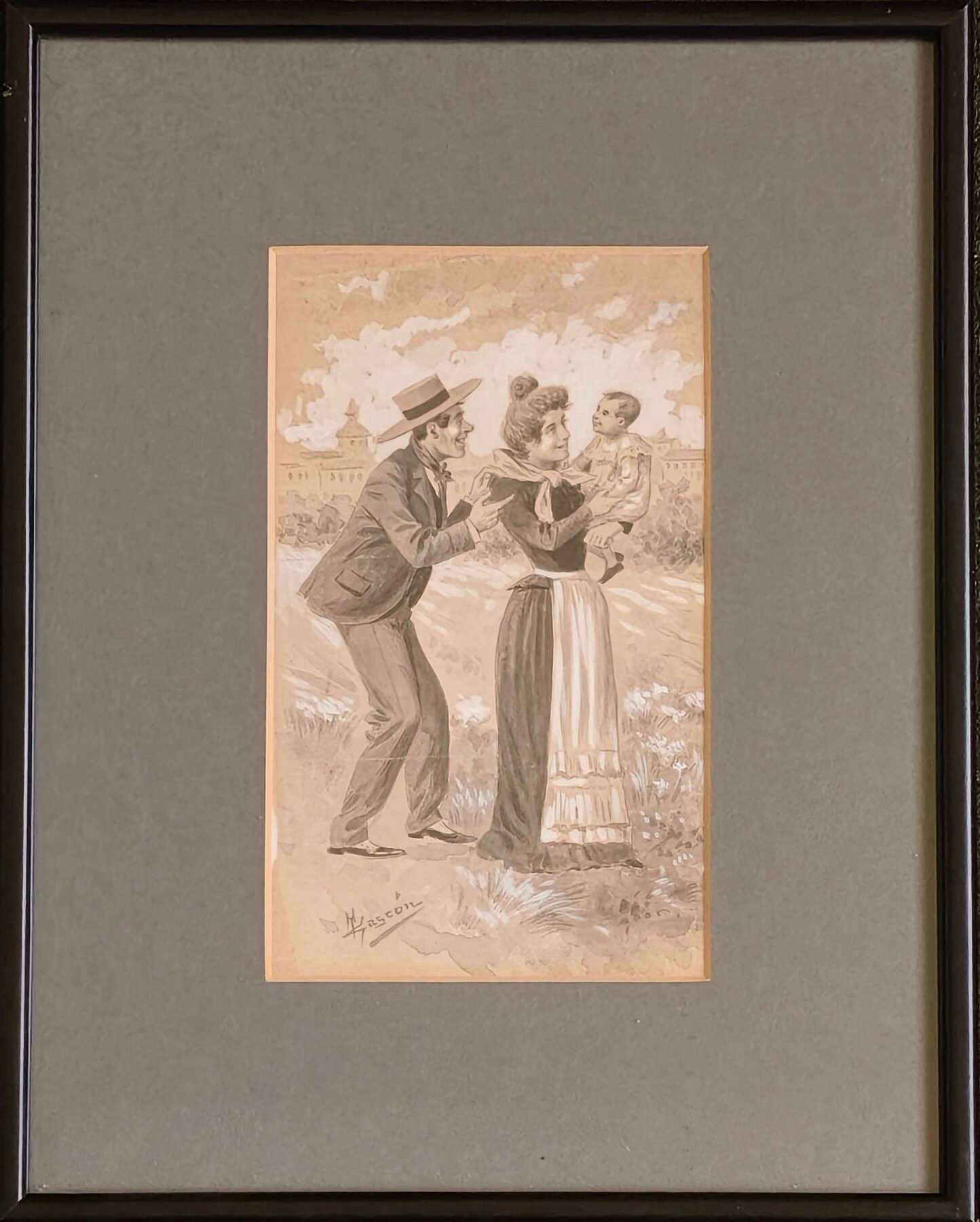
This original illustration on paper (33 × 26 cm) signed by Teodoro Gascón Baquero (1850–1926) represents a remarkable example of genre and narrative drawing from the Spanish Silver Age, conceived explicitly as a photomechanical matrix for the turn-of-the-century illustrated press using the technique of grisaille (ink wash, monochrome gouache, and vibrant white pigment highlights). The composition, imbued with striking dynamism and bucolic warmth, depicts a young peasant family outdoors, where an idyllic father wearing a flat-topped straw hat and a neckerchief gesticulates with a smile and enthusiasm toward his wife, who holds a beaming child in her arms while the architectural outline of a village with a bell tower appears in the background. Iconographically, the work celebrates the values of rural life, fatherhood, and the idyllic scenery of the Spanish countryside, conveying a warm and lively vision of everyday existence through a perceptive psychological characterization of faces and glances. Stylistically, Gascón's confident line demonstrates mastery of chiaroscuro and the modulation of neutral values optimized for typographic photogravure reproduction, reflecting both the genre realism of the Madrid school and the compositional solidity of contemporary illustrators such as Narciso Méndez Bringas, Ángel Díaz Huertas, and Francisco Sancha. A pharmacist by profession and a prolific artist for essential publications such as Blanco y Negro, Madrid Cómico, Gedeón, and La Ilustración Española y Americana, the historical and artistic value of Teodoro Gascón's matrix drawings and original illustrations has ensured the preservation of his works in major national public institutions, most notably the National Library of Spain (BNE), the ABC Museum of Drawing and Illustration in Madrid, the Museum of History of Madrid, and the Museum of Zaragoza.
TechniqueAguada de tinta y gouache sobre papel
Dimensions33x26cm
YearCirca 1895 – 1910
ArtistGASCÓN, Teodoro
GASCÓN, Teodoro
Teodoro Gascón Baquero (Ojos Negros, Teruel, 1850 – Madrid, 1926) was one of the most unique and prominent figures in satirical drawing, graphic humor, and journalistic illustration in turn-of-the-century Spain and the Silver Age. Holding a degree in Pharmacy from the Central University of Madrid, a profession he practiced continuously throughout his life, he developed a parallel and self-taught artistic career that was both prolific and influential, characterized by a keen observational capacity for the customs and psychology of contemporary society. His visual vocabulary evidenced a strong influence from the grand 19th-century Iberian and European tradition of satirical and illustrated printmaking, drawing upon the genre realism of the Madrid academic school while maintaining close compositional affinities with contemporary narrative illustrators such as Francisco Sancha, Ángel Díaz Huertas, Narciso Méndez Bringas, and Eduardo Sáenz Hermua ("Mecachis"). Specializing in pen-and-ink drawing, artistic calligraphy, and grisaille (ink wash and monochrome gouache with neutral highlights) optimized for photomechanical photogravure, Gascón stood out for his synthetic, dynamic, and expressive line, focused on caricature, socio-political cartoons, and the illustration of short stories and popular tales. His contribution was fundamental to the leading periodicals of the golden age of Spanish graphic press, regularly contributing to high-circulation titles such as Blanco y Negro, Madrid Cómico, Gedeón, La Ilustración Española y Americana, El Gato Negro, La Risa, and Barcelona Cómica, alongside illustrating serial literature and monographic publications. Acclaimed by contemporary critics as an essential graphic chronicler of traditional Madrid and turn-of-the-century rural and urban Spain, the historical, artistic, and documentary significance of his original legacy —comprising matrix drawings, watercolors, and sketches for press— led to the preservation of his holdings in leading institutions such as the National Library of Spain (BNE), the ABC Museum of Drawing and Illustration in Madrid, the Museum of History of Madrid, and the Museum of Zaragoza.
Works
More works by this artist
Pieces related to the same artist.