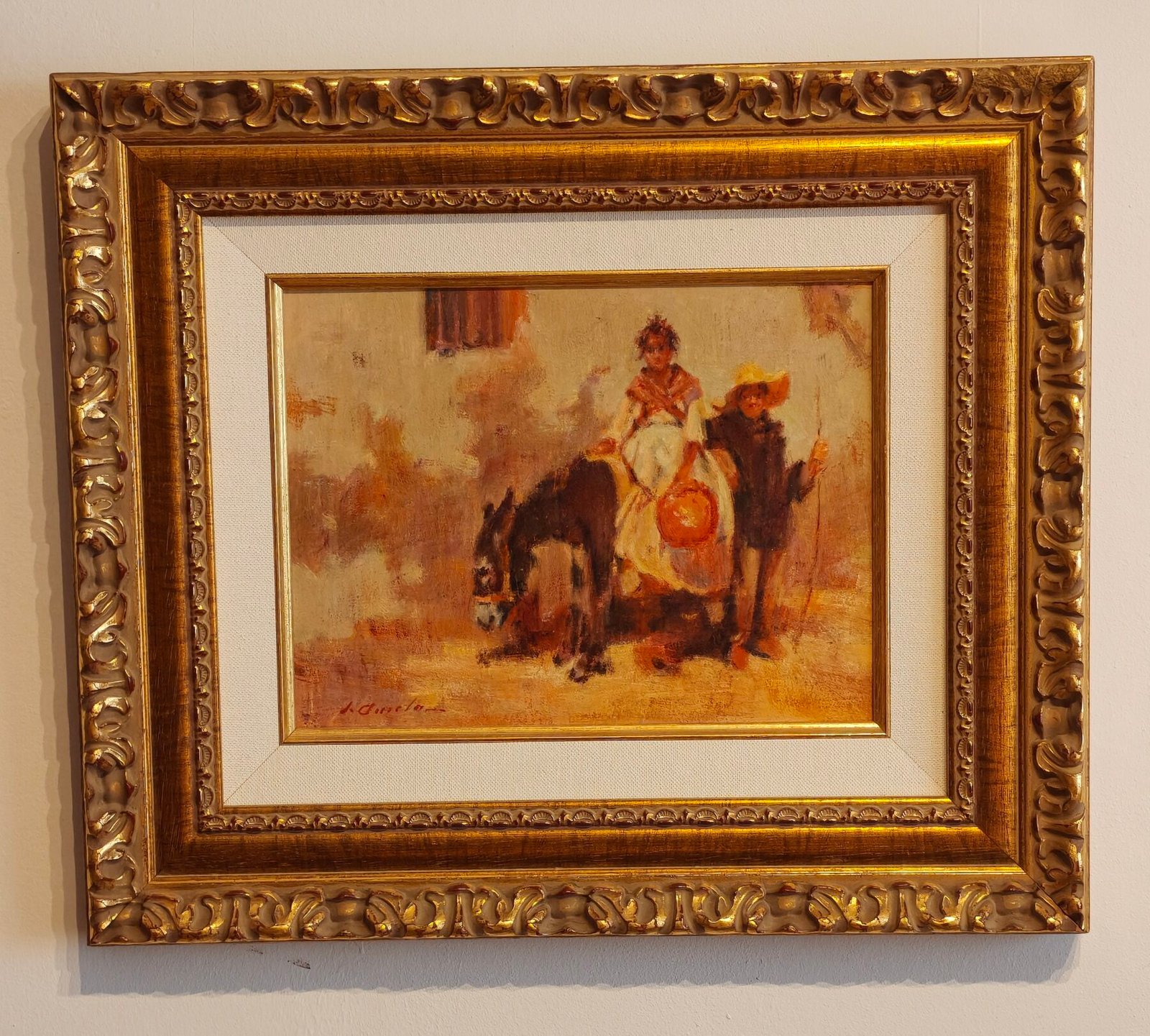
Village Path
500 €
This original oil on wood panel (43 × 37 cm) by Josep Amela Ferrando (Barcelona, 1920 – 2005) stands as a testament to pronounced artistic maturity within second-half 20th-century Catalan figurative painting, depicting a Mediterranean rural genre scene where a young female figure mounted on a donkey and accompanied by a villager wearing a straw hat lead a composition of harmonious lyrical cadence. The work reveals a direct aesthetic connection to post-impressionism and turn-of-the-century Catalan luminism —heir to the tradition of masters such as Joaquín Sorolla, Eliseu Meifrèn, and Francesc Gimeno—, distinguished by a technique featuring juicy, impastoed, and gesturally fluid brushwork that breaks down sunlight into warm chromatic nuances of ochres, golds, and earth tones. Despite developing as an artist of essentially self-taught background —balancing his artistic practice with professional responsibilities after having lived through the dramatic historical experience of the Lleva del Biberó during the Spanish Civil War—, Amela achieved a vocabulary of remarkable formal rigor and poetic sensitivity that earned him the esteem of contemporary intellectuals and collectors. The output of Josep Amela —father of the renowned journalist and writer Víctor-M. Amela— is preserved primarily in select private collections in Catalonia and the Mediterranean region dedicated to post-war Catalan landscape and genre art, as well as in documentary archives and family heritage collections linked to the historical memory of the Civil War and contemporary Catalan culture.
TechniqueOil sobre madera
Dimensions43x37cm
YearCirca 1965 – 1975
ArtistAMELA, Josep
AMELA, Josep
Josep Amela Ferrando (Barcelona, 1920 – Barcelona, 2005) was a self-taught artist with a deep humanistic profile and remarkable painterly technical skill, whose life and creative trajectory synthesize the evolution of 20th-century Catalan figurative painting. A combative member of the historic Lleva del Biberó (the draft class of 1920 mobilized during the Spanish Civil War), his front-line experiences forged in him a humanistic sensitivity and a profound generational memory that would later feed the literary work and historical testimony of his son, the celebrated journalist, critic, and novelist Víctor-M. Amela, co-founder of the iconic section La Contra in the newspaper La Vanguardia. Balancing his professional work with a constant and uncompromising dedication to the fine arts, Josep Amela consolidated a pictorial vocabulary of strong post-impressionist affiliation, fully integrated into the rich tradition of Catalan Mediterranean luminism and genre painting. His output, focused with singular mastery on rural landscapes, peasant scenes, and outdoor figures, is distinguished by a juicy, impastoed, and gesturally fluid brushstroke, characterized by an exquisite command of chiaroscuro, a vibrant chromatic modulation of warm tones, and a lyrical poetry that elevates everyday rural life. Kept apart from mass commercial circuits by an intimate and rigorous artistic approach, his creative legacy —backed by meticulous technical execution and genuine expressive authenticity— is preserved in prominent private collections and academic spheres as an essential testimony of post-war Catalan genre art and the artistic dignity of an unrepeatable generation.
Recommended works
Other selected pieces from the Art Andorra catalogue.