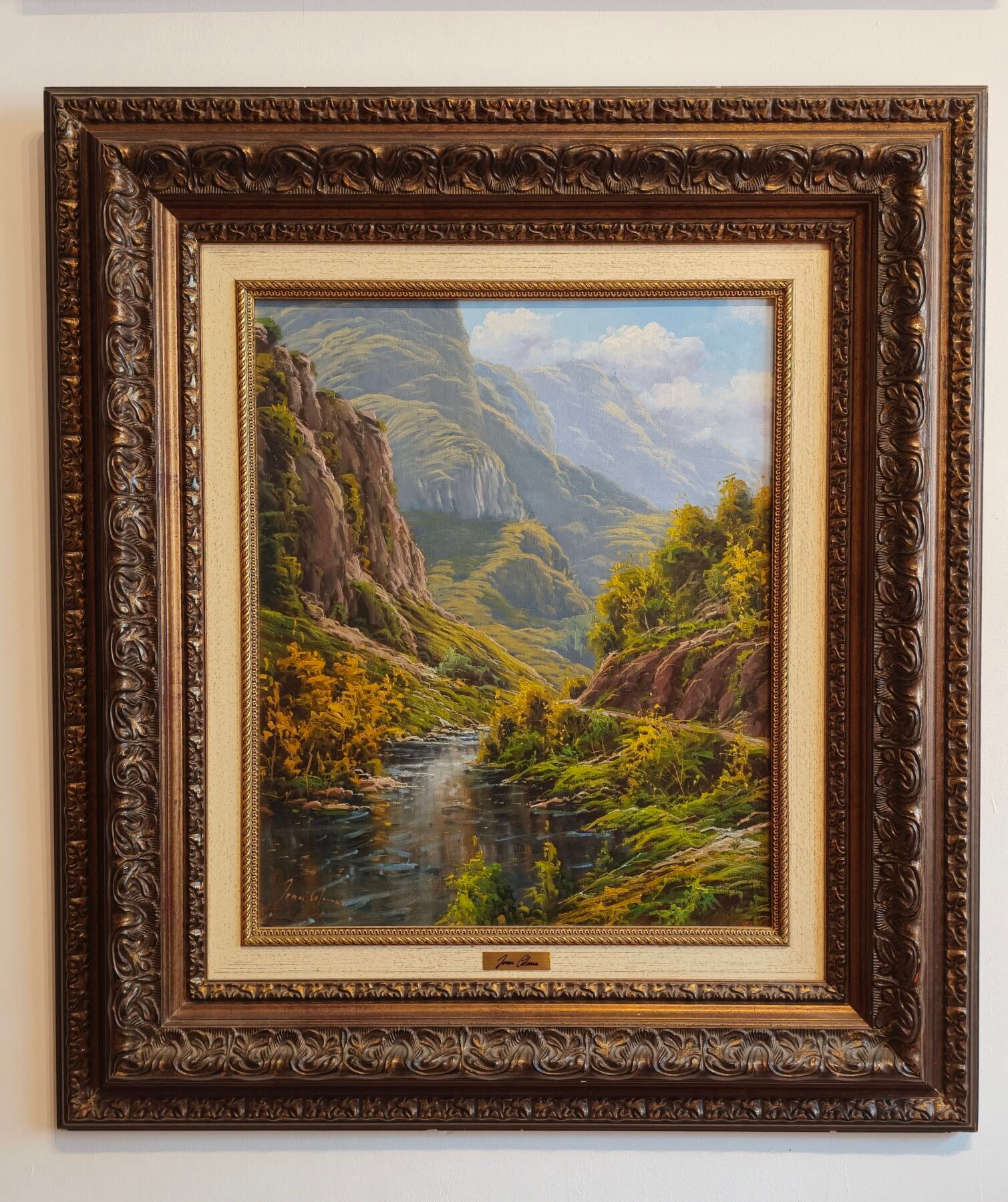
The Deva River in La Hermida (Cantabria)
750 €
Autographically titled on the reverse as El río Deva en La Hermida (Cantabria), this oil on canvas painting by Joan Coloma (Alcoy, 1956) stands as a representative testament to his period of creative maturity in the late 1990s, when it achieved a notable acquisition value of 125,000 pesetas on the 1998 art market. The composition belongs to the Spanish plein-air and naturalist movement of the final third of the 20th century, capturing the rugged gorge of La Hermida through a rigorous analysis of Cantabrian topography where the course of the Deva River, lush riverside vegetation, and the monumental scale of rock faces bathed in Northern light converge. Stylistically, the work demonstrates the assimilation of 19th-century naturalism and the landscape tradition of the Olot School alongside Levantine plein-air painting, characterized by a vibrant, juicy, and precisely textured brushstroke that skillfully resolves the mirror-like reflections of the water, mineral textures, and tonal gradations of green, ochre, and gold within the mountain flora. Despite beginning his artistic path at the School of Applied Arts and Artistic Crafts in Alcoy, Coloma chose an itinerant, self-directed learning approach whose turning point occurred after his journeys to the Picos de Europe starting in 1985, incorporating a profound poetics of untouched nature into his body of work ever since. Awarded in provincial competitions and backed by a established exhibition history across Spain and Andorra, Joan Coloma’s paintings are preserved in municipal public collections within the Valencian Community, institutional holdings, and select private collections dedicated to contemporary landscape art.
TechniqueOil sobre tela
Dimensions75x67cm
Year1997
ArtistCOLOMA, Joan
COLOMA, Joan
Joan Coloma (Alcoy, Alicante, 1956) is a prominent Levantine figurative painter whose artistic career embodies the renewed vitality of plein-air landscape painting and the poetics of untouched nature within Spanish painting of the late 20th and early 21st centuries. Drawn to the visual arts at an early age, he began his formal training in 1979 by enrolling at the School of Applied Arts and Artistic Crafts in Alcoy, where he engaged with the foundational principles of analytical drawing and color syntax under the guidance of the faculty; however, his strong drive for creative independence and introspection led him to step away from formal academic education in favor of direct naturalism and the freedom of self-directed learning through sustained plein-air practice. This nomadic artistic pursuit reached a decisive turning point in 1985 following his first journey to the Picos de Europe, a region whose rugged topography, Pyrenean-Cantabrian mists, and ever-shifting Atlantic light radically transformed his palette, prompting extended painting stays in northern Spain and introducing into his oeuvre a profound lyricism of mountainous terrain that dialectically contrasts with the warm luminism of his Mediterranean roots. Stylistically, his work is distinguished by a firm mastery of oil on canvas and panel, characterized by a vibrant, juicy, and precisely textured brushstroke that effectively captures atmospheric qualities, woodland density, and the striking play of light upon rock face. Recognized from early in his career, his accolades include Third Prize at the Provincial Painting Competition of San Vicente del Raspeig (Alicante, 1980) and Third Prize at the Poster Competition "24 Sports Hours of Alcoy" (1981), subsequently building a solid exhibition record through major solo and group shows in galleries and institutions across Spain and the Principality of Andorra. The artwork of Joan Coloma is prominently represented in institutional holdings, municipal public collections in the Valencian Community and the broader Levantine region, as well as in select international private collections dedicated to the study and preservation of contemporary Spanish landscape art.
Recommended works
Other selected pieces from the Art Andorra catalogue.