
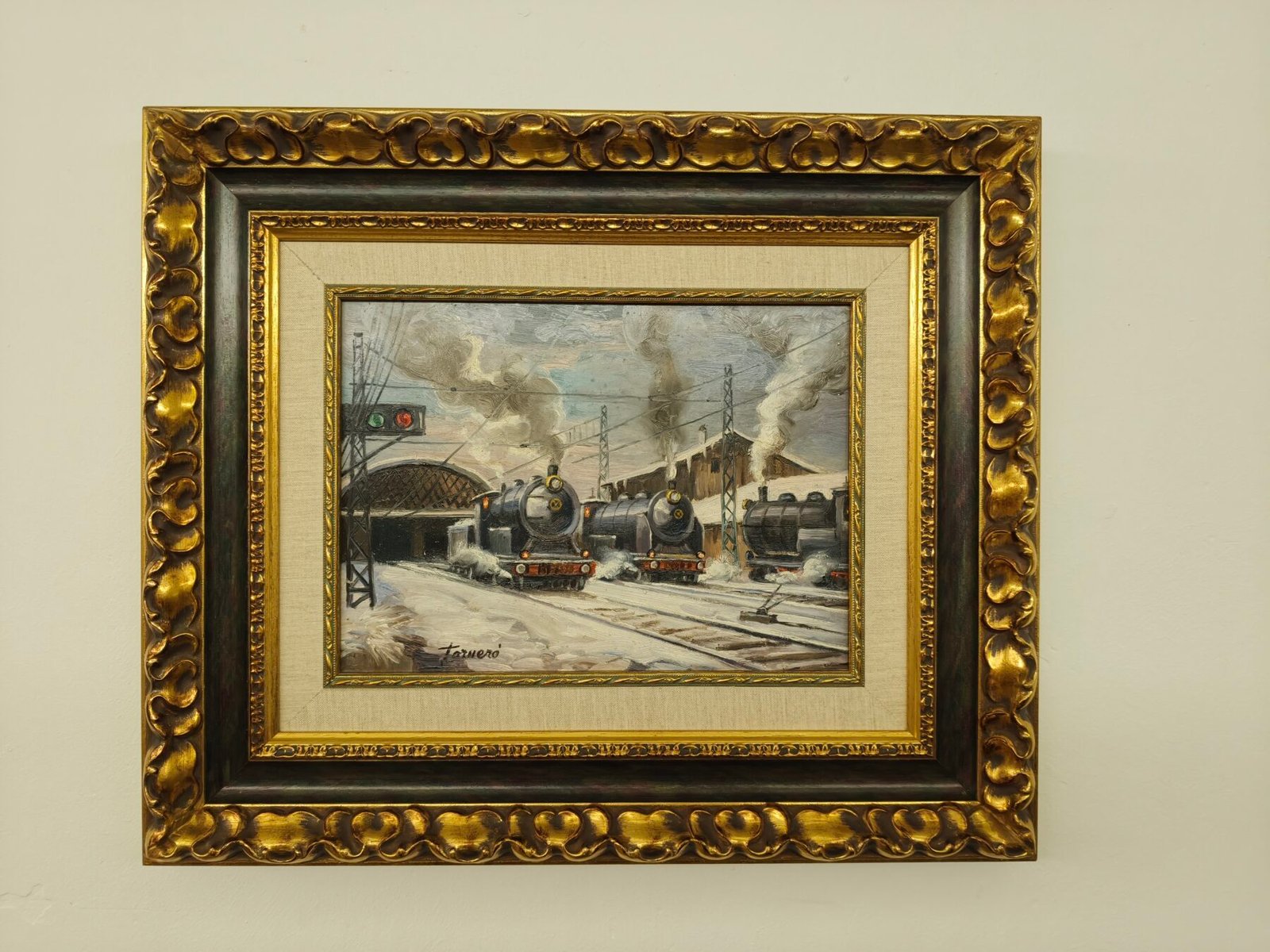
Train Station under the Snow
800 €
This work by the celebrated Catalan landscape and intimate painter Francesc Torneró, executed in oil on panel in a 54x45 cm format and explicitly signed in the lower left corner (Torneró), represents a superb example of industrial archaeology and modern urban landscape painting, centered on the poetics of vintage railways; the composition is structured through a perspective vanish of pronounced linear dynamism that draws the viewer's eye toward the vaulted train shed, where three steam locomotives rest and set off amidst tracks covered in a blanket of snow and ice; thematically, the piece addresses the 19th and early 20th-century fascination with mechanical power, speed, and industrial atmosphere, capturing the exact moment when the chimneys spew dense plumes of smoke and steam that intertwine with power lines and the iron infrastructure; technically, it displays an extraordinary command of the palette knife and broad brush, evident in the thick textural application with which Torneró models the steam through swirling circular rhythms and impasto in cream, ochre, and gray tones, contrasting sharply with the synthetic, structured precision of the locomotives' draftsmanship; stylistically, the work denotes a clear alignment with Post-Impressionism and European and British-rooted Realism, connecting explicitly with the luminist and industrial tradition inaugurated by J.M.W. Turner in Rain, Steam and Speed, as well as Claude Monet's views of the Saint-Lazare station; the color palette, dominated by a restrained range of steel grays, ochres, chalk whites, and dark browns, is masterfully broken by vibrant accents of pure color in the red and yellow signal lights and glowing boiler headlights, adding a warm touch to the cold winter setting; the artwork of Francesc Torneró is widely represented in prominent private collections of 20th-century Catalan art, corporate collections specializing in railway and industrial themes, and galleries and institutions dedicated to preserving contemporary figurative and en plein air pictorial heritage.
TechniqueOil sobre madera
Dimensions50x48cm
YearCirca 1988
ArtistTORNERÓ, Francesc
TORNERÓ, Francesc
Francesc Torneró (Barcelona, 1934–2018) embodies the mature and synthetic evolution of second-half 20th-century Catalan landscape painting, receiving his academic training at the Barcelona School of Arts and Crafts and the Sant Jordi Royal Catalan Academy of Fine Arts, an institutional setting where he absorbed the rigor of the great figurative tradition. His precocious technical skill and plastic sensitivity earned him key formative and institutional milestones, notably the historical El Paular grant in 1956 and the National Landscape Award in 1966, honors that solidified his prominent standing in the Iberian art scene. Following a fruitful phase of experimentation with informalism, abstract structures, and the material symbolism characteristic of mid-century avant-garde movements—from which he assimilated a keen sense of internal geometry, the architectural weight of space, and the expressive quality of texture—Torneró undertook a conscious stylistic shift toward a poetic and renewed figuration. In his period of full artistic maturity, he combined an impressionistic vocabulary with a restrained realistic solidity, standing out exceptionally in capturing the atmospheric mood of Barcelona urban landscapes, Mediterranean seascapes, and intimate interior scenes. His painting, characterized by absolute command over focal light and tonal modulation, relies on a fluid, energetic, and highly synthetic brushstroke that dispenses with superfluous detail to convey the ephemeral quality of atmosphere. Drawing stylistic influence from the luminism of the Sitges School and the landscape work of Josep Amat to the tactile freedom of European post-impressionism, Torneró's oeuvre reached international acclaim through numerous solo and group exhibitions, and is preserved today in the holdings of public collections such as the Museum of the Royal Academy of Fine Arts of San Fernando in Madrid and the Barcelona Museum of Contemporary Art, alongside prestigious corporate, institutional, and private collections across five continents.
Works
More works by this artist
Pieces related to the same artist.