
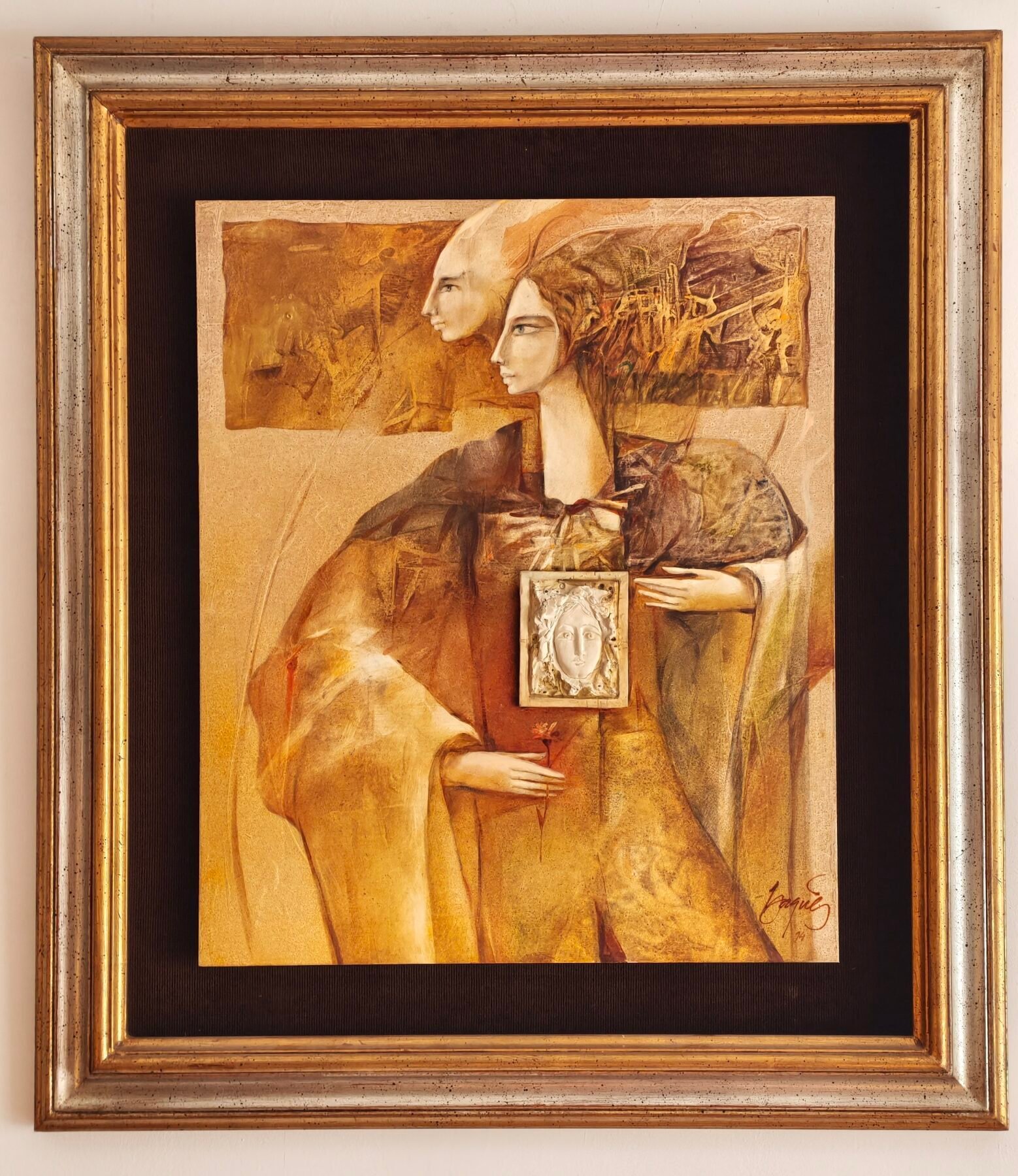
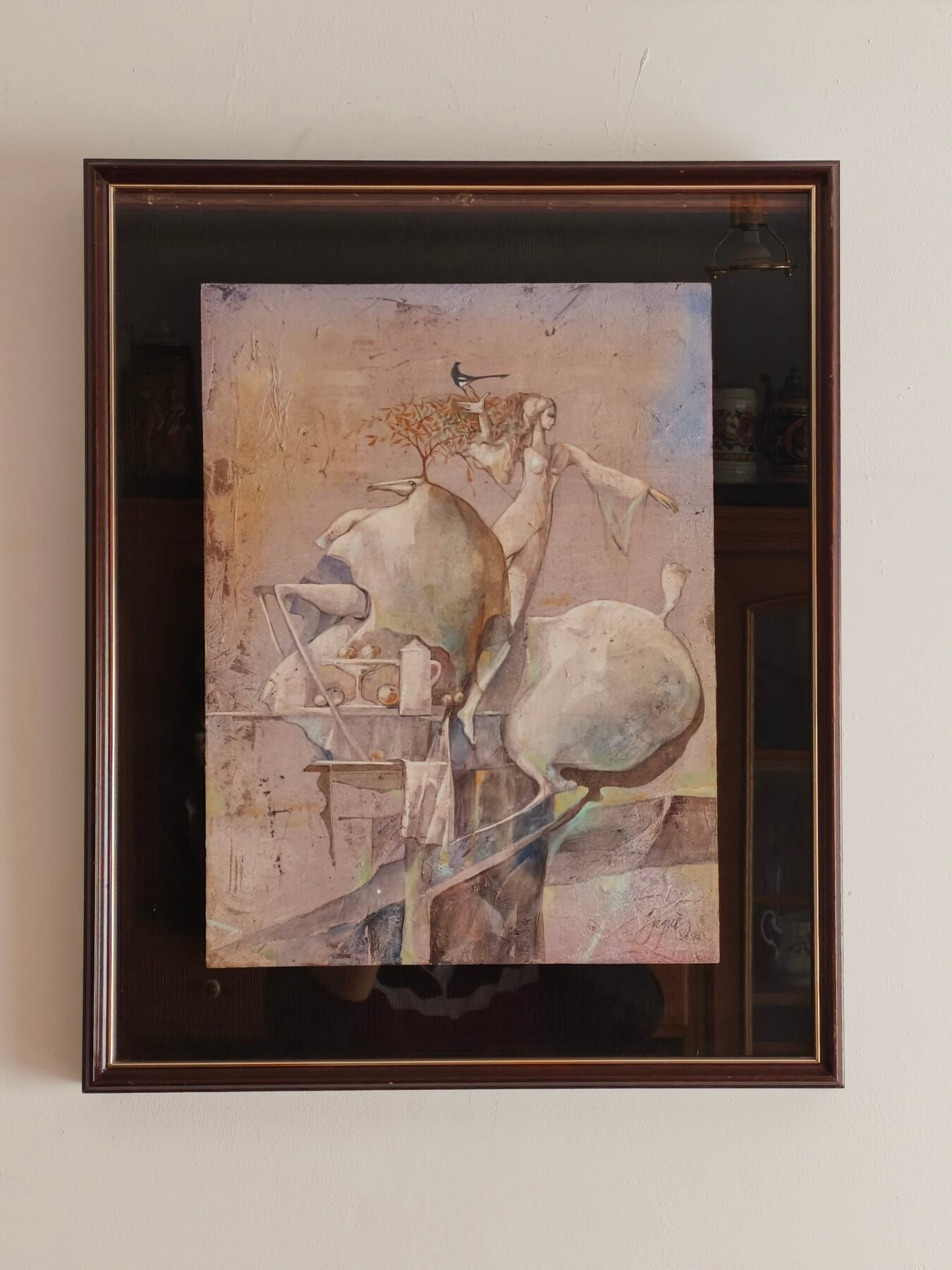
Equus and Magpie II
1.500 €
Equus and Magpie II (1993), a mixed media on panel measuring 54 x 44 cm signed by the revered Catalan master Josep Baqués (1931–2021), stands as a masterful testament to the Magic Realism and Poetic Surrealism of Mediterranean lineage that brought the artist international acclaim. The work unfolds an dreamlike universe of refined technical execution where the mythologized figure of the horse (Equus) transfigures into a volumetric mass with organic, metamorphic contours, engaging in perfect lyrical tension with the ethereal presence of a stylized female figure and the magpie strategically perched at the top as a symbol of omen and contemplation. Stylistically, Baqués displays a plastic virtuosity inherited from the graphic design tradition that marked his origins, blending almost Renaissance-like anatomical precision with textural exploration using subtle glazes, scraping, and gouache on wood that bestow an ageless patina akin to ancient frescoes upon the panel. The composition is structured around a pyramidal framework supported by a metamorphic still life of everyday objects—a pitcher, ceramic elements, and floating drapery—connecting the scene to the fantastical realms of Flemish painting and the lyrical stagecraft of Salvador Dalí, Remedios Varo, and Max Ernst, albeit stripped of drama to favor a metaphysical and introspective serenity. The chromatic palette, dominated by a symphony of nacreous tones, soft ochre, earth brown, ivory, and subtle greenish glints, demonstrates the painter's extraordinary skill in capturing sifted light and the weightlessness of forms. This mature work captures the poetic peak of an essential figure in 20th-century Catalan art whose creation dwells along the boundaries of tangible reality, classical mythology, and dreamscape.
TechniqueMixta sobre madera
Dimensions54x44cm
Year1993
ArtistBAQUÉS, Josep
BAQUÉS, Josep
Josep Baqués i Hargreaves (Montmeló, Barcelona, 1931 – Barcelona, 2021) was a prominent Catalan painter, illustrator, graphic designer, and sculptor, considered a leading figure in magical lyricism and Surrealism in the second half of the 20th century. Following the Spanish Civil War, he moved to Barcelona, starting at age fifteen as an apprentice at a textile printing firm and later working as a draftsman and advertising artist. In 1957 he established his first professional studio in Barcelona and in 1961 co-founded Grafistes FAD (now ADG-FAD), becoming a pivotal figure in Spanish graphic design, earning honors such as the Silver Delta Award (1972) and the Laus Award (1974), alongside two nominations for the National Design Award. In 1968 he held his first solo painting exhibition in Barcelona, launching an intense artistic career defined by a highly personal, poetic, and dreamlike Surrealism. In parallel, he produced major lithographic editions for Sweden and Germany, with the core of his creative vision compiled in the monograph Baqués… Lirisme màgic. Over his extensive career, his artwork was exhibited across Spain, the United States, France, Germany, Sweden, Venezuela, Andorra, Portugal, India, Canada, and Japan, preserved today in major art foundations and private collections worldwide.
Works
More works by this artist
Pieces related to the same artist.