
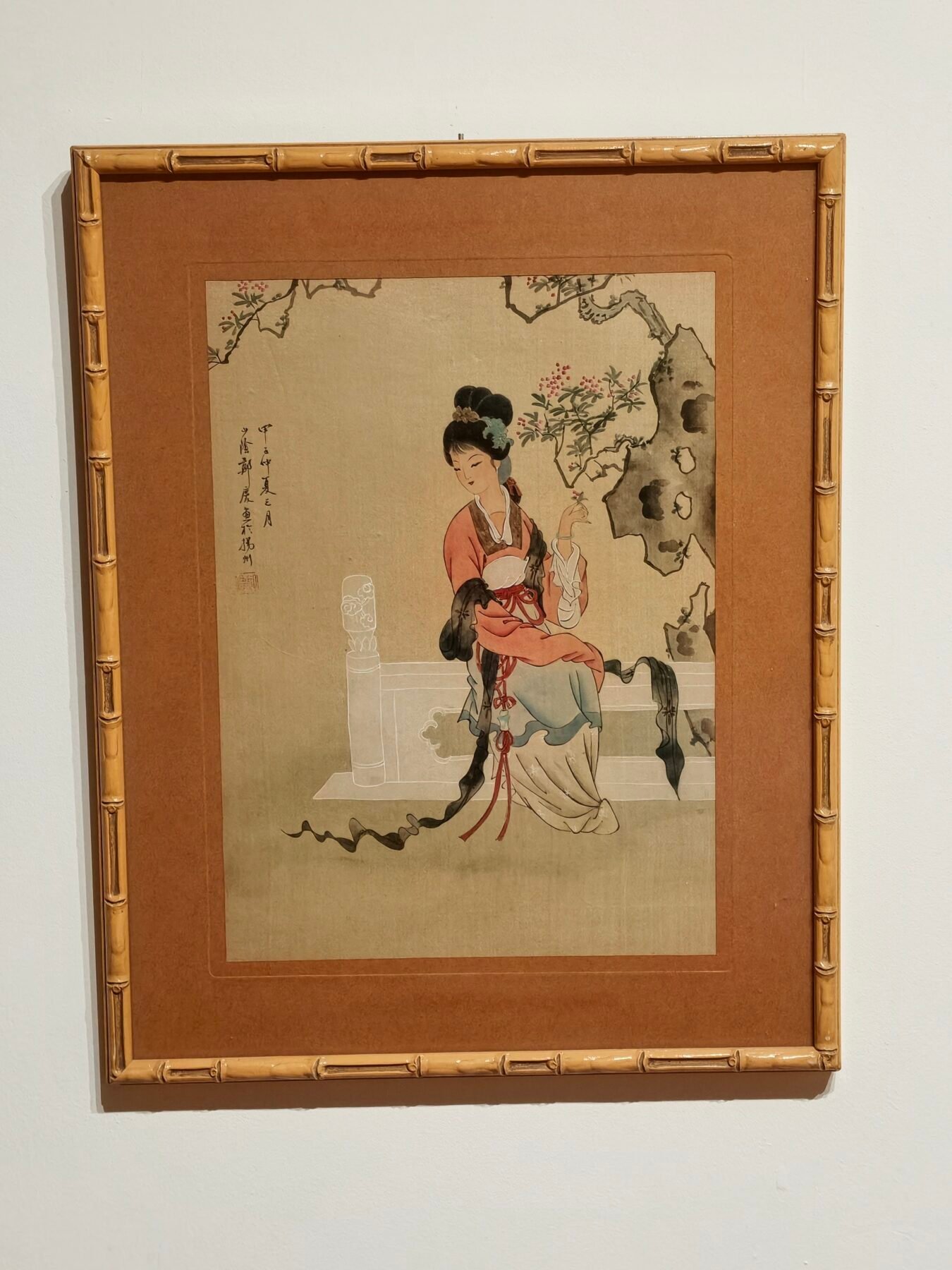
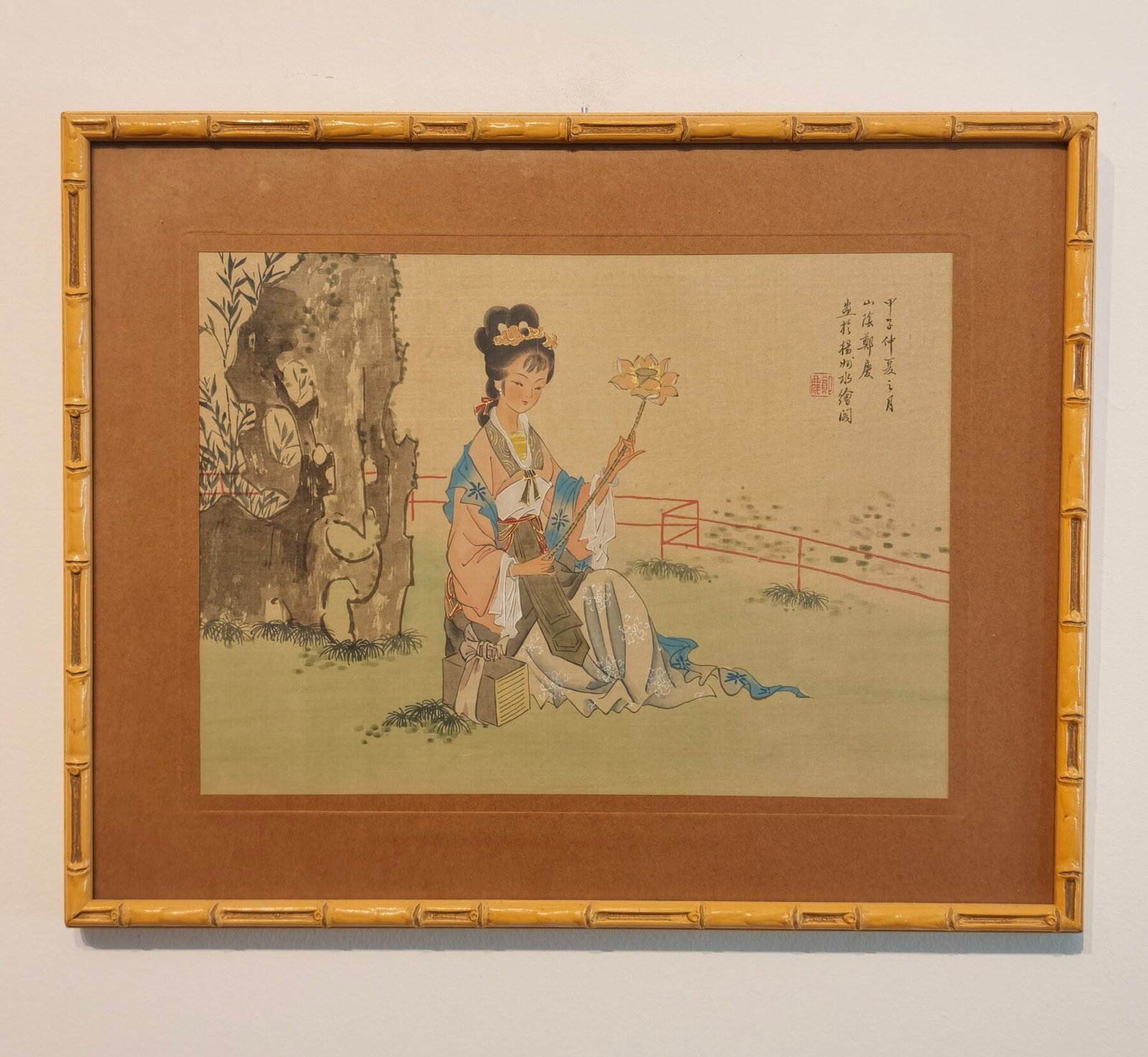
Court lady with a lotus flower in a scholar's garden
200 €
This painting on silk created in the summer of 1984 by the Chinese master Zheng Qing (郑庆) constitutes a refined academic work framed within the traditional genre of court ladies or refined beauties (meiren图 / shinü图), characterized by a rigorous technical mastery of the meticulous painting technique (gongbi). The scene depicts a young scholar lady seated on the bank of a pond beside a porous garden rock (Taihu shi) and a vermilion railing, delicately holding a blooming lotus flower in her hand while resting her other hand on the case of a stringed musical instrument, with a set of traditionally bound books (xianzhuangshu) tied in a box upon the grass. Zheng Qing's visual language exhibits a painstaking technical execution using the 'silk thread' contour line (yousi miao), where the human figure is defined by extremely fine, fluid lines combined with a subtle layered color application (shuanran) and intricate gold leaf details on her headdress and robe embroideries. The work reflects the clear stylistic influence of the great masters of the genre from the Tang, Ming, and Qing dynasties, such as Zhou Fang, Qiu Ying, and Gai Qi, as well as the 20th-century neoclassical reinterpretation led by masters of the stature of Zhang Daqian and Fu Baoshi in dignifying the scholar woman. Through its iconography and academic execution, this composition connects directly with works of court ladies with flowers or instruments from the imperial collection housed in the collections of the Palace Museum in Beijing (Forbidden City), the National Palace Museum in Taipei, and the Shanghai Museum.
TechniqueInk y pigmentos sobre seda natural
Dimensions48x38cm
Year1984
ArtistQING, Zheng
QING, Zheng
Chinese painter and scholar Zheng Qing (郑庆), active in the second half of the 20th century, originated from Shanyin (山阴, present-day Shaoxing, Zhejiang province) and developed the mature stage of his artistic production in the historic cultural center of Yangzhou (扬州, Jiangsu province). Trained in the refined scholar tradition of the Jiangnan region, he skillfully cultivated landscape painting, flower-and-bird compositions, as well as figurative and court lady portraiture (仕女图), combining the calligraphic fluidity characteristic of the Zhejiang school with the luminosity and compositional freedom inherited from the artistic environment of Yangzhou. His visual language stands out for its profound lyrical sensitivity, a virtuous command of ink and color on paper and silk, and a rigorous respect for academic calligraphy and traditional sealing. The customary signature of his work, "Shanyin Zheng Qing" (山阴郑庆), attests to a steadfast fidelity to his cultural and historical roots in Shaoxing, while his active engagement around the Shuihui Pavilion (水绘阁) positions him as a prominent and respected representative of the enduring traditional Chinese academic painting in the final third of the 20th century.
Works
More works by this artist
Pieces related to the same artist.