
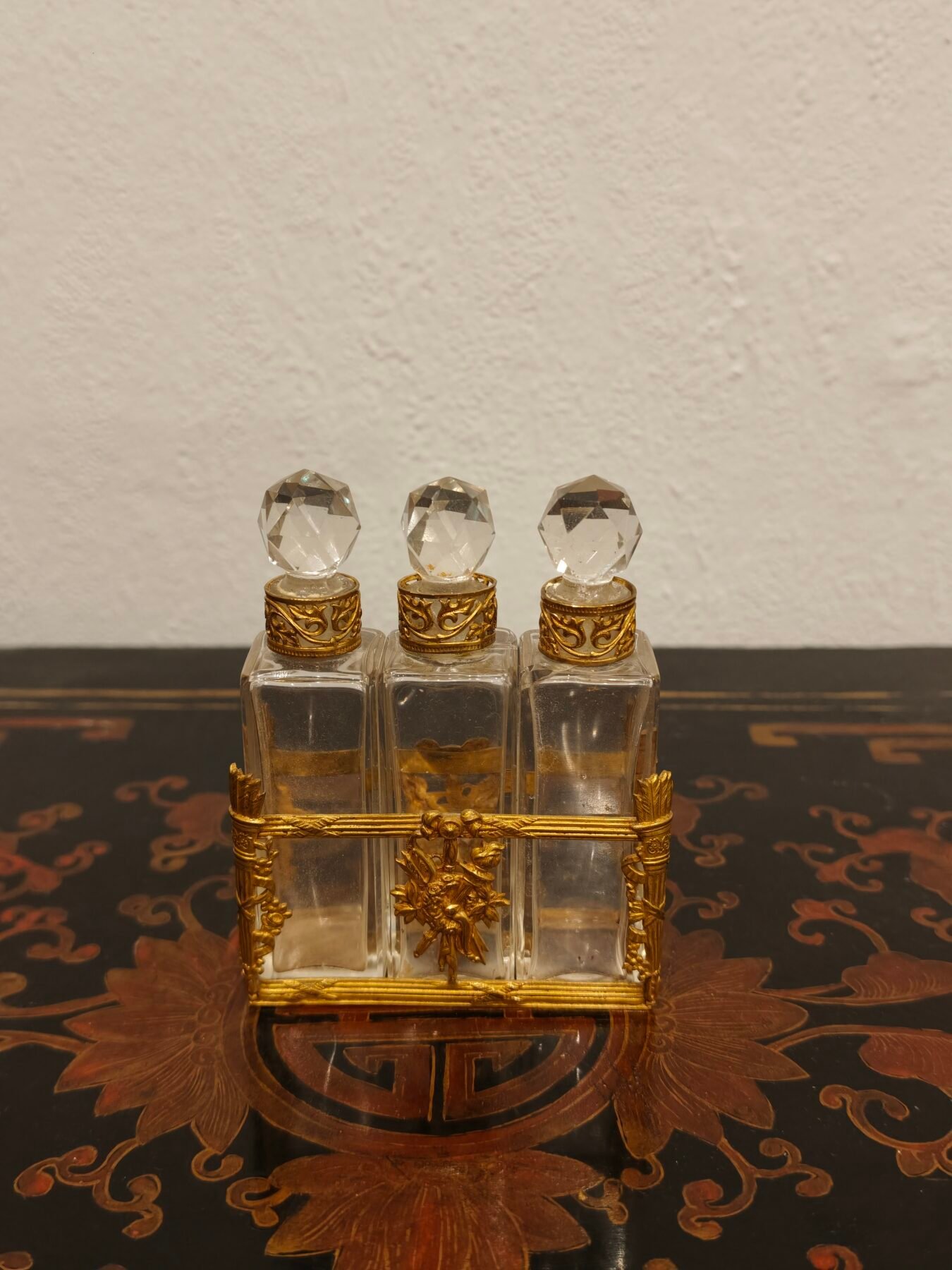
BACCARAT, Compagnie des Glassleries deAntiques
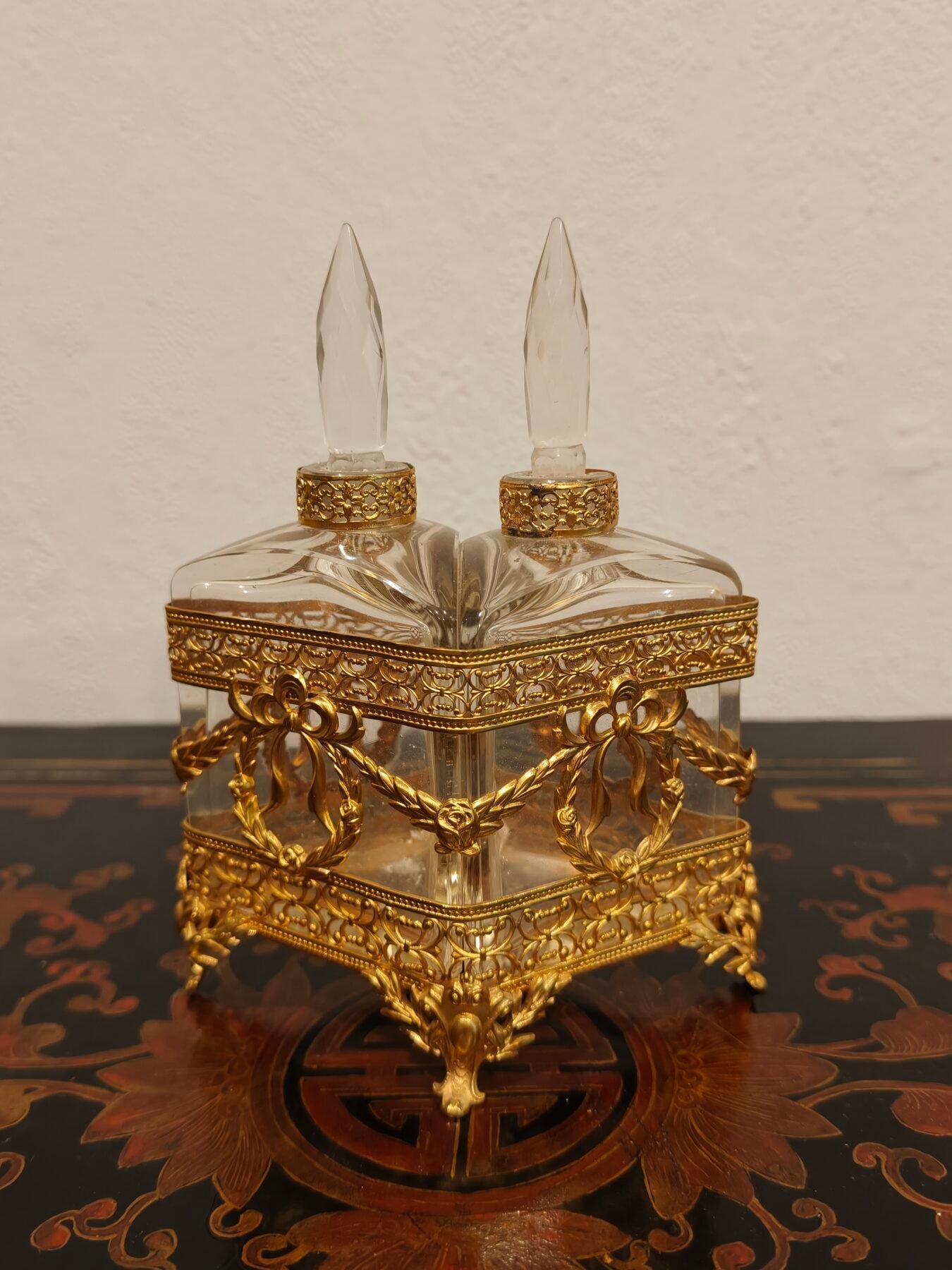
Pair of perfume bottles (servante de parfum) from the Napoleon III period (circa 1860-1880), crafted in France during the second half of the 19th century under the aesthetic canons of the Neoclassical and Empire styles. The set consists of a rhombic frame or mount in hand-chased gilt bronze (ormolu) housing two angular triangular-rhomboid section hand-blown and hand-cut crystal bottles, topped with faceted pointed-arch prism stoppers featuring elegant gold filigree collars. The frame stands out for its delicate openwork decoration, comprising geometric-vegetal friezes, suspended garlands, laurel festoons, and neoclassical ribbon bows in relief, set upon molded feet adorned with scrolls and acanthus leaves. The execution reflects the mastery of Parisian bronze workshops through lost-wax casting (cire perdue), meticulous hand-chasing, and fire-gilding, delivering a sumptuous finish characteristic of dressing-table objects produced by or in collaboration with prestigious houses such as Baccarat, Glasslerie de Saint-Louis, or L'Escalier de Glass. Pieces of identical typology and technical virtuosity are preserved in prominent decorative arts collections including the Musée des Arts Décoratifs in Paris, the Château de Compiègne, the Palace of Versailles, and the Victoria and Albert Museum in London.
Founded in 1764 under the royal decree of King Louis XV granted to Cardinal Louis-Joseph de Laval-Montmorency in the town of Baccarat (Lorraine), the Compagnie des Glassleries de Baccarat was originally established as a glass workshop before transforming, following the installation of its first lead crystal furnace in 1816, into France's paramount manufacture of luxury and mouth-blown excellence, reaching its historical maturity during the 19th century through an unparalleled mastery of chemical material purity, the development of geometrically precise wheel-cutting techniques (taille à la roue), and patented optical grinding methods that redefined the decorative arts. After receiving its first royal commission in 1823 from Louis XVIII and consolidating its signature aesthetic with the iconic Harcourt goblet in 1841, the firm turned the Paris Universal Expositions (most notably the 1855, 1867, 1878, and 1889 editions) into its primary stage for international prestige, where its master artisans—consistently awarded gold medals—showcased monumental showpieces (pièces d'apparat et de grande forme), palace-scale crystal chandeliers such as the famous Zénith, finely enamelled perfume bottles, and colossal uncatalogued sideboard decanters (carafes de dressoir hors-catalogue). This technical supremacy in cold work, characterized by fine diamond-point cutting, fire gilding, acid etching, and iconic base treatments such as the 16-point cut starburst (cul à étoile taillée à 16 rayons), captivated the European high aristocracy and global royal dynasties, establishing Baccarat as the favored purveyor to the imperial court of Napoleon III, the Royal House of Spain, the Ottoman courts, and most notably the Russian Imperial Family, for whom the manufacture crafted legendary commissions including the "Tsar's Candelabra" for Alexander III and state banquet glass services for Nicholas II. Today, the rich historical heritage, master prototypes, original molds, and monumental display pieces of the Compagnie des Glassleries de Baccarat are preserved and exhibited across leading museum institutions worldwide: primarily at its corporate and heritage sites, the Musée du Glass de Baccarat in Lorraine and the Maison Baccarat at Place des États-Unis in Paris (formerly the mansion of Marie-Laure de Noailles, redesigned by Philippe Starck); within France's major national collections, such as the Musée des Arts Décoratifs (MAD) in Paris, the Musée d'Orsay, and the Musée du Louvre; and among prestigious international palatial holdings, including the Royal Palace of Madrid and the Palace of La Granja de San Ildefonso in Spain, the Dolmabahçe Palace in Istanbul (renowned for housing its monumental crystal staircase), the Hermitage Museum in Saint Petersburg, and the decorative arts collections of the Victoria and Albert Museum (V&A) in London, solidifying the brand as an enduring symbol of French art de vivre and the pinnacle of crystal craftsmanship.
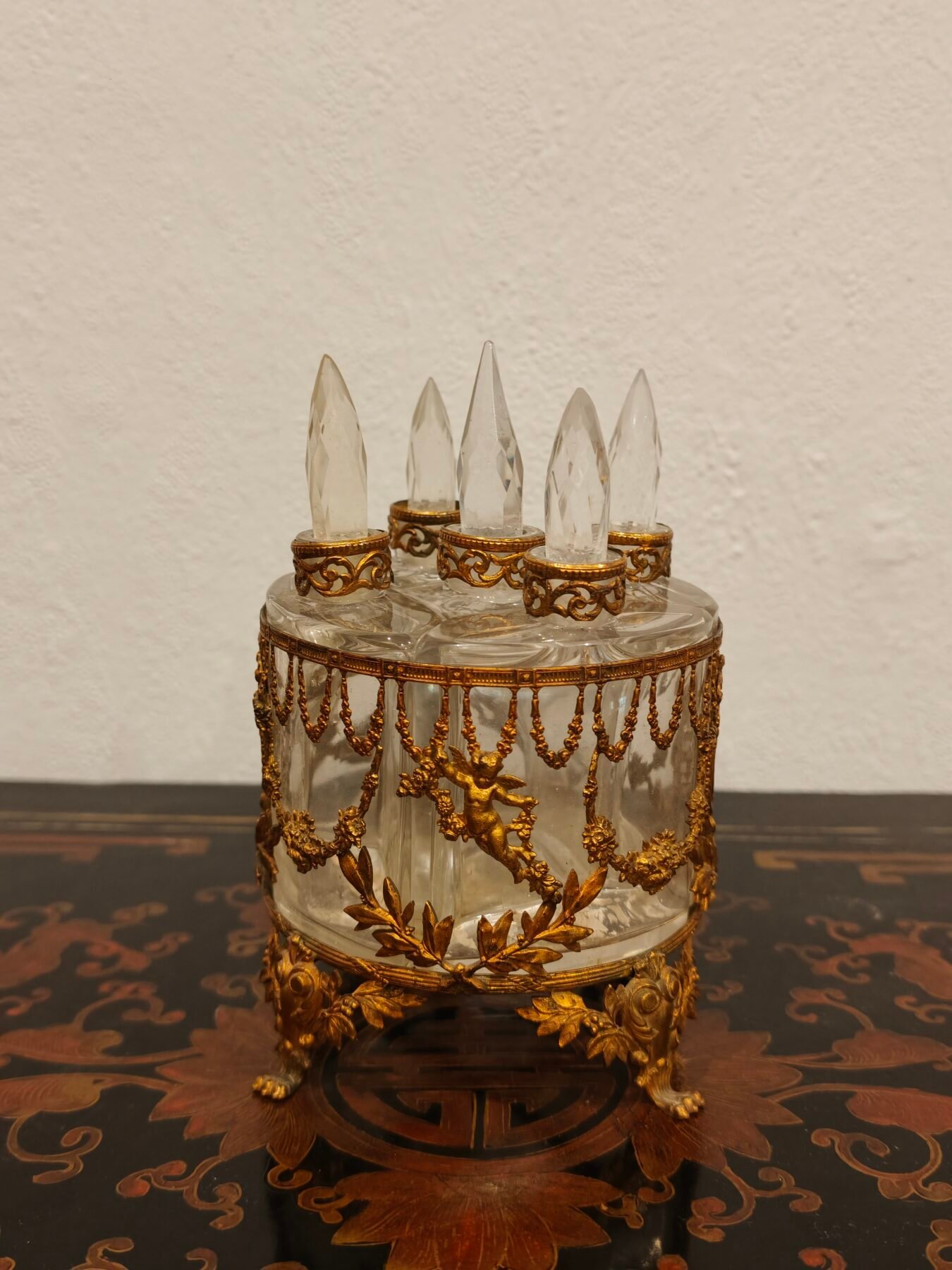
Pieces related to the same artist.