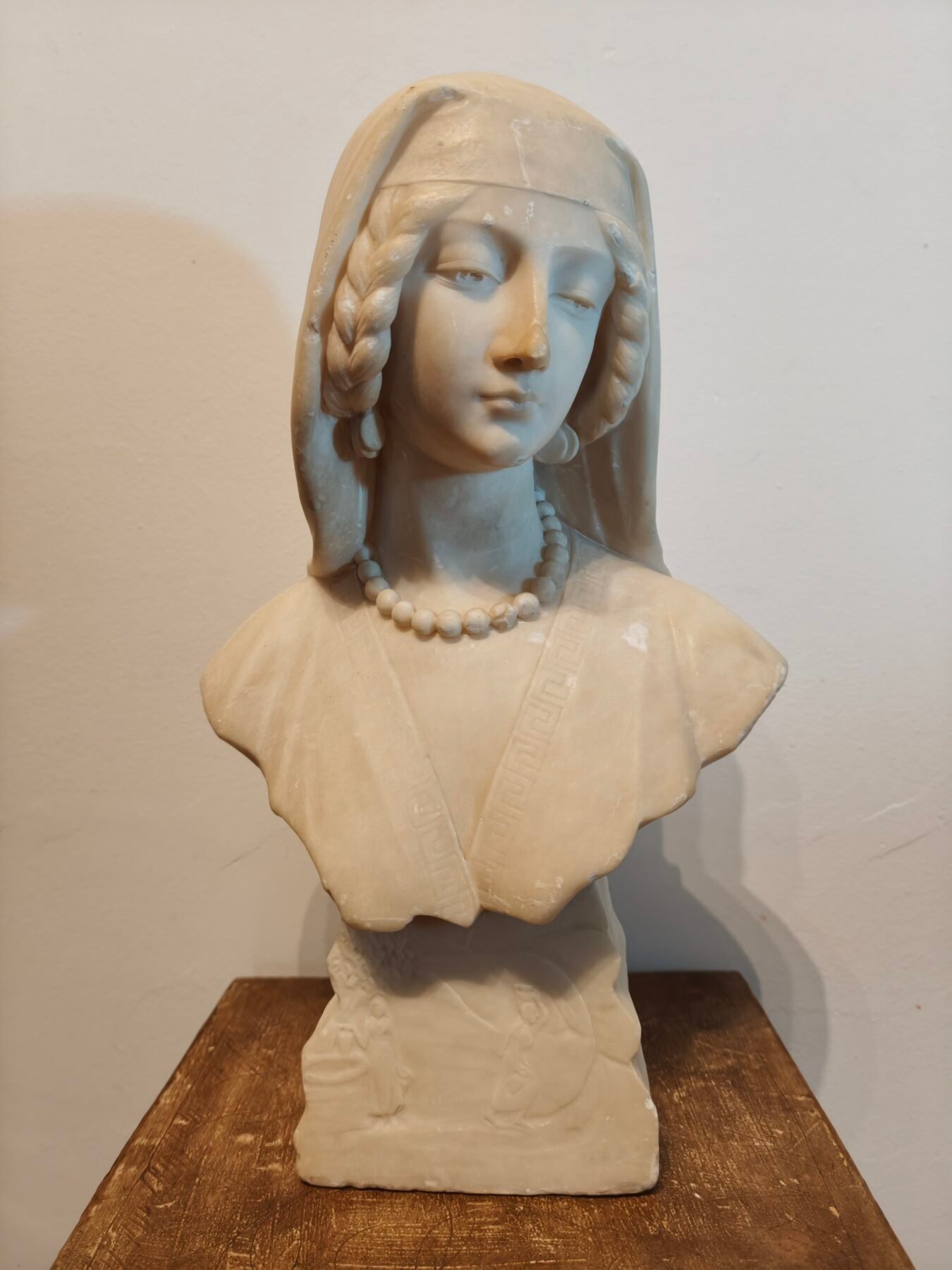
Idealized Tuscan Neo-Renaissance female bust
5.000 €
This sublime 41 cm high idealized white marble bust, incisively signed by the noted Italian sculptor Giovanni Paganucci (1827–1888/89), represents a masterly document of romantic academism and Tuscan historicism from the second half of the 19th century. Born in Livorno and trained at the prestigious Accademia di Belle Arti di Firenze under the guidance of leading Italian Neoclassical and Purist masters, Paganucci established an international reputation for his technical virtuosity in carving statuary marble. The artwork depicts a female figure of serene and melancholic grace, conceptualized within Tuscan Neo-Renaissance aesthetics and drawing inspiration from the Florentine Quattrocento; the young woman features hair dressed in thick braided coils framing her face, covered by a draped headscarf and adorned with a spherical bead necklace, while her mantle reveals a hem embroidered with geometric meanders carved in low relief. The execution of the pedestal base possesses extraordinary narrative and sculptural value, as Paganucci carves a delicate figurative low-relief onto its front face depicting two water bearers in a bucolic setting, seamlessly blending three-dimensional bust portraiture with classic relief carving. Bearing the autograph incised signature 'G. Paganucci' on the reverse, this piece exemplifies the artist's most sought-after cabinet production, whose mastery is held in institutions such as the Camposanto Monumentale in Pisa —housing his famous statue of Leonardo Fibonacci—, the Museo Nacional de Artes Visuales in Montevideo, the gardens of Villa Fabbricotti in Livorno with his 'Genio della Musica', alongside public monuments and monumental funerary sculpture in the Cimitero della Misericordia in Livorno.
TechniqueMármol tallado
Dimensions41cm
Year1870-1880
ArtistPAGANUCCI, Giovanni
PAGANUCCI, Giovanni
Giovanni Paganucci (Livorno, 1827 - Montevideo, 1889) was a prominent 19th-century Italian sculptor, linked to academicism and the beginnings of sculptural realism in his country. He trained at the Royal Academy of Fine Arts in Florence. During his youth in Florence (around 1855), he shared a studio and forged a deep friendship with key figures of 19th-century Italian painting such as Giovanni Fattori and Giovanni Boldini. Beginning in 1873, he started teaching at the Florentine Academy, an institution where he was appointed resident academician and where he consolidated his professional reputation. In his final years, he traveled to Latin America, settling in Montevideo (Uruguay), where he worked as a teacher at the local academy and passed away in 1889 (some sources place his death in late 1888). His style was characterized by the pursuit of naturalness and expressiveness, gradually moving away from strict classicism to embrace a detailed realism. Among his most notable works are: the sculptures for the facade of the Duomo of Florence: he was one of the first sculptors commissioned to work on the iconic facade of the Florentine cathedral, sculpting the reliefs of the Angels singing glory (circa 1872-1879) on the door jambs; the Statue of Leonardo Fibonacci (1861): located in the Camposanto Monumentale of Pisa; San Tommaso (1882): a statue destined for the Gallery of the Apostles; The Genius of Music: a sculpture located in the gardens of Villa Fabbricotti in Livorno; Busts and portraits: he created numerous commemorative and commissioned busts, such as those dedicated to John Peard, Carlo Poerio, and delicate female marble portraits.
Recommended works
Other selected pieces from the Art Andorra catalogue.