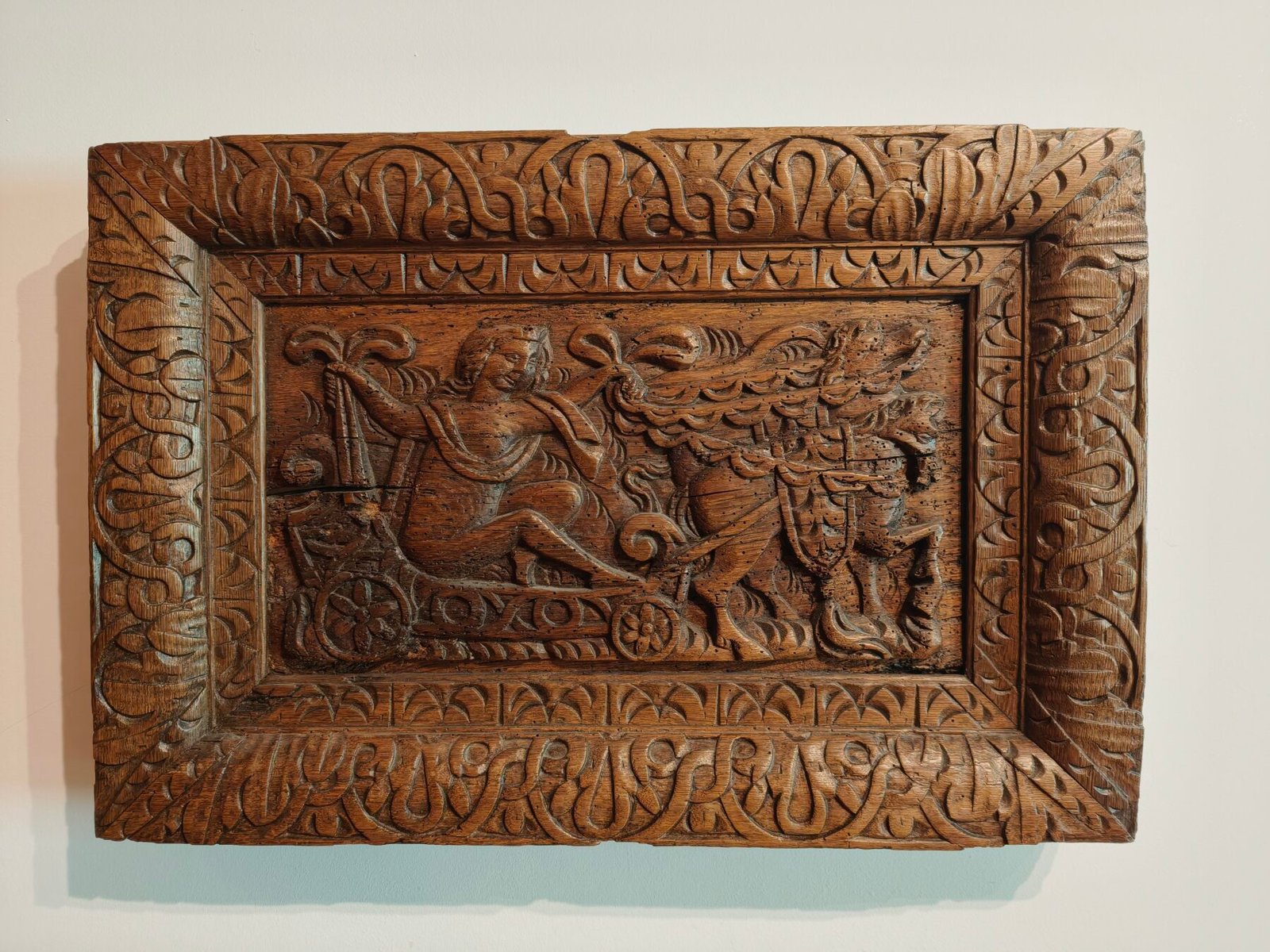
The Triumph of Apollo (circa 1580-1600)
12.000 €
An exceptional Italian cassone front panel in solid walnut (Juglans regia) attributed to the High Late Cinquecento or Mannerism (circa 1580–1600), executed through the direct technique of hand-gouge carving, hollowing, and roughing out, preserving the refined anatomical and formal vocabulary characteristic of the noble workshops of Central-Northern Italy. The piece demonstrates a plastic treatment of high sculptural complexity in the definition of the musculature, the dynamic drapery, and the expressive volumetric rendering of the face, achieved through fine V-bevel incisions and concave background strokes that bear witness to the mastery of hand-craftsmanship and rule out any mechanical intervention or subsequent re-carving. The surface retains a noble organic patina resulting from the natural oxidation of the wood and the centuries-old accumulation of waxes, along with the historical marks of its chronology, such as inactive wood-boring galleries and a perfectly stabilized radial shrinkage crack that fully respects the structural integrity of the main scene. Iconographically, the secular program of this masterpiece celebrates the Triumph of Apollo and Cosmogonic Harmony through the central depiction of the god playing the lyre, framed by delicate friezes of grotesques, phytomorphic motifs, and allegorical references that evoke order, classical virtue, and family concord, typical of the most exclusive bridal commissions of the Cinquecento aristocracy. This typology of relief and its distinctive Mannerist program align directly with surviving examples in the world’s most prestigious decorative arts institutions, drawing close stylistic and compositional parallels with the collections of the Victoria and Albert Museum in London, the Bargello National Museum in Florence, the Musée Émile Guimet / Musée de Cluny in Paris, and the Renaissance furniture collection of the Metropolitan Museum of Art in New York. The extraordinary quality of the relief, the richness of its humanist narrative, and the magnificent integrity of the panel render this piece a standalone cabinet work of the highest order and true museum quality.
TechniqueTalla a gubia en nogal macizo
Dimensions60x42cm
Yearcirca 1580-1600
ArtistAnónimo (Escuela Italiana)
Anónimo (Escuela Italiana)
Recommended works
Other selected pieces from the Art Andorra catalogue.