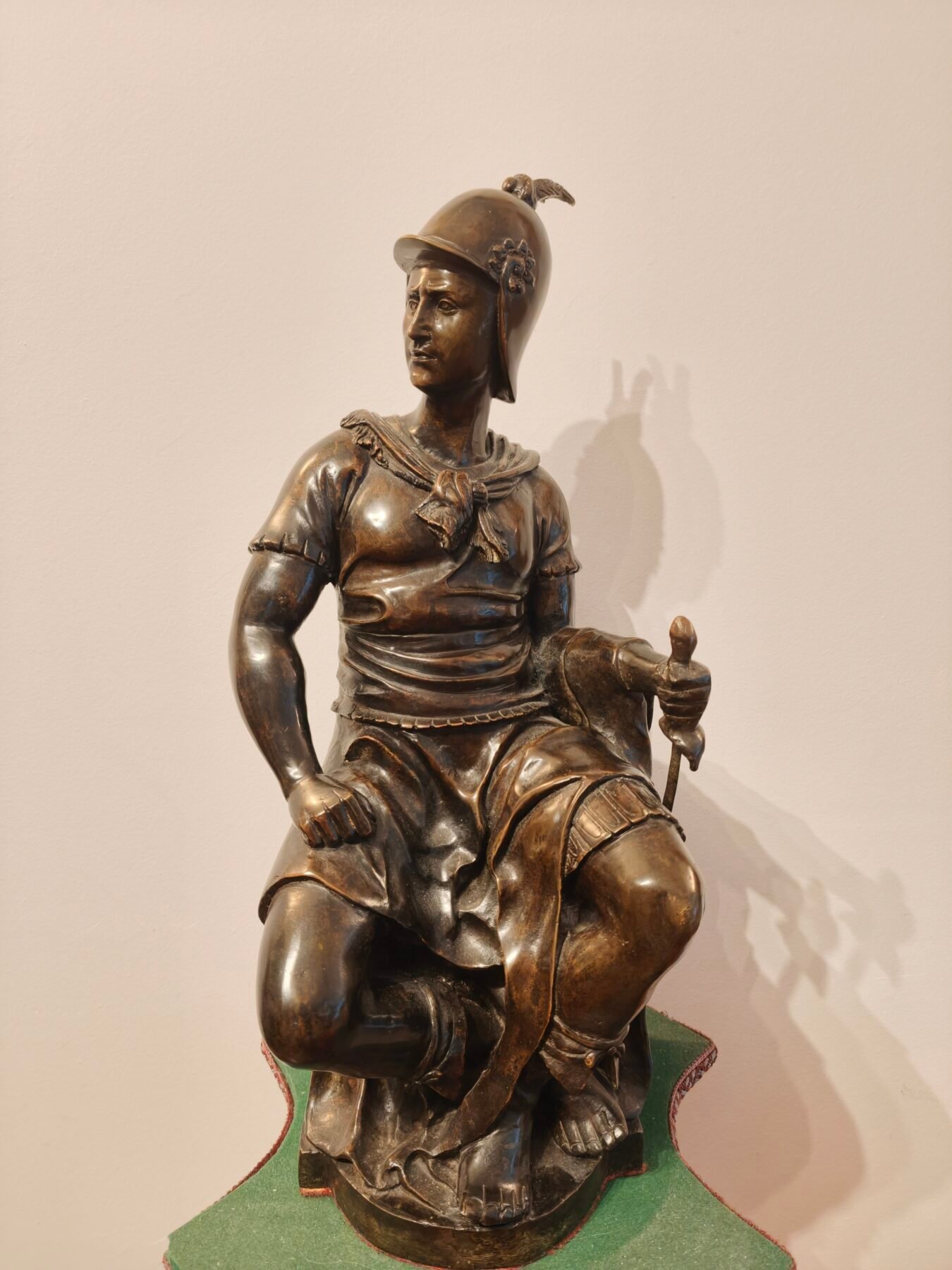
Military Courage
4.000 €
This 60 cm bronze version of Military Courage (circa 1880–1900), attributed to the prestigious Parisian foundry Ferdinand Barbedienne after the celebrated model by Paul Dubois (1829–1905), represents one of the highest achievements of nineteenth-century French academic sculpture produced for large-format collecting. Originally conceived as the iconic monumental figure for the cenotaph of General Lamoricière in Nantes Cathedral, this allegory of valor and temperance achieved such public veneration that full-scale monumental outdoor versions were erected in iconic locations including the Place de la Trinité in Paris and the gardens of the Musée des Beaux-Arts in Troyes, as well as prominent casts held in leading international institutions such as the Musée d'Orsay in Paris and the Ny Carlsberg Glyptotek in Copenhagen. The present cast utilizes the renowned system of réduction mécanique patented by Achille Collas and exclusively exploited by the Maison Barbedienne, a process of mathematical precision that allowed the sculptural presence and anatomical rigor of public monuments to be translated to the intimacy of the private cabinet with absolute fidelity. The piece displays masterly chasing in the details of the Roman armor, the dynamic folds of the tunic, and the serene structure of the face, enhanced by a warm brown bronze patina rich in metallic highlights, an unmistakable hallmark of the finest late nineteenth-century foundries. The exceptional scale of 60 cm—substantially larger than standard domestic reductions—combined with its fine cast lineage, imposing physical presence, and direct stylistic connection to the great public monuments of European capitals, firmly establishes this piece as a museum-grade work of the highest caliber within the international market for historic sculpture.
TechniqueFundición en bronce a la cera perdida
Dimensions60cm
YearCirca 1880–1890
ArtistDUBOIS, Paul
DUBOIS, Paul
Paul Dubois (Nogent-sur-Seine, 1829 - Paris, 1905) was a prominent French sculptor and painter, considered one of the most influential figures of academicism and the Neo-Florentine movement in French sculpture during the second half of the 19th century. Although he initially began studying law under family pressure, he soon abandoned the legal profession to dedicate himself to art. He trained in Paris under the tutelage of sculptor Armand Toussaint and undertook study trips to Italy, where he became deeply fascinated by Italian Renaissance art (especially Donatello and the Florentine masters), an influence that would mark his entire career. He debuted at the Paris Salon in 1860, quickly winning recognition from both critics and the public. He was awarded the medal of honor at the 1865 Salon thanks to his works The Florentine Singer and Narcissus. He was a figure of great power within the French institutional art world. He served as a professor at the prestigious École des Beaux-Arts in Paris and, starting in 1878, held the position of director of the National School of Fine Arts. Additionally, in 1873 he was appointed curator of the Luxembourg Museum. In 1876, he was inducted into the Academy of Fine Arts (French Academy). His style combined the technical precision of academicism with formal elegance and a deep lyricism inspired by the Italian Quattrocento. Among his most celebrated works are: The Florentine Singer (1865): one of his most famous sculptures, which personifies the Neo-Florentine aesthetic and earned him international fame; Monument to General Lamoricière (Nantes Cathedral): a monumental funerary sculpture ensemble considered one of the peaks of 19th-century French monumental sculpture; Joan of Arc (1889): his celebrated equestrian statue of the French heroine, made of bronze and installed in Saint-Augustin Square in Paris (as well as other notable replicas, such as the one in Reims).
Recommended works
Other selected pieces from the Art Andorra catalogue.