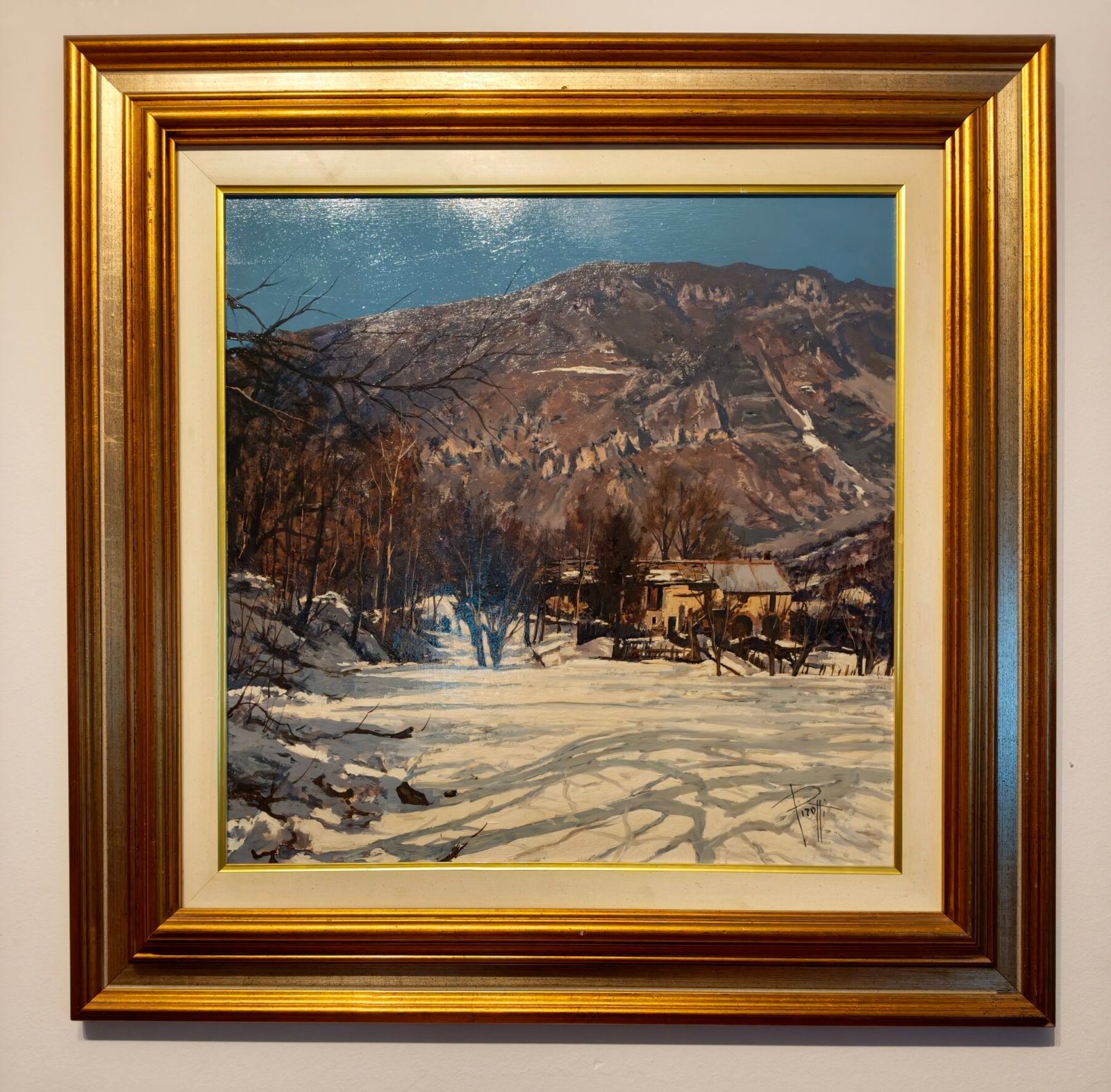
In the Vermenagna Valley
2.000 €
This imposing 73 x 73 cm oil on panel titled 'In Val Vermenagna', created by Carlo Pirotti (Turin, 1938) circa 1992–1993, represents a masterpiece in the depiction of the Piedmontese alpine winter landscape. Pirotti masterfully captures the geographical setting of the Vermenagna Valley in the province of Cuneo, conveying the restrained majesty of the mountain range under the crisp clarity of winter air. The composition structures a compelling dialogue between the foreground covered in fresh snow—where projected shadows in blue and violet tones reveal absolute mastery over color and tactile perspective—and the formidable rocky massif rising in the background bathed in low-angled light. His brushwork is energetic, impastoed, and confident, merging the structural poise inherited from his background in draftsmanship with the lyrical freedom of 19th-century Piedmontese verism and echoes of the Rivara School. The treatment of traditional mountain homesteads nestled within winter foliage invokes a profound sense of contemplative peace, aligning with the poetic vision of nature celebrated by critical scholarship. Encased in an elegant golden frame with a light inner mat, this artwork highlights the artist's mature period in Madonna dell'Olmo and matches the technical caliber of his works preserved in Piedmontese civic institutions, municipal galleries in Cuneo, and prestigious private and corporate collections across Italy, France, and Switzerland.
TechniqueOil sobre madera
Dimensions73x73cm
Year1992-1993
ArtistPIROTTI, Carlo
PIROTTI, Carlo
Carlo Pirotti (Turin, 1938) embodies the landscape and printmaking tradition of the Piedmont region of Italy, receiving his early technical training in the graphic arts as an apprentice lithographer until his decisive meeting in 1950 with the renowned master Enrico Tovagliari, under whose mentorship he refined drawing and lithographic techniques to earn an advanced diploma in the discipline. Following this period of graphic rigor, Pirotti turned his focus to drawing, oil painting, and engraving, launching a fruitful series of solo exhibitions across Italy in the 1960s and forming the artistic group "I Tre" in the 1970s alongside painters Alfredo Ciocca and Dino Pasquero, a prominent alliance with European reach that exhibited in several continental capitals. Drawing his figurative vocabulary from the rich 19th-century Piedmontese landscape tradition—showing clear influences from the Rivara School, the lyrical verism of Antonio Fontanesi, and the mastery of atmospheric light of Lombard masters—his painting combines refined draftsmanship with a poetic brushstroke of rich tonal modulation. Settling in his mature period in the tranquil town of Madonna dell'Olmo, in the province of Cuneo (Piedmont), the artist found the ideal sanctuary to consolidate an iconic plastic vision centered on alpine vistas, serene seascapes, intimate still lifes, and Piedmontese valleys—a body of work that professor and critic Antonio Dogliani defined as a poetic invitation to the contemplative revaluation of nature. Backed by extensive institutional support and critical acclaim, Carlo Pirotti's artistic heritage extends beyond the regional Italian scope, holding a place in the collections of various civic institutions, municipal galleries, and public holdings across Piedmont and northern Italy—such as the art collections of the Municipality of Cuneo and the Province of Turin—as well as prestigious private collections, banking foundations, and select collectors' holdings across Italy, France, Belgium, Switzerland, and other European countries.
Recommended works
Other selected pieces from the Art Andorra catalogue.