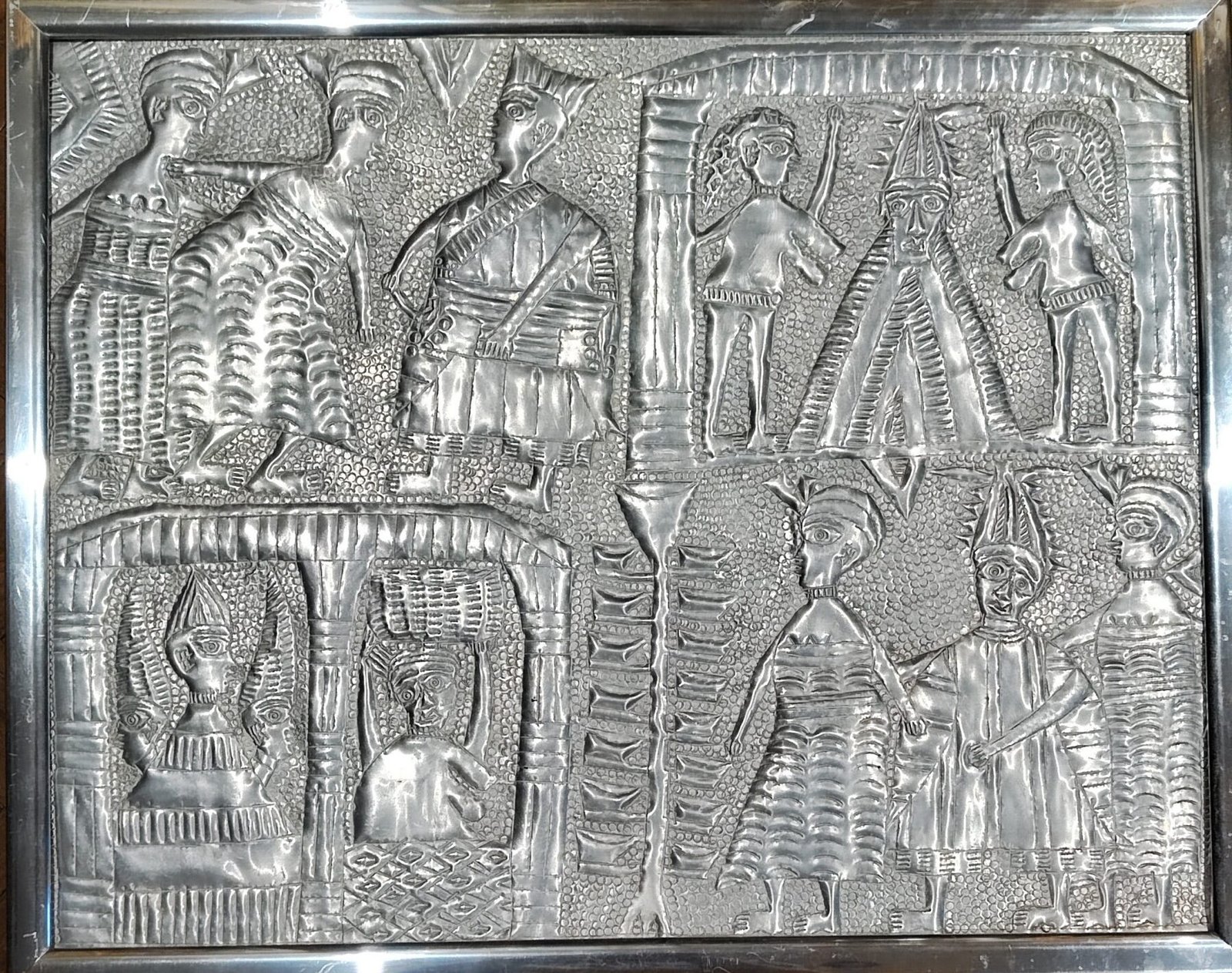
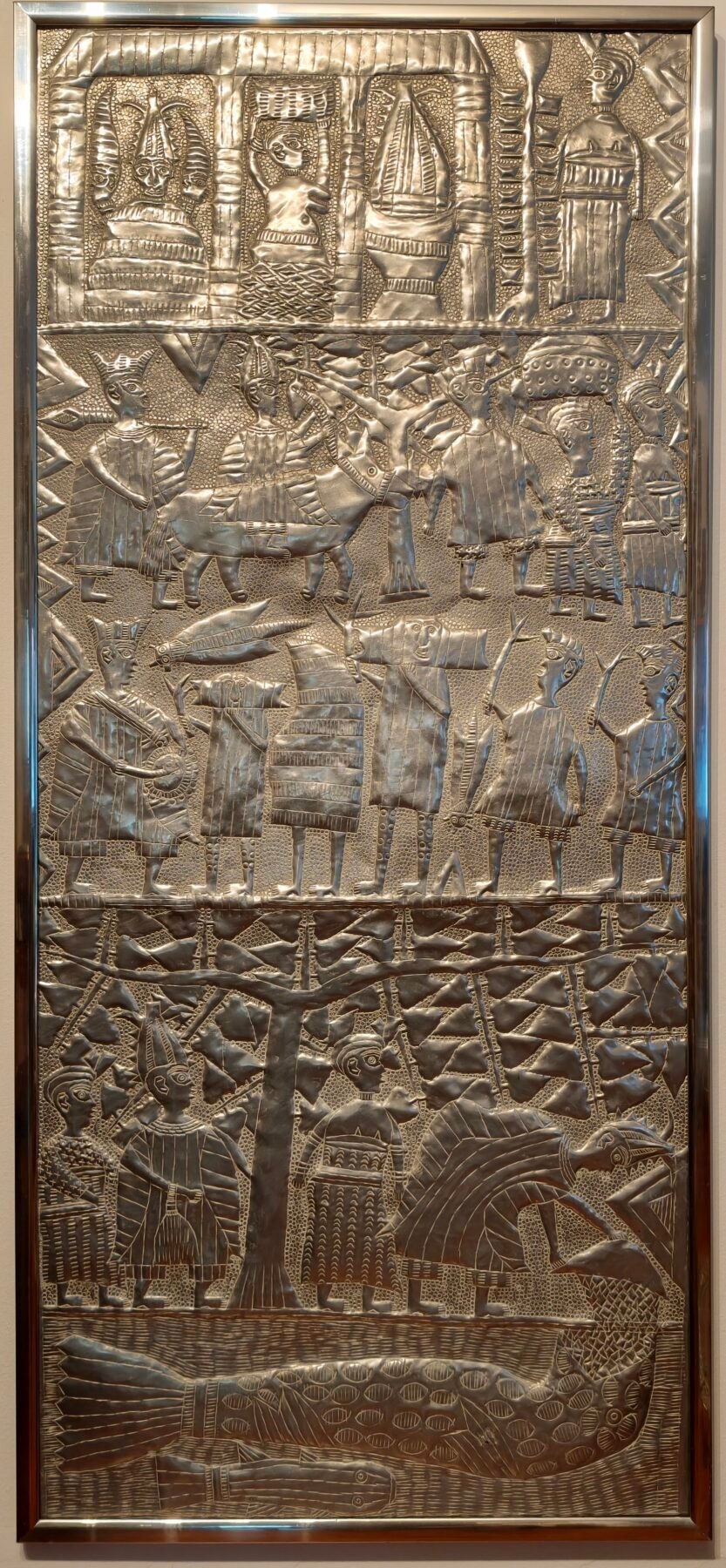
Offering to the river goddess Oshun
12.000 €
This monumental and masterly embossed relief on a 123 x 56 cm aluminum panel, titled "Offering to the river goddess Oshun" and signed by the distinguished Nigerian artist Asiru Olatunde (1918–1992), stands as one of the visual pinnacles of the Osogbo contemporary art movement, preserved in pristine condition and impeccably framed with a silver-finish molding that subtly complements the reflections and organic texture of the hammered metal. His crucial discovery in the early 1960s by the renowned German scholar, playwright, and cultural promoter Ulli Beier alongside artist and protector of Yoruba heritage Suzanne Wenger —who radically transformed the trajectory of modern African art by founding the legendary Mbari Mbayo Club in Osogbo— marked the decisive turning point that led Olatunde to channel his ancestral mastery of metal hammering into the creation of intricate narrative reliefs on copper and aluminum sheets, instantly positioning him as the foundational figure of the Osogbo movement. Given its exceptionally large scale and the compositional technical maturity displayed across multiple superimposed horizontal registers, the piece can be dated with absolute certainty between the late 1960s and the 1970s, the artist's peak creative period during which he executed his most ambitious public and institutional commissions. Stylistically, the work is a triumph of Yoruba visual storytelling, seamlessly blending his people's mythical worldview with a boldly modern compositional language, wherein the artist repoussés ritual scenes with a hypnotic dynamism enhanced by meticulous geometric stippling in the background to yield vibrant light and tactile effects; in this specific relief dedicated to Oshun —the revered orisha deity of fertility, fresh waters, and love within the Yoruba pantheon, and patron guardian of Osogbo and the sacred Osun-Osogbo Grove inscribed as a UNESCO World Heritage site—, Olatunde structures a devotional procession of worshippers, musicians, and priests bearing offerings toward the sacred waters, personified in the lower register through stylized fish motifs and river deities, all imbued with the figurative hierarchy, expressive frontality, and symbolic schematism characteristic of traditional Yoruba sculpture. Asiru Olatunde's international stature and the corresponding appreciation of his work across major auction houses stem from his status as a pioneer of 20th-century African art, with his masterwork panels housed in the permanent collections of world-renowned institutions including the Smithsonian Institution (National Museum of African Art in Washington D.C.), the British Museum in London, the Tropenmuseum in Amsterdam, IWALEWAHAUS at the University of Bayreuth, and the prestigious Jean Pigozzi Collection, solidly reinforcing the immense commercial, historiographical, and museum-grade value of this extraordinary original monumental panel.
TechniqueRelieve en repujado y cincelado sobre panel de aluminio martillado
Dimensions123x56cm
YearCirca 1970
ArtistOLATUNDE, Asiru
OLATUNDE, Asiru
Asiru Olatunde (Osogbo, Nigeria, 1918–1993) was a distinguished sculptor, metalworker, and foundational figure of modern Nigerian art, internationally celebrated as one of the cornerstone artists of the Osogbo Art Movement (Osogbo Art School). Born into a prominent family lineage of Yoruba blacksmiths and metalsmiths, he mastered traditional metallurgy under his father and grandfather while learning the art of the ceremonial talking drum for local rituals. In the late 1950s, a severe illness prevented him from continuing heavy blacksmithing, prompting him to pivot toward delicate jewelry crafting. His artistic talent was discovered in 1961 by cultural patrons Ulli Beier and Susanne Wenger, who encouraged him to expand into monumental sculpture. Olatunde revolutionized African contemporary art as the first artist to adopt hand-hammered repoussé aluminum sheets as his primary plastic medium, originating a signature technique of chiseled textures and punched dot patterns that depicted Yoruba mythological narratives, biblical lore, and everyday genre scenes. Appointed the first president of the Osogbo Artists Association in 1967, his work achieved vast global recognition within high-end collecting circuits. His monumental relief panels were commissioned for prestigious public and civic landmarks, including the King’s Market in Osogbo, St. Peter’s Cathedral in Enugu, and the Central Bank of Nigeria in Lagos, while joining major permanent collections at institutions such as the Smithsonian National Museum of African Art in Washington, D.C., the International Monetary Fund (IMF), the British Museum in London, and the Newark Museum.
Works
More works by this artist
Pieces related to the same artist.