River Deveron (Banff)
2.800 €
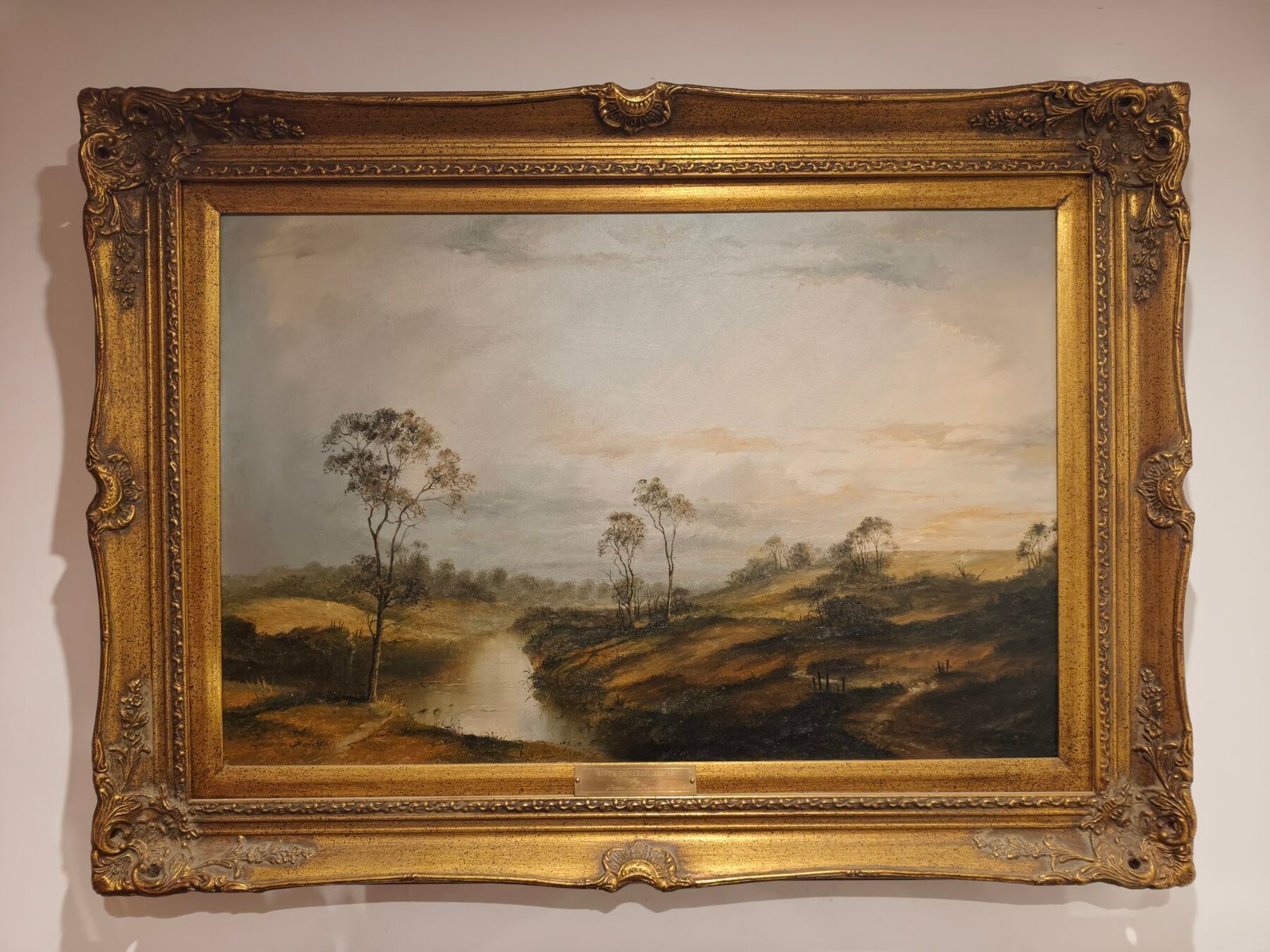
This monumental oil on canvas (96 x 70 cm), titled River Deveron, Banffshire and signed by Peter M. Drewett, represents one of the most mature, poetic, and masterful expressions of late 20th-century British neo-romantic landscape painting, standing as a truly exceptional piece within the artist's oeuvre. Centered on the lyrical topography of the River Deveron as it flows through the historic county of Banffshire—the precise geographical heart of northeastern Scotland where Drewett established his studio after consolidating his calling—the canvas transcends mere naturalistic record to become a meditative elegy on space, time, and Atlantic light. The composition is structured through a classical framework of clear tonalist and romantic lineage, a direct heir to the British tradition of John Constable, Joseph Mallord William Turner, and the 17th-century Dutch school of Jacob van Ruisdael, where the riverbed acts as a serene diagonal guiding the viewer's gaze toward a broad horizon submerged in a twilight sky of extraordinary painterly complexity. Striking is the technical mastery with which Drewett renders the atmospheric mass and sifted mist, applying successive layers of oil glazes to achieve a luminous transparency that appears to emanate from the very depths of the canvas, contrasted against the meticulous, organic execution of the foreground foliage and the golden hills lining the riverbank. The chromatic treatment, dominated by a refined palette of raw and burnt Siennas, warm ochres, deep greens, and ashen nuances across the leaden sky, demonstrates a direct study from nature and a superlative ability to capture the intimate, shifting atmosphere of Gaelic geography. The work's monumental scale, substantially larger than the artist's conventional easel formats, together with the presence of the historic gilded baroque-moulding frame and the commemorative catalog plaque, endows the piece with a dazzling institutional presence. The convergence of its regional topographic value, its classical technical virtuosity, and the prestige derived from the patronage of H.R.H. Princess Margaret, sister of Queen Elizabeth II of England, as his principal patron, sustains with absolute authority and market rigor the distinguished position of this work within the high-end international circuit and specialized collecting market.
TechniqueOil sobre tela
Dimensions96x70cm
Year1991
ArtistDREWETT, Peter M.
DREWETT, Peter M.
Peter M. Drewett (Kent, United Kingdom, 1957) stands as one of the most solid and highly sought-after names within contemporary British neo-Romantic landscape and atmospheric painting, establishing himself as a true master of the topographical representation of the Scottish Highlands. Born in the county of Kent, in 1971 he moved with his family to Scotland—a biographical turning point where the visual impact of the Gaelic geography awakened a painterly vocation defined by a rigorous study from nature and an exceptional mastery of Atlantic light. Fascinated by the geological monumentality of the Great Glen—the imposing fault line stretching over 100 kilometers that forms the spine of the Scottish glens from Inverness to Fort William—Drewet devoted his oeuvre to capturing the poetic essence, shifting light, and transient mists of this sacred land, consolidating an aesthetic vision of immense visual magnetism. In 1981, he formalized his professional career by opening his own studio and exhibition gallery in northeastern Scotland, a space that rapidly became a hub for international collectors. Far removed from mass production, the artist works through a painstaking layer-upon-layer process that demands extended execution periods, endowing each canvas with the status of a highly scarce and technically delicate unique piece. This exacting formal standard has driven his global reach: his works have been exhibited on traveling shows from Australia to the Americas and currently grace the holdings of prestigious galleries, private foundations, and corporate and institutional collections across Spain, Andorra, England, the United States, and Japan. The masterful convergence of classic technical virtuosity, the scarcity of his annual output, and a constant presence in the most exclusive private and institutional collections across five continents fully substantiate the premium market positioning of his artwork in the international art trade.
Recommended works
Other selected pieces from the Art Andorra catalogue.