
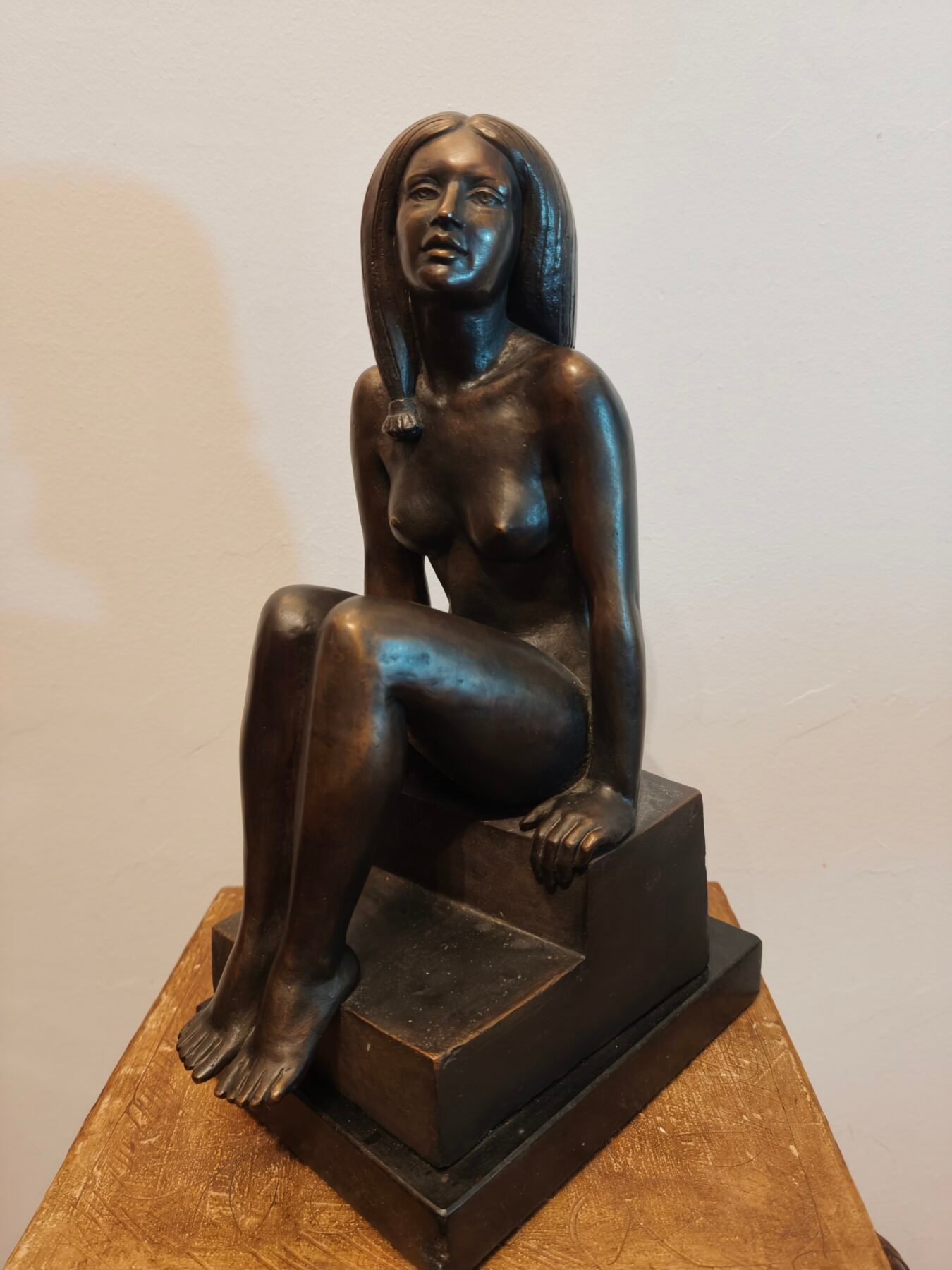
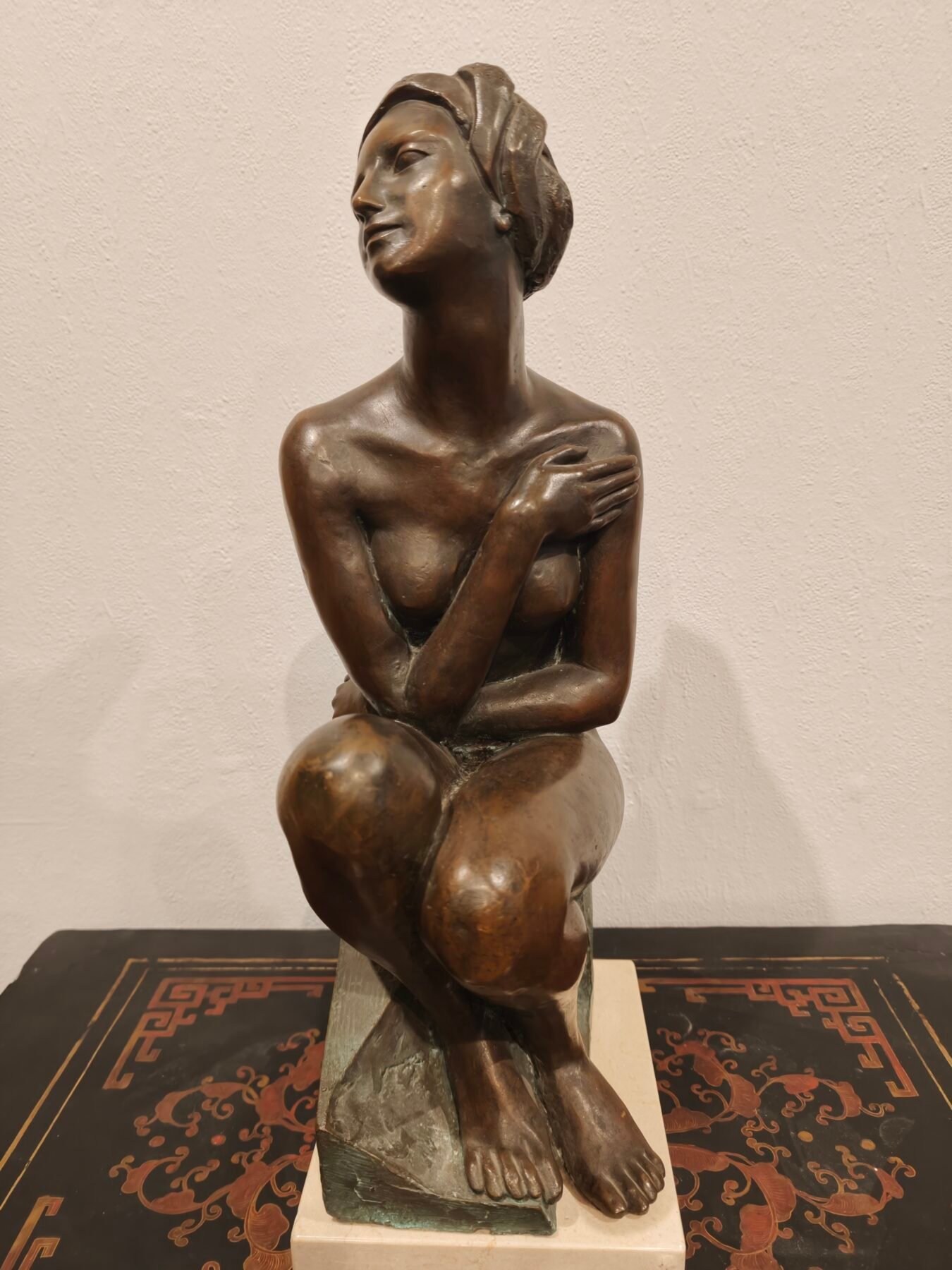
Roxana
3.800 €
The refined freestanding solid bronze sculpture entitled "Roxana" (c. 1991-1992), executed by the renowned international sculptor and researcher Ció Abellí (Girona, 1963; born Ció Xiaohui Abellí Pujiula), represents an exemplar of singular beauty, formal synthesis, and plastic rigor within late 20th-century contemporary figurative production; standing 51 cm high mounted on a light marble base, this highly sought-after work belongs to an ultra-limited edition of just six casts, this specific piece being number 3/6, incised-signed by the artist (Ció Abellí) and conceived through the refined lost-wax bronze casting technique with a patina of brown, satin tones and subtle greenish patinas on the rocky base that highlight the organic reliefs of the material. The composition features the figure of a nude woman seated in a self-contained pose, her torso tilted, her serene face turned slightly upward, and her hand resting on her chest in a gesture of poetic introspection, serenity, and classical restraint that evokes a profound, timeless elegance; stylistically, the piece reflects a virtuous fusion of influences, synthesizing Mediterranean Noucentista classicism—reminiscent of Aristide Maillol and Enric Casanovas in its refined handling of sensuously rounded volumes—with the expressive elegance of late 19th and early 20th-century classicism as seen in Auguste Rodin or Josep Clarà, articulating clean lines and soft yet firm contours that engage with space through bodily containment. Conceived in all likelihood between 1991 and 1992 during the sculptor's period of full technical consolidation—prior to its immediate acquisition and entry into prominent private collections in 1993—this creation embodies the mastery of an artist holding a Doctorate in Fine Arts with extraordinary honors, trained at prestigious institutions in Girona, Barcelona, and China, whose public and studio works have been awarded in international competitions and exhibited across European and American art fairs and galleries, confirming this edition 3/6 of "Roxana" as a piece of exquisite aesthetic refinement and an asset of outstanding value for specialized collecting.
TechniqueFundición en bronce a la cera perdida
Dimensions51cm
Year1991/1992
ArtistABELLÍ, Ció
ABELLÍ, Ció
Concepció Abellí i Grau, artistically known as Ció Abellí (Girona, 1963; also registered as Ció Xiaohui Abellí Pujiula), is one of the most prominent and influential figures in contemporary Catalan figurative and monumental sculpture. Her artistic journey began with large-format drawing under the mentorship of the renowned Girona painter Josep Perpiñá, later enrolling at the Faculty of Fine Arts at the University of Barcelona, where she earned her degree specializing in Sculpture and completed her Doctorate with extraordinary honors, further enriching her background with a diploma from the Escola d'Art d'Olot and research residencies at the Central Academy of Fine Arts in Beijing, the Accademia di Belle Arti in Florence, and the University of Girona. During her academic training, she perfected her technical mastery as a pupil of the celebrated Catalan sculptor Ricard Sala (1915–2010), from whom she inherited anatomical rigor, mastery of volume, and the understated elegance of Mediterranean figurative classicism. Her stylistic language articulates an intimate, lyrical figurativism that synthesizes the legacy of Noucentisme—most notably masters such as Josep Llimona, Enric Clarasó, Aristide Maillol, and Enric Casanovas—with the restrained expressiveness of Auguste Rodin and the meditative serenity of Eastern lyricism. The central theme of her work focuses on the human figure, female anatomy, everyday allegories, poetic introspection, maternity, and respect for the natural environment, crafted through the traditional lost-wax bronze casting technique, terracotta, marble, stone, and resin. Since her first solo exhibition in 1987, her small and medium-format sculptures have been showcased in galleries and art fairs across Spain, France, and the Principality of Andorra, combining studio work with a prolific career in monumental public art and institutional integration; among her most iconic projects are the famous Monument to Ava Gardner (Tossa de Mar, 1998) in the Vila Vella, the Monument a la pagesa (Gavà, 2003), the La Dona de l'Aigua monument (Cassà de la Selva), the Solidaritat sculpture dedicated to Neus Català (Els Guiamets), the work Aigües termals (Caldes de Malavella, 2021), and the institutional bust of Agustí Riera i Pau at the Provincial Council of Girona, as well as commemorative monuments in Figueres, Olot, Pla de l'Estany, and the Balearic Islands. Awarded in several international competitions and maintaining a continuous teaching career in municipal art schools across the province of Girona, her work is held in prominent museum holdings, institutional collections, and public spaces that attest to the contemporary projection and enduring significance of her sculptural language.
Works
More works by this artist
Pieces related to the same artist.