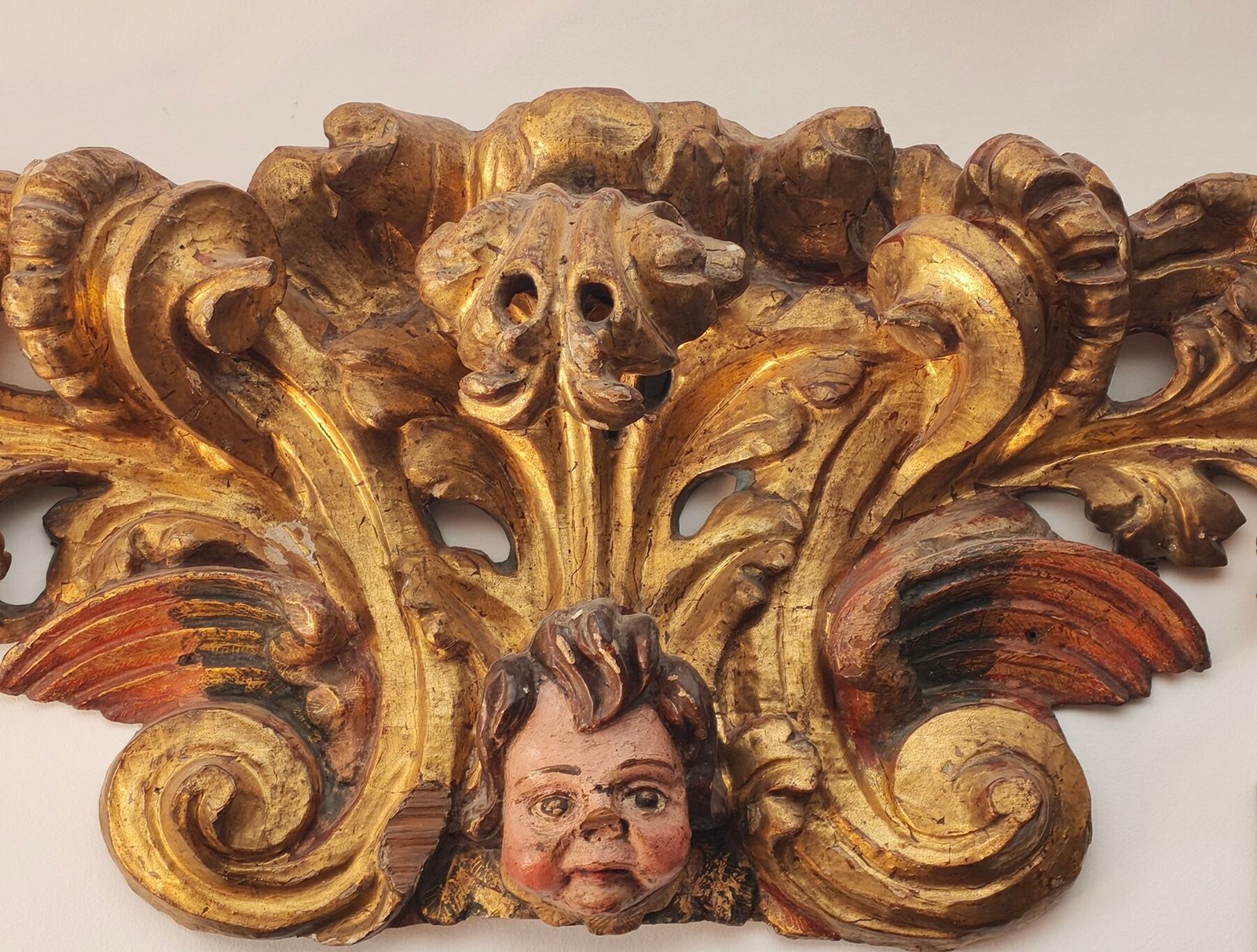
Baroque altarpiece crest (17th century)
7.500 €
Magnificent baroque altarpiece crest or pediment in carved, gilded, and polychrome wood, attributed to the Catalan-Aragonese School, executed in the late 17th century (c. 1680–1690). Measuring 150 cm in width by 50 cm in height with significant tectonic depth, the piece served as the top crowning or cresting of a monumental altarpiece woodwork whose total height is estimated to have reached 5 meters. It stands out for its profuse ornamental arrangement featuring deeply carved curling acanthus leaves and large scroll volutes, delivering a pronounced dynamism and powerful chiaroscuro effects characteristic of the High Baroque. The lower central axis is presided over by the head of a cherub carved in the round with outstretched wings, whose oil carnation retains its original rosy tones, finely modeled facial features, and voluminous hair. At the top central crest sits an openwork cartouche with vegetal motifs, originally designed to hold rays or sacred emblems. Technically, the structure displays the traditional stratigraphy of high-period imagery, featuring a gesso ground, an underlying coat of red Armenian bole, and fine water-applied gold leaf. Natural wear to the gilded surface reveals the underlying red bole, endowing the piece with a valuable period patina. Sourced from a prominent private Andorran collection of sacred art, it remains in good condition, maintaining the structural soundness of the wooden support and the symmetrical cohesion of the design, with only minor edge wear and a small loss on the side of the angel's pedestal. Due to its scale, structural richness, and solid provenance, it represents a standalone piece of significant architectural and art-historical value.
TechniqueTalla de madera, dorada y policromada
Dimensions150x50cm
Year1680/1690
ArtistAnónimo (Escuela Catalano-Aragonesa)
Anónimo (Escuela Catalano-Aragonesa)
Recommended works
Other selected pieces from the Art Andorra catalogue.