
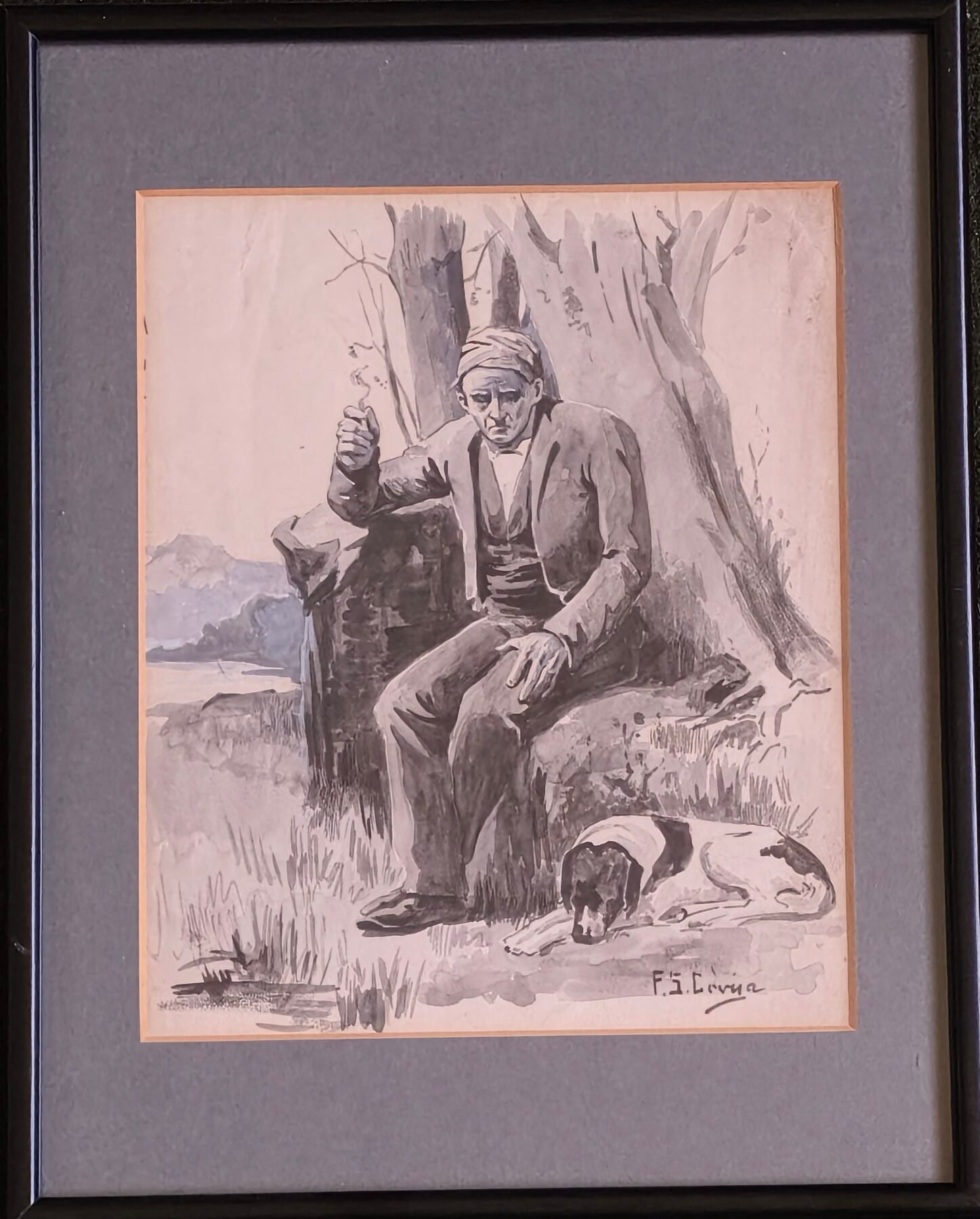
The Old Man and the Dog
450 €
This work on paper (33 × 26 cm) signed by Fernando Sánchez Covisa (1866–1938) constitutes an original illustration created for photomechanical reproduction in the illustrated press at the turn of the century. Executed through the grisaille technique (ink wash, monochrome gouache, and white pigment highlights on paper), the piece employs a rigorous tonal scale in grayscale optimized for the photogravure process. The composition, featuring a marked genre and regionalist character, portrays an elderly peasant seated outdoors next to the trunk of a tree, wearing a traditional headscarf and smoking a pipe, accompanied in the foreground by a hunting dog resting at his feet. In the background, a gentle rendering of a river or mountain landscape frames the figure, conveying an introspective and serene atmosphere. Stylistically, the work reflects the social realism and genre painting of the late 19th and early 20th centuries, evidencing the clear influence of naturalistic drawing from the Madrid academic school, as well as contemporary illustrators of the stature of Joaquín Sorolla, Ulpiano Checa, and Narciso Méndez Bringas. As a prominent figure in Spanish graphic illustration, Sánchez Covisa contributed regularly to the leading periodicals of the period, notably Blanco y Negro, La Ilustración Española y Americana, and Nuevo Mundo. The historical and artistic significance of his graphic output has led to the inclusion of his holdings and original matrix drawings in prestigious reference collections and institutions, including the National Library of Spain (BNE), the ABC Museum of Drawing and Illustration in Madrid, and the Museum of Romanticism.
TechniqueAguada de tinta y gouache sobre papel
Dimensions33x26cm
YearCirca 1898 – 1912
ArtistSÁNCHEZ COVISA, Fernando
SÁNCHEZ COVISA, Fernando
The Spanish painter, engraver, and illustrator Fernando Sánchez Covisa (Madrid, 1896 – 1986) is a prominent figure in press illustration and 20th-century Spanish figurative landscape painting; his artistic training took place at the Special School of Painting, Sculpture, and Engraving at the Royal Academy of Fine Arts of San Fernando in Madrid, where he acquired a refined technique in academic drawing, printmaking, and life oil painting; throughout his learning stage, he was taught by professors and mentors who were influential masters of the era, such as Cecilio Pla, Julio Romero de Torres, and Antonio Muñoz Degrain, who instilled in him mastery of figurative composition and rigor in the treatment of light; regarding his influences, his graphic and painterly language draws from the great tradition of classical Spanish printmaking, Madrid casticismo, late impressionist movements, and interwar Art Deco illustration styles; concerning his style, he cultivated canvas, etching, and ink on paper with equal fluency, standing out for an elegant, synthetic, and precise line, a remarkable sensitivity for portraiture and Castilian landscapes, and a prolific career as an illustrator for major periodicals of the era such as Blanco y Negro, ABC, and La Esfera; regarding the destination of his work and museum holdings, his creations form part of the collections of the ABC Museum of Drawing and Illustration, the National Library of Spain, the Municipal Museum of Contemporary Art of Madrid, as well as distinguished private and institutional collections dedicated to 20th-century Spanish illustration and figurative art.
Works
More works by this artist
Pieces related to the same artist.