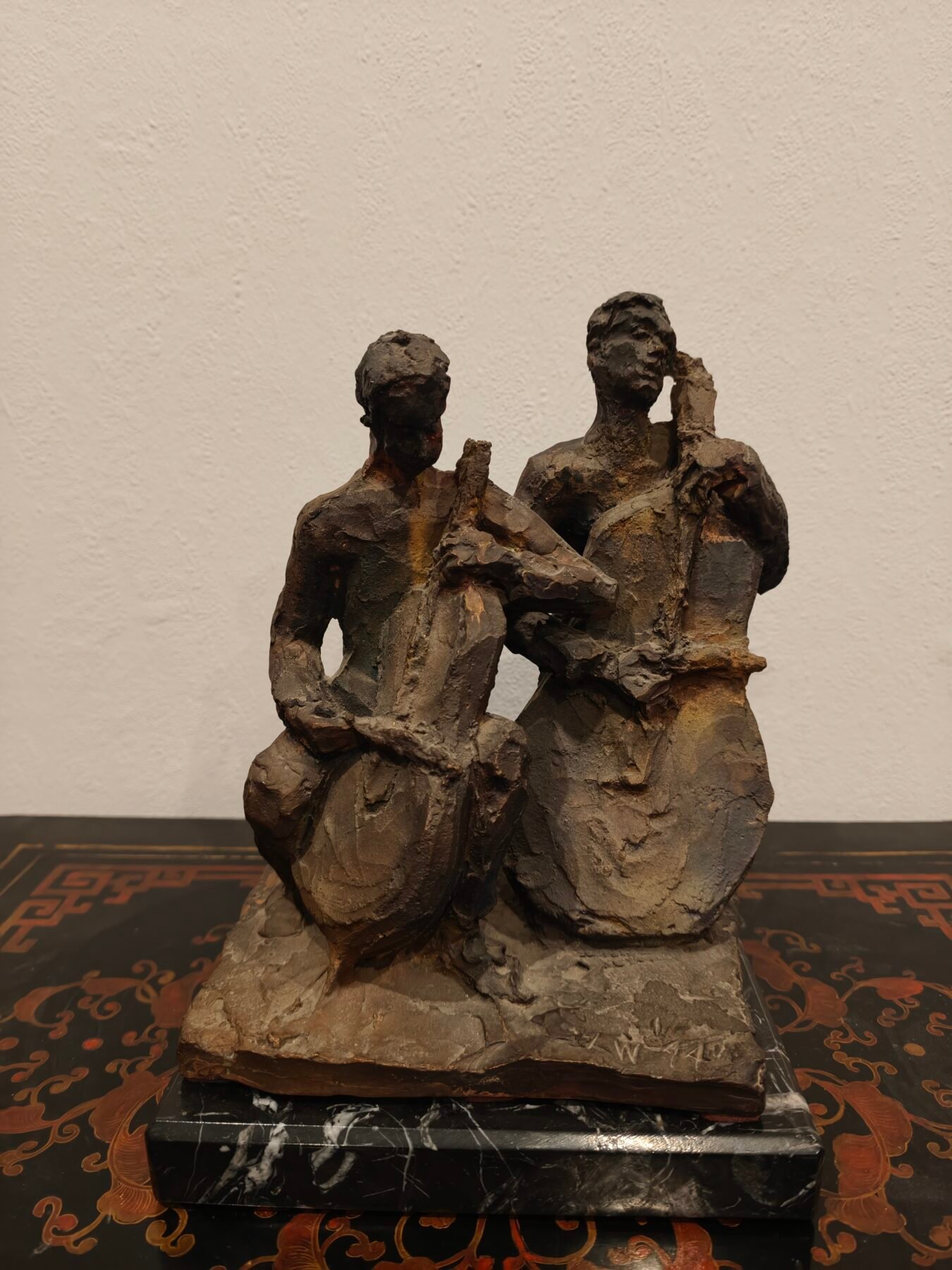
Cello Duo
3.200 €
The remarkable freestanding sculpture in cast bronze with a shaded finish and earthy polychromy entitled "Cello Duo" (c. 1996), created by the prominent Spanish-Dutch sculptor Carmina Wiegerinck (born Carmina Guillén y Jering in Madrid, 1947), constitutes a singular exemplar of late 20th-century expressionist figurative sculpture; measuring 28 x 20 cm mounted on an elegant black veined marble base, this work belongs to a short edition of just six casts (being in its direct modeling a piece with unique patina variations), signed on the bronze with the incised initials of the artist's mark (W) and numbered (4/6), attesting to the supreme lost-wax casting technique with which the artist works. The composition depicts two seated musicians playing the cello, articulating a evocative symbiosis between sculptural mass and musical rhythm through an eminently gestural, textural, and vibrant plastic language; stylistically, Wiegerinck displays clear influences of post-war European Expressionism, the formal solidity of Marino Marini, the textural modeling of Giacomo Manzù, and the imprint of Medardo Rosso's three-dimensional Impressionism, intentionally leaving visible the additive clay marks, hand fingerprints, and clean spatula cuts that catch the light and create a dynamic interplay of chiaroscuro across the surface. Trained at the Real Academia de Bellas Artes de San Fernando in Madrid and the Gerrit Rietveld Academie in Amsterdam, Carmina Wiegerinck's career spans over four decades of production in which she has stood out for her series dedicated to music, flamenco dance, and the human figure in motion, earning significant international acclaim that has led her work to be exhibited across art fairs, galleries, and private collections in Spain, the Netherlands, France, Germany, and the United States, as well as entering institutional holdings and public spaces such as the Museo de la Danza Española, European corporate collections, and various international monumental commissions, establishing this cast 4/6 as a work of exquisite plastic dynamism, musical rhythm, and high academic value for specialized collecting.
TechniqueFundición en bronce a la cera perdida
Dimensions28x20cm
YearCirca 1996
ArtistWIEGERINCK, Carmina
WIEGERINCK, Carmina
Carmina Guillén y Jering, artistically known as Carmina Wiegerinck (Madrid, 1947), is a prominent Spanish-Dutch sculptor, draftsman, and educator whose artistic career stands out for its profound exploration of movement, musical rhythm, and the human figure; introduced to the visual arts at an early age, she pursued her studies in drawing and modeling at the prestigious Real Academia de Bellas Artes de San Fernando in Madrid under the guidance of leading masters of the mid-20th-century Spanish academic scene, later expanding her higher education and mastery of European avant-gardes at the renowned Gerrit Rietveld Academie in Amsterdam, where she consolidated an international perspective fusing Iberian tradition with the formal rigor of the Central European school; stylistically, her artistic language falls within an eminently tactile, gestural, and vibrant figurative expressionism, bringing together the influences of Medardo Rosso's and Giacomo Manzù's textural modeling, Marino Marini's bold spatial presence, and the plasticity of contemporary Spanish sculpture, working primarily in lost-wax bronze casting, terracotta, direct plaster, and resin to bring to life celebrated thematic series dedicated to performing musicians, flamenco dancers, athletes, and deeply poetic nudes; across more than four decades of prolific teaching and creative endeavor, she has taught in workshops and art instruction centers in Spain and the Netherlands, combining pedagogy with a continuous presence in solo and group exhibitions across galleries and art fairs in Europe and the United States; the significance of her work is reflected in its presence in major institutional collections, international corporate holdings, and public art spaces, notably including representation in the Museo de la Danza Española, European cultural foundations, and prominent private collections in the Netherlands, Spain, France, Germany, and the United States, reaffirming her status as one of the most versatile creators in the plastic articulation of dynamism and music.
Recommended works
Other selected pieces from the Art Andorra catalogue.