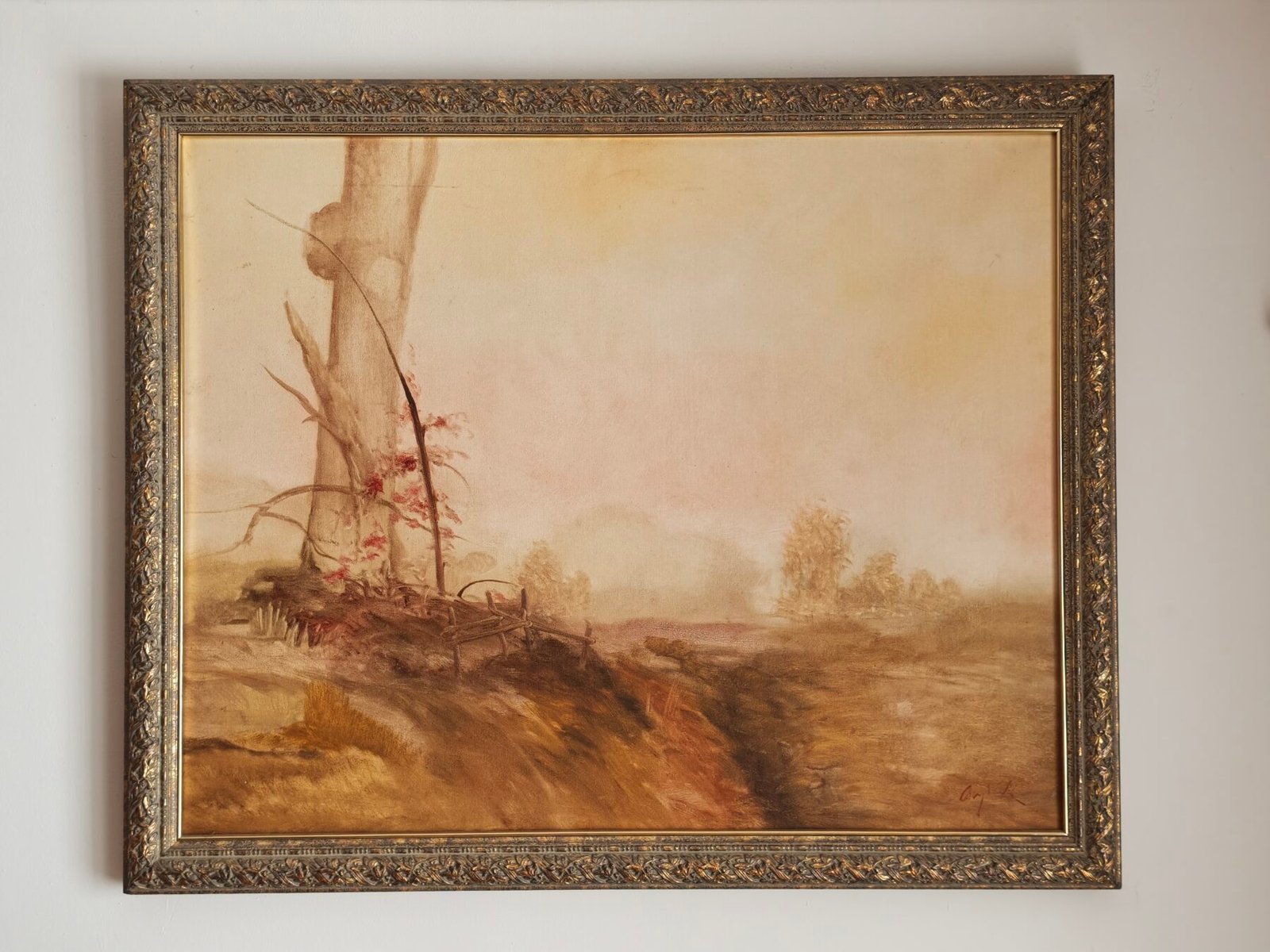
Ethereal Landscape (Lyrical Composition)
2.500 €
In this monumental and breathtaking large-scale composition measuring nearly a meter across, Robert Anglada reveals one of the most refined, rare, and sought-after facets of his entire artistic body of work, stepping away from his signature visceral expressionism to embrace a contemplative poetic style of extraordinary subtlety. The canvas stands as a triumph of technical virtuosity in which the Catalan painter pays explicit homage to the delicate aesthetic of traditional Japanese silk paintings and Oriental Nihonga art, organizing the compositional space through a misty, ethereal atmosphere charged with mystery and serenity. Demonstrating supreme mastery over infinite glazes, sepia washes, ochres, and warm pigments, Anglada fashions an enveloping fog where physical matter appears to dissolve, allowing the subtly modeled tree trunk and the delicate, calligraphic sweep of slender branches and reddish buds to emerge with the lyrical precision of an Ukiyo-e print. His profound command of the Oriental concept of spatial void (Ma) and the nuanced chromatic rendering of filtered ambient light elevate this canvas into a highly prized anomaly within the artist's output; a museum-grade masterpiece showcasing the versatility of a complete artist, whose timeless lyricism and commanding visual scale firmly justify a top-tier market valuation and solidify its status as a prized asset for fine institutional and private collections.
TechniqueOil sobre tela
Dimensions90x74cm
Year1992
ArtistANGLADA, Robert
ANGLADA, Robert
Born in Barcelona in 1944 and passing away in the same city in 2013, Robert Anglada stands as one of the most compelling, transgressive, and uncompromising figures in second-half 20th-century Spanish figurative painting, recognized by art historians as a vital contributor to the 1960s avant-garde. His precocious genius was recognized in 1962 when he was awarded the prestigious Young Artists Award in Barcelona, a accolade that earned him a study grant from the French Government to refine his painterly vision amidst the vibrant artistic climate of post-war Paris. That same year, his public debut caused a sensation when the work awarded at the Cercle Mayol of the Institut Français in Barcelona was censored and removed from the Barcelona Museum of Modern Art due to its erotic audacity and formal radicalism, an episode that permanently established his status as a cult figure of fierce artistic independence. Anglada’s artistic output explores the depths of the human psyche through a visceral deconstruction of perceived reality, wherein eroticism, cruelty, and psychological tension are rendered through dynamic, heavily impastoed brushwork and a powerful expressionist syntax that international critics have consistently equated with the tormented masterworks of Francis Bacon. Over a prolific career, he achieved extensive international recognition through major exhibitions in key art capitals including Paris, London, Barcelona, and numerous German cities, reaching exceptional global exposure by exhibiting as far as Kandahar, Afghanistan. This synthesis of aesthetic defiance, technical mastery, and international presence firmly establishes his oeuvre as a cornerstone of modern Spanish expressionism, commanding high valuation among discerning private and institutional collectors.
Recommended works
Other selected pieces from the Art Andorra catalogue.