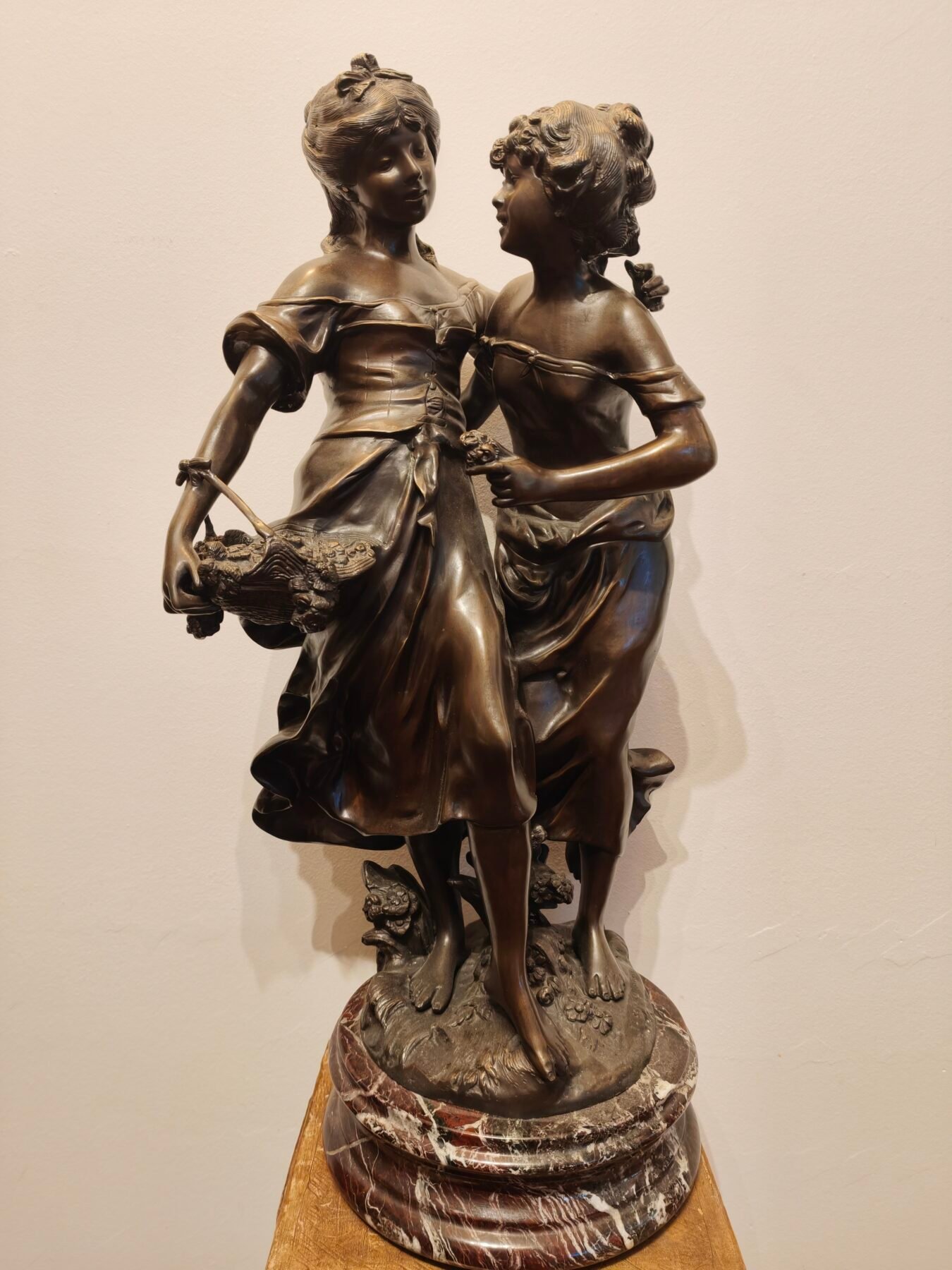
Return from the fields
5.000 €
This monumental and masterly bronze sculpture standing 73 cm tall, signed by the distinguished French master Auguste Moreau (1834–1917), represents one of the most ambitious and plastically refined bucolic creations from the French fin de siècle sculptural production, impeccably elevated upon a sumptuous circular carved veined-marble base that lends an imposing solidity and architectural elegance to the composition. Belonging to the celebrated Moreau dynasty of Dijon —where alongside his father Jean-Baptiste and his brothers Hippolyte and Mathurin he forged the most influential and prolific sculptural saga of 19th-century France—, Auguste Moreau stood out uniquely for his ability to imbue the human figure with graceful lyricism, fluid gesture, and delicate naturalism, marking the stylistic transition from Second Empire academic Romanticism to the sinuous organic forms of Art Nouveau. Titled *Retour des champs* ("Return from the fields"), the work unfolds a virtuoso dynamic composition featuring two young peasant girls clad in flowing drapery with expertly chased folds, whose endearing glances and shared gestures dialogue with the intricate floral basket they carry, showcasing an absolute mastery of botanical detail and bronze modeling with a period brown patina. Auguste Moreau's historiographical prominence is attested by the presence of his models and historical castings in the permanent collections of world-renowned institutions such as the Musée d'Orsay in Paris, the Musée des Beaux-Arts de Dijon, the Philadelphia Museum of Art, and the Museum of Fine Arts, Boston, an institutional and museum-grade endorsement that solidly underscores the extraordinary heritage value, the rarity of this monumental scale, and the unquestionable prestige of this collector's piece.
TechniqueFundición en bronce a la cera perdida
Dimensions73cm
YearCirca 1890
ArtistMOUREAU, Auguste
MOUREAU, Auguste
Auguste Moreau (1834–1917), one of the most eminent figures of the celebrated Moreau dynasty of sculptors from Dijon alongside his father Jean-Baptiste and his brothers Mathurin and Hippolyte, occupies an extraordinarily prominent place in the history of French and European sculpture of the second half of the 19th and early 20th centuries. Initially trained in the family workshop in Burgundy and later refined at the prestigious École des Beaux-Arts in Paris under the tutelage of the distinguished Neoclassical and Romantic master Aimé Millet, Moreau acquired a masterly command of anatomical modeling, delicate drapery, and lyrical sensibility. Following his virtuoso debut at the Paris Salon of 1861, where he exhibited continuously until 1910, his work gained rapid international prominence, crossing French borders to captivate major collectors in Great Britain, Germany, and the United States during the Universal Expositions. Particularly influenced by the poetic naturalism of Jean-Baptiste Carpeaux and the Rococo elegance of Étienne-Maurice Falconet, the artist forged a pivotal stylistic bridge between Second Empire academic classicism and the organic fluidity of Art Nouveau. Beyond his vast output of cabinet sculptures, Auguste Moreau contributed to notable monumental public projects, including the decoration of the iconic Hôtel de Ville in Paris following the events of the Commune and the design of fountains and commemorative monuments cast by the era's most prestigious art foundries, such as Val d'Osne and Barbedienne. The historiographical stature of his catalog is confirmed by the presence of his bronzes in the permanent collections of world-renowned institutions such as the Musée d'Orsay in Paris, the Musée des Beaux-Arts de Dijon, the Philadelphia Museum of Art, the Museum of Fine Arts in Boston, and the Victoria and Albert Museum in London, establishing his signature as one of the most sought-after, reliable, and valued among top-tier international collectors and major auction houses worldwide.
Recommended works
Other selected pieces from the Art Andorra catalogue.