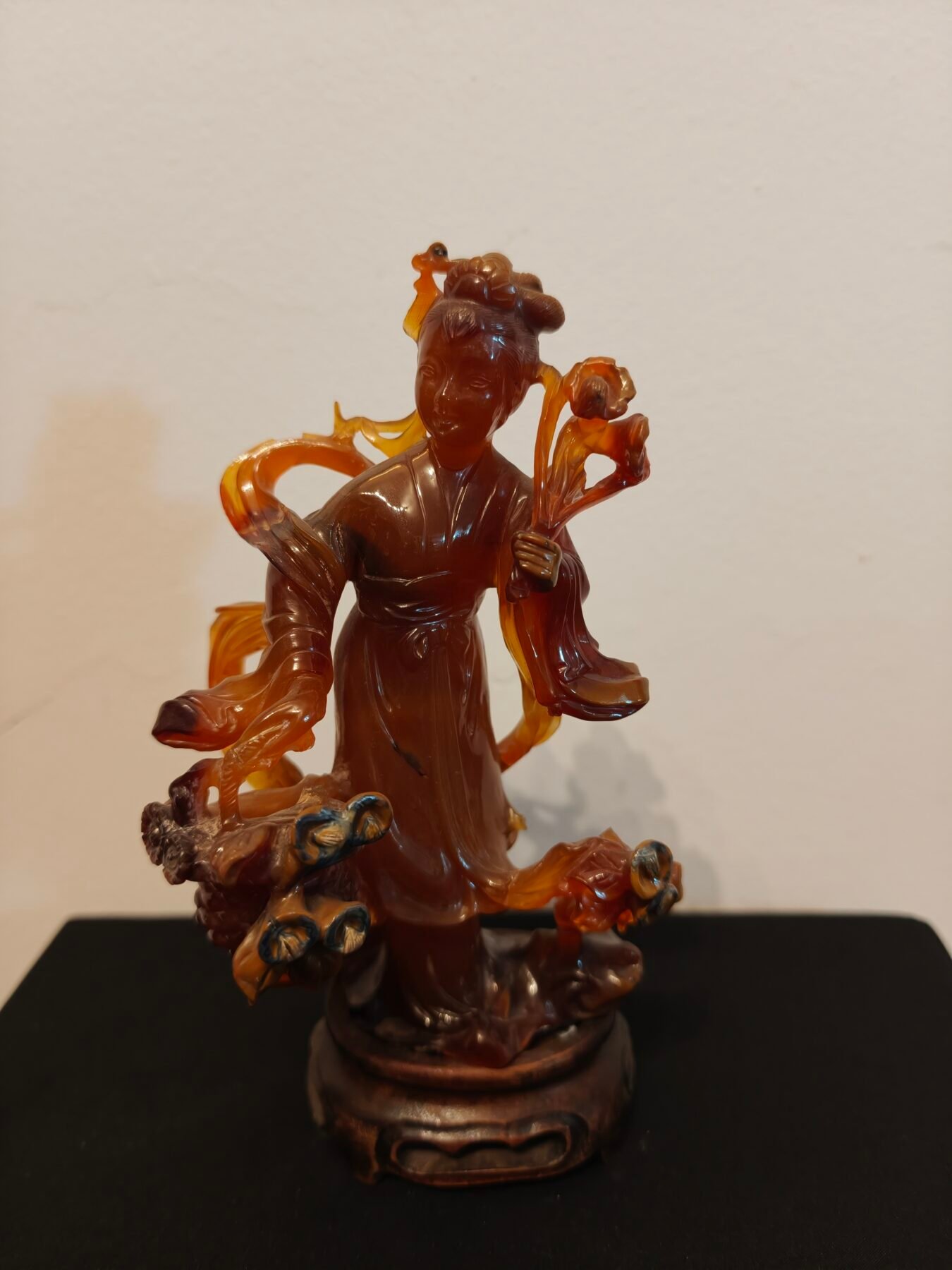
Chinese Carnelian Agate Openwork Sculpture of Guanyin
1.500 €
This extraordinary freestanding sculpture standing eighteen centimeters high, carved from carnelian agate (or brown/honey agate) on its original carved hardwood base, depicts the Chinese celestial maiden or deity Guanyin (or a Meiren / Immortal maiden) holding a flower basket and a lotus spray. The piece is distinguished by the master lapidary's skillful exploitation of the mineral's natural banding and hues: utilizing the translucent amber and orange-brown tones of the agate to carve the delicate features, high topknot adorned with a phoenix (fenghuang), and flowing robes with windblown ribbons (fei tian), while reserving the greyish-blue chalcedony inclusions to intricately undercut the blossoms within the basket. Iconographically associated with benevolence, purity, and prosperity, this carving exemplifies the supreme artistry of traditional Chinese hardstone carving. Dated to between the late Qing Dynasty (19th century) and the Republic Period (early 20th century), the sculpture perpetuates the centuries-old tradition of carving semi-precious stones for scholar's desks and connoisseurs' cabinets. Artworks of similar mineralogical quality and complex openwork are preserved in renowned collections such as the Palace Museum in Beijing (Forbidden City), the National Palace Museum in Taipei, the Victoria and Albert Museum in London, and The Metropolitan Museum of Art in New York. Its exceptional state of preservation, the vibrant natural beauty of the carnelian agate, and the masterly hand-carved detail elevate this antique to a prominent position in the international Asian art market.
TechniqueTalla directa manual en piedra semipreciosa (ágata cornalina)
Dimensions18cm
YearCirca 1880
ArtistCANTÓN, Escuela de
CANTÓN, Escuela de
The Canton School (Guangzhou) established itself during the Qing Dynasty (1644–1912) as one of the most influential and virtuoso hardstone and ivory carving centers in all of Asia. Strategically located in the Pearl River Delta, the city of Canton served as the sole authorized trading port for Chinese foreign commerce throughout much of the Qing period under the renowned Canton System, a unique position that enabled its artisans to blend age-old Oriental lapidary techniques with a nuanced understanding of Western tastes and luxury demands across Europe and America. Cantonese workshops reached their technical zenith in the late 19th century (c. 1880), distinguished by an exuberant decorative style marked by dramatic dimensionality, deep undercutting, and a masterly command of intricate openwork lattice, where Canton masters were celebrated for their extraordinary ability to transform tough minerals such as carnelian agate, chalcedony, and jade into dynamic, flowing compositions featuring windblown robes, floating ribbons (fei tian), and elaborate botanical details, highly prized today as pinnacle examples of Qing-era export craftsmanship. Representative historical exemplars of Cantonese lapidary carving—ranging from early 18th-century export carvings to 19th-century masterworks in carnelian agate, chalcedony, and jade—are preserved and researched within the Asian art departments of the world's most prestigious institutions, most notably at the Palace Museum in Beijing (Forbidden City) within its Qing Decorative Arts Division, the National Palace Museum in Taipei in its Department of Antiquities, the Victoria and Albert Museum in London in its Chinese Export Art Galleries, the Musée Guimet (Musée National des Arts Asiatiques) in Paris in its Chinese Sculpture Collection, The Metropolitan Museum of Art in New York in the Asian Art Department, and the Asian Art Museum of San Francisco in its Hardstone Cabinet.
Recommended works
Other selected pieces from the Art Andorra catalogue.