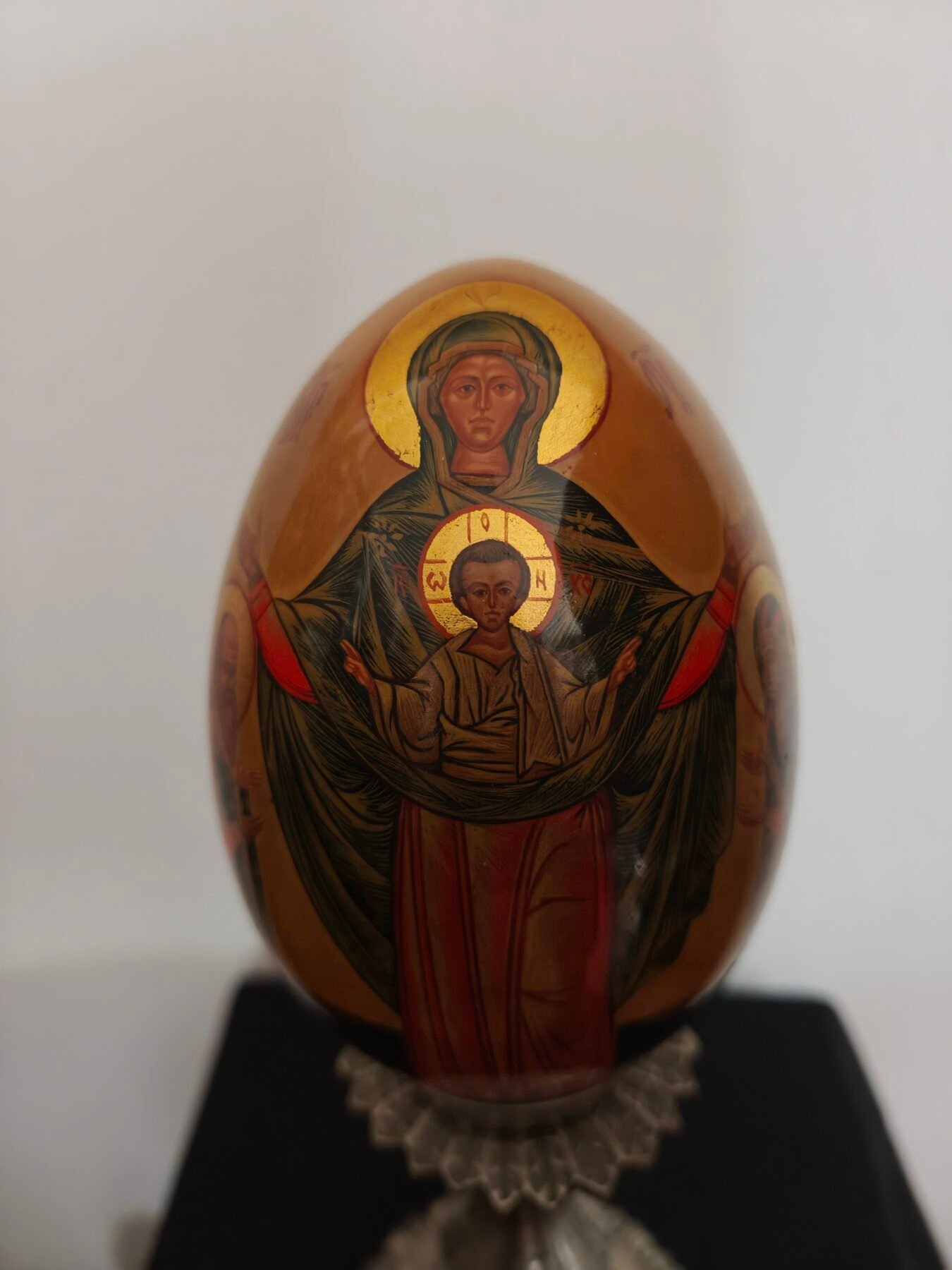
Russian Lacquered Wooden Easter Egg "Our Lady of the Sign" Signed
350 €
This notable 17 cm high devotional Easter egg represents a key iconographic collector's piece signed and dated 1992 from the famous artistic center of Abramtsevo (Абрамцево), whose main scene depicts the Marian iconography of Our Lady of the Sign or Orant (Богоматерь Оранта), showing the Mother of God praying with outstretched arms while the Christ Child (Immanuel) is depicted within a haloed medallion on her chest bestowing a blessing, flanked by intercessory saints venerated in Orthodox tradition. Along the lower border, inscriptions in Church Cyrillic clearly show the title «Богоматерь Оранта», the artist's signature Pastushkov (Пастушков), and the location and date «Абрамцево • 1992», featuring on the reverse a stylized floral-ended cross highlighted with gold leaf filigree against a natural warm brown lacquered background. The piece reflects the post-Soviet revival of sacred art carried out by workshops associated with the historic Abramtsevo artistic movement, with works of this school and technique studied and exhibited in major global institutions, including the Abramtsevo Museum-Reserve of History, Art and Literature, the State Russian Museum in St. Petersburg, the Fabergé Museum in St. Petersburg (Shuvalov Palace), the Hillwood Estate, Museum & Gardens in Washington D.C., and the Icon Museum of Frankfurt (Ikonen-Museum Frankfurt).
TechniqueWood noble torneada, laca natural multicapa, pintura al temple, óleo con pan de oro y firmado
Dimensions17cm
Year1992
ArtistABRÁMTSEVO, Escuela de
ABRÁMTSEVO, Escuela de
The Abramtsevo Artistic Colony and School (Абрамцево) emerged in the second half of the 19th century as a pivotal center for the revival of decorative arts, architecture, and applied crafts in Russia, tracing its roots to 1870 when industrialist, patron, and scholar of Russian culture Savva Mamontov acquired the estate located 60 kilometers northeast of Moscow to transform it under his patronage into a thriving artistic community where leading painters and architects of the era, including Ilya Repin, Valentin Serov, Mikhail Vrubel, Vasily Polenov, and Viktor Vasnetsov, resided and collaborated to form the Mamontov Circle, advocating a philosophy centered on recovering national identity, studying Slavic folklore, and elevating medieval peasant craftsmanship that birthed the Neo-Russian Style (Russian Art Nouveau), establishing on the estate grounds the Woodcarving Workshop in 1882 —focusing on cabinetry, furniture, and relief carving that directly influenced the creation of the first matryoshka nesting doll in the late 19th century— and the Ceramic and Majolica Workshop in 1889 —led by Vrubel to revolutionize decorative tilework and ceramic sculpture through metallic glazes and epic folklore imagery—, culminating in the architectural and iconographic benchmark of the Church of the Savior Not Made by Human Hands (1881–1882) inspired by medieval Novgorod and Pskov architecture, a legacy that, following the estate's nationalization as a museum after the 1917 Revolution, experienced a post-Soviet revival starting in 1991 through the production of sacred art and lacquered miniatures on turned wood by workshops inheriting this historic craft tradition, preserved and displayed today across major global art institutions, including the Abramtsevo Museum-Reserve of History, Art and Literature, the State Tretyakov Gallery in Moscow, the State Russian Museum in St. Petersburg, the State Historical Museum in Moscow, the Hillwood Estate, Museum & Gardens in Washington D.C., and the Icon Museum of Frankfurt (Ikonen-Museum Frankfurt).
Recommended works
Other selected pieces from the Art Andorra catalogue.