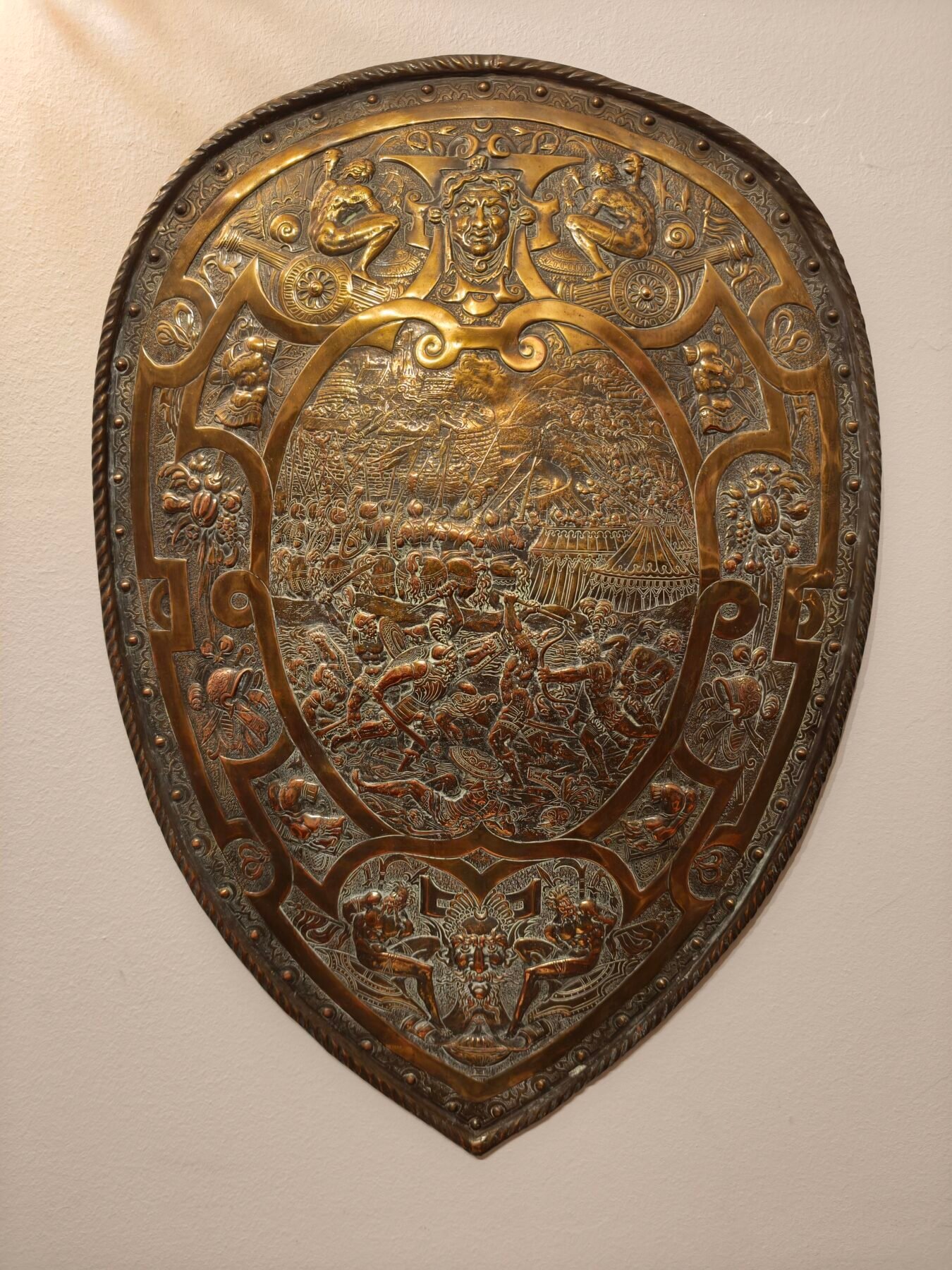
Parade shield of Henry II of France
2.200 €
This spectacular monumental metal shield (63 x 44 cm) with a two-tone patina is a 19th-century gallery replica (ca. 1860–1870) of exceptional technical fineness, reproducing with pinpoint accuracy one of the greatest jewels of 16th-century French Renaissance armory: the parade shield of King Henry II of France, attributed to armor decoration designs executed in Paris by artists such as Étienne Delaune, Jean Cousin the Elder, and Baptiste Pellerin, whose original historical model is preserved in the Louvre Museum (inventory no. MS 118). The composition features a dazzling, highly defined repoussé and chased relief where the border of strapwork and cartouches intertwines the historical initials 'H' for Henry II, 'C' for Queen Catherine de' Medici, and 'D' for his famous favorite Diane de Poitiers, interspersing crescents, bows, and quivers that refer both to the royal emblem and the goddess Diana. The intricate central medallion depicts a complex classical equestrian battle that traditional historiography identified with the siege of Bonifacio (1553), whereas contemporary art criticism interprets the scene as Hannibal and the Carthaginians' victory over the Romans at the Battle of Cannae (216 B.C.), conceived as an elegant Renaissance allegory of the French Crown's triumph over the Holy Roman Empire. High-quality historicist reproductions of this caliber, found in landmark collections such as the Stibbert Museum in Florence, were crafted during the second half of the 19th century for the most discerning private armory and decorative arts collections across Europe, making this piece an object of exceptional ornamental and historical value, as well as high collectible distinction.
TechniqueFundido en bronce con cincelado, repujado y patinado bitonal
Dimensions63x44cm
Year1860/1870
ArtistDELAUNE, Etienne
DELAUNE, Etienne
Étienne Delaune (or De Laune) was one of the most eminent goldsmiths, medallists, draughtsmen, and engravers of the French Renaissance. He stood out as one of the great disseminators of the Fontainebleau School's Mannerist style through his meticulous decorative designs and burin engravings. Born around 1518 (probably in Milan or Orléans, according to various period sources), he settled in Paris at a very young age and was registered as a master goldsmith in 1546. In 1552, he was appointed medallist at the Royal Mint of Paris (La Monnaie du Moulin) by King Henry II. Although he held the post for only a few months, his connection to the court allowed him to receive high-profile commissions. He is credited with creating numerous sketches and cartoons for luxury objects, silverware, tableware, and parade armor for the French monarch (such as the famous parade shield preserved in the Louvre Museum). Around 1557, he turned heavily toward copper engraving. He produced more than 400 small-format prints characterized by astonishing miniaturist precision, depicting mythological, allegorical, and biblical motifs, as well as ornamental repertoires (strapwork, grotesques, and cartouches). A Huguenot (Protestant) by conviction, Delaune was forced to flee Paris following the St. Bartholomew's Day Massacre in 1572. He took refuge in Strasbourg and Augsburg, where he continued his artistic work alongside his son Jean Delaune. He briefly returned to Paris before his death around 1583. His decorative models circulated widely across Europe, serving as direct inspiration for goldsmiths, armorers, enamelers, and watchmakers well into the 19th century, when his compositions continued to be replicated by the historicist market.
Recommended works
Other selected pieces from the Art Andorra catalogue.