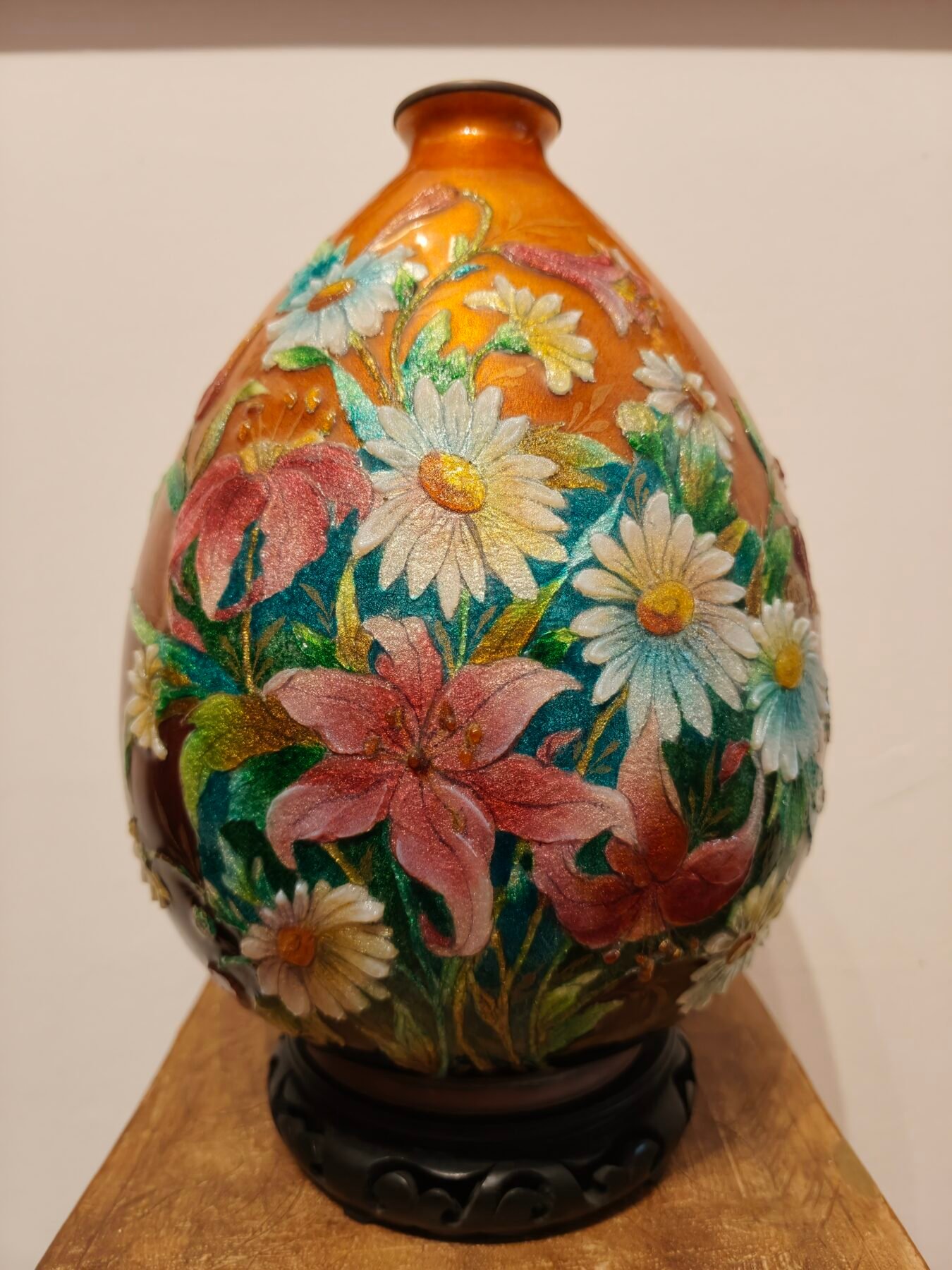
Primroses, Daisies, Small Flowers & Lilies
18.000 €
This monumental Limoges enamel vase constitutes an absolute masterpiece by the celebrated house of Camille Fauré, executed circa 1928 during the height of the floral Art Deco period through the complex technique of high-relief champlevé enamel (émail en relief) over a copper body with an iridescent foil-backed (paillonné) metallic base. Standing at an impressive 32 centimeters in height, the piece achieves an extraordinarily rare monumental scale within the firm's output, vastly exceeding standard formats ranging from 14 to 28 centimeters and challenging the technical limits of firing glass onto metal—a process in which every additional centimeter of concave surface exponentially increases technical difficulty and the risk of kiln cracking. Its exclusivity reaches the highest degree of rarity, being hand-signed on the matrix in gold lettering "Fauré - Limoges - FRANCE - nº 1/8", certifying it not only as an ultra-limited edition of just 8 pieces worldwide, but as the prized specimen number one of the series, a prototype or master piece status highly sought after in international collecting. The vase displays a lush and refined botanical design in the floral Art Deco style titled "Primerose, Marguerites, Fleurettes & Liliums" (Primroses, Daisies, Small Flowers & Lilies), retaining on its brass base the original handwritten title label alongside the intact seal of the Chambre Syndicale des Maîtres Émailleurs Limousins, which guarantees its execution entirely by hand by the Master Enameler of the Maison Fauré. Its pristine, mint state of preservation—free of cracks, chips, or restorations on the delicate vitreous surface—combined with its giant format, top-tier numbering, and complete documentary traceability, positions this golden-era work at the pinnacle of 20th-century decorative arts, consolidating it as a true museum-quality masterpiece suited to anchor the finest high-end private collections in the global market.
TechniqueEsmalte alveolado en alto relieve (émail en relief) sobre cobre
Dimensions32cm
YearCirca 1928
ArtistFAURÉ, Camille
FAURÉ, Camille
Camille Fauré (1874-1956) was a French master enameler whose work revolutionized the art of enamel on copper in Limoges, becoming an emblematic figure of 20th-century decorative arts and an essential name for international collecting. Born in Périgueux, Fauré moved at a young age to Limoges, the historical center of European enameling, where he established his own workshop after completing his craft training, initially directing his output toward motifs of refined botanical and naturalistic inspiration characteristic of the Art Nouveau style. During the early years of the 20th century, his workshop masterfully perfected traditional champlevé and painted enamel techniques, standing out for its pioneering use of gold and silver metallic foils (paillons) laid under layers of colored glass to impart unprecedented luminosity and iridescence to concave surfaces and three-dimensional forms. Although his firm achieved universal acclaim in the 1920s for its dazzling pieces of cubist geometry and Art Deco abstraction presented following the landmark 1925 Paris International Exhibition of Decorative Arts, the name of Camille Fauré holds paramount significance within Art Nouveau collecting due to the matchless quality of his floral and botanical works in dense high relief (émail en relief). In these creations, the transition between fin-de-siècle symbolism and the stylized forms of the new century manifests through technical virtuosity, where the organic volume of the flowers, the vitreous hues, and the complexity of the kiln firing transform each vessel into an enameled sculpture of museum stature. Throughout his career, Fauré collaborated with prominent Limoges craftsmen such as Alexandre Marty, establishing a signature mark defined by technical rigor, strictly limited editions, and a constant pursuit of luminous glass effects. Following his death in 1956, the Maison Fauré continued its operations under the leadership of his daughter Andrée Fauré into the 1980s, preserving the prestige of a name that today leads the most demanding international decorative arts auctions, where his large-format floral creations of flawless provenance are coveted by premier collectors and museums worldwide as crowning achievements of the golden age of French enameling.
Recommended works
Other selected pieces from the Art Andorra catalogue.