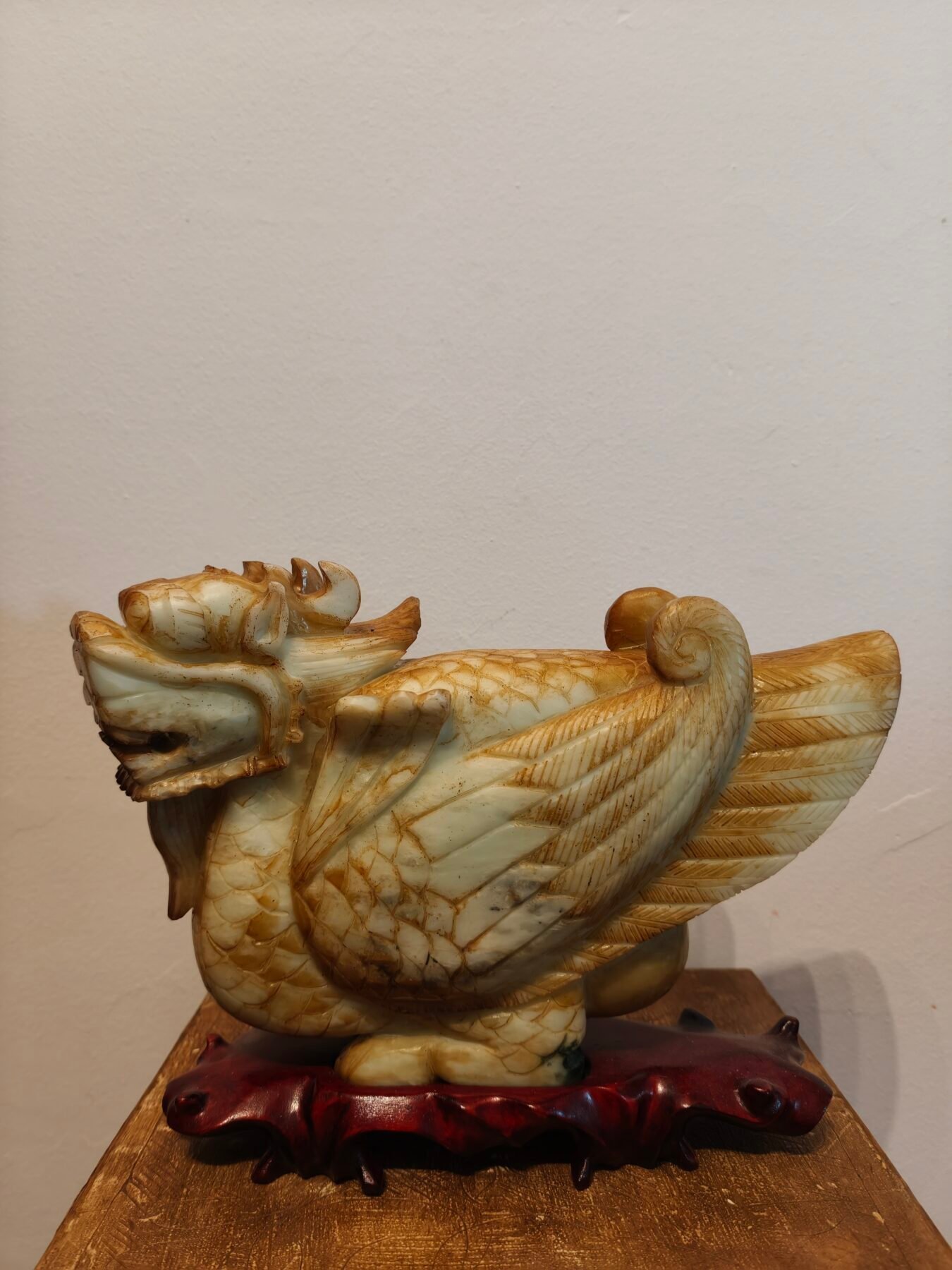
Carved Hetian jade bixi zoomorphic sculpture
15.000 €
This imposing and monumental zoomorphic sculpture represents a bixi or pixiu, the mythical celestial creature of Chinese syncretic tradition endowed with a dragon's head, a winged lion's body, and an incorruptible nature historically associated with attracting good fortune, protection against malevolent influences, and the incessant accumulation of wealth, whose venerable antiquity is framed with absolute precision in the mid-18th century (c. 1750), fully coinciding with the reign of Emperor Qianlong and the celebrated "Golden Age" of glyptic splendor of the Qing dynasty; materialized in an exceptional block of authentic Hetian jade—unanimously considered by scholars, emperors, and collectors as the purest, most coveted, and most appreciated of all existing jades due to its unmatched greasy density, tactile warmth, and subtle natural mineral nuances that reveal an authenticity unalterable by the passage of centuries—, this masterwork dazzles with an absolutely indisputable carving quality and uncommon anatomical virtuosity where every muscle, every scale, and the majestic plumage of its wings are sculpted with a dazzling expressive tension, finding it truly colossal and unusual to discover a piece of this nature that reaches an imposing weight of 6 kilograms and monumental dimensions of 31 x 22 centimeters, a titanic magnitude in the field of ancient art that defies the laws of traditional carving in maximum-hardness materials due to the extreme scarcity of boulders of such volume; this artistic summit unmistakably emerged from the expert, patient, and sovereign hands of the lapidary masters integrated within the Imperial Workshops of the Forbidden City (Zaobanchu) or the legendary highly specialized workshops of Suzhou and Yangzhou—the most prestigious and select centers of glyptic production in the empire—, where the most outstanding lineages of artisans of the era worked under strict court patronage, transmitting the most rigorous secrets of cutting, trimming, and polishing on hard stone, culminating in a sculptural jewel that stands upon a superb noble wood base custom-fitted to embrace with millimetric precision its sinuous and heavy forms, and destined from its origin to preside over the most exclusive cabinets and salons of the high aristocracy.
TechniqueTalla manual en piedra dura (Glíptica)
Dimensions31x22cm
YearCirca 1750
ArtistCIUDAD PROHIBIDA, Talleres Imperiales de la
CIUDAD PROHIBIDA, Talleres Imperiales de la
The legendary imperial workshops of the Forbidden City, formally known under the designation of Zaobanchu and officially founded in the late 17th century under the auspices of the Qing dynasty, specifically during the reign of Emperor Kangxi around 1680 and absolutely consolidated by his successors Yongzheng and the great Emperor Qianlong, constituted the most sophisticated creative and technical epicenter in the history of China's glyptic and sumptuary art, a network of palatial workshops where the empire's most select lineages of artisans and lapidaries converged, heirs to millennial traditions jealously transmitted from generation to generation since glorious preceding eras but sublimated under strict rigor and unprecedented court patronage; these imperial workshops were not restricted solely to the walled precincts of the Forbidden City in Beijing, but maintained a symbiotic and constant network with the legendary regional workshops located in the south of the empire, specifically in the prosperous cities of Suzhou and Yangzhou in the Jiangnan region, where local artisan dynasties, possessing supreme mastery over the cutting and trimming of colossal hardstones, worked under direct imperial supervision to supply the court's demands; the period of maximum splendor, apogee, and artistic summit of these workshops is unquestionably framed within the 18th century, fully coinciding with the long and brilliant reign of Emperor Qianlong, a golden age in which territorial expansion toward the Khotan regions in Xinjiang guaranteed the constant supply of the most coveted blocks of pure nephrite jade and in which the masters of the imperial workshops reached absolute technical perfection in the carving of monumental pieces and cabinet sculptures; today, the vast majority of unrepeatable masterpieces that emerged from the hands of these illustrious artisans of the Forbidden City and the workshops of Suzhou and Yangzhou are preserved and exhibited as national treasures of incalculable value in the permanent collections of the world's most prestigious museum institutions, prominently featuring the Palace Museum (The Palace Museum) inside the Forbidden City itself in Beijing and the National Palace Museum (National Palace Museum) in Taipei—an institution that safeguards a primordial part of the sumptuary legacy evacuated from the imperial court—, in addition to featuring prominently in the Asian holdings of international institutions the likes of the Victoria and Albert Museum and the British Museum in London, the Musée Guimet in Paris, and the Metropolitan Museum of Art in New York, thus perpetuating the undying memory of a technical and aesthetic refinement that continues to fascinate the most demanding global scholars and collectors.
Recommended works
Other selected pieces from the Art Andorra catalogue.